_(2).jpg)
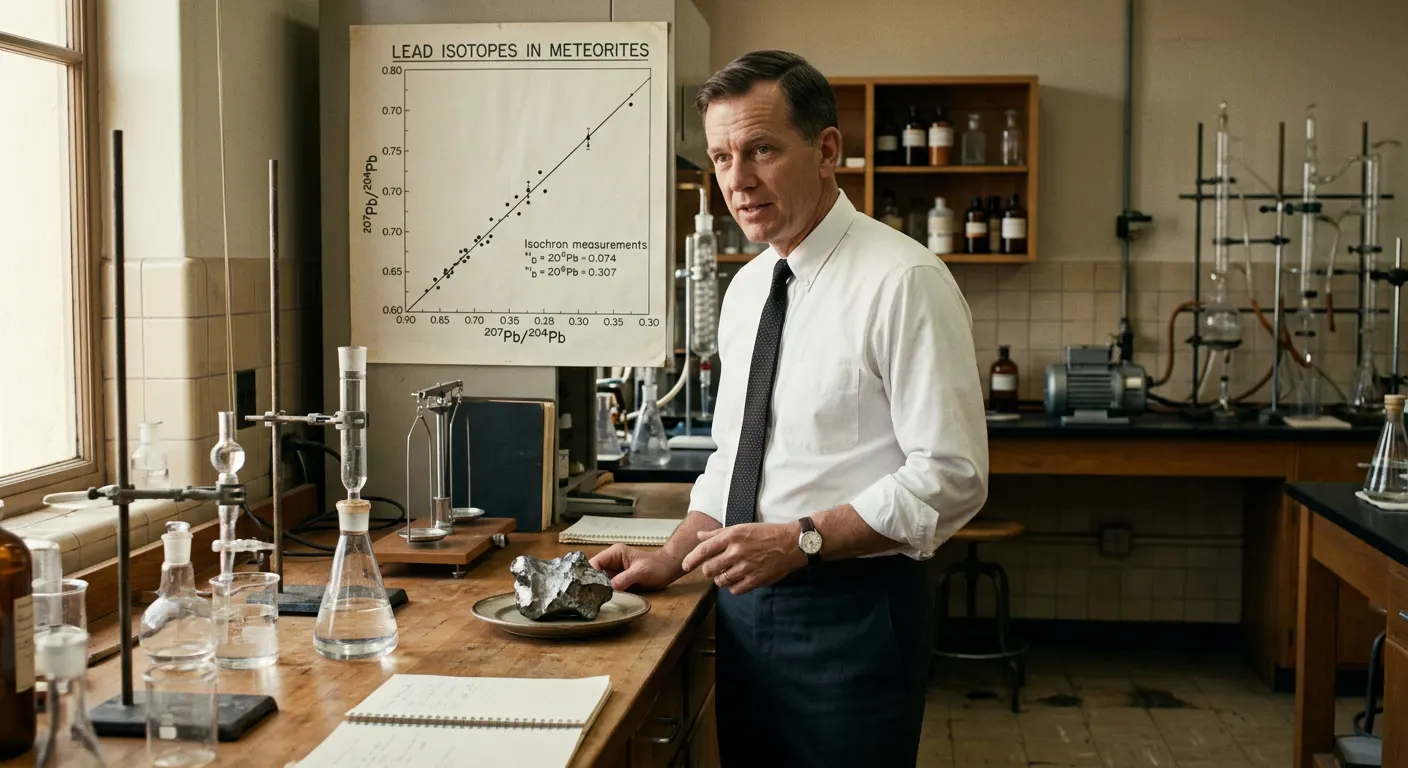
Clair Cameron Patterson
1922–1995 · Geochemistry
American geochemist Clair Patterson used lead isotopes in meteorites to establish that Earth is about 4.55 billion years old, then revealed industrial lead pollution.
Why is this scientist famous?
Established an age of about 4.55 billion years for Earth using lead isotopes in meteorites and campaigned against lead pollution.
More reliable lead-isotope measurement transformed geochemistry and helped establish Earth's age. His environmental research gave strong evidence of human-caused lead contamination.
Clair's story
A geochemist from Iowa
Clair Cameron Patterson was born on 2 June 1922 in Iowa, United States. Friends knew him as Pat. A childhood chemistry set helped spark his interest in the subject. He earned a chemistry bachelor's degree from Grinnell College in 1943, a master's degree from the University of Iowa in 1944, and a doctorate from the University of Chicago in 1951. His doctoral supervisor was Harrison Brown, who would become central to Patterson's most famous work.
Meteorites and the age of Earth
Brown proposed that lead in iron meteorites could help reveal the early Solar System's starting lead-isotope composition — an essential comparison for calculating Earth's age. Patterson took on the challenge. He developed extremely clean laboratory procedures to isolate and measure tiny quantities of lead, because ordinary surroundings and materials contained interfering lead that could skew results. Working with material from the Canyon Diablo meteorite, and using mass-spectrometer measurements in Mark Inghram's Chicago laboratory, Patterson helped establish an age of about 4.55 billion years for Earth and the early Solar System. His landmark paper appeared in 1956. Today's commonly stated estimate is approximately 4.54 billion years. George Tilton worked on related uranium measurements that supported the project.
From Caltech to a career of measurement
Patterson moved with Brown to the California Institute of Technology (Caltech) in 1952 and spent the rest of his research career there. His work on lead extended from ancient rocks and meteorites to the modern environment. He investigated lead in oceans, ice and the everyday surroundings of people, measuring how much lead was natural and how much came from industrial activity.
Lead in the environment
Patterson's measurements helped show that widespread lead pollution was largely human-made. His evidence supported efforts to reduce lead exposure, including the removal of lead from petrol. He did not personally cause a particular law to pass, but his research provided the scientific foundation for those who campaigned for change. He was elected to the National Academy of Sciences in 1987 and received the Tyler Prize for Environmental Achievement in 1995. An asteroid and an Antarctic peak bear his name.
What did they discover?
Establishing Earth's age at about 4.55 billion years
Using lead isotopes from the Canyon Diablo meteorite and extremely clean laboratory methods, Patterson helped determine that Earth and the early Solar System are about 4.55 billion years old.
Clean laboratory techniques for lead measurement
Patterson developed cleaner procedures to isolate and measure tiny quantities of lead, recognising that ordinary surroundings and materials contained interfering lead.
Evidence of human-caused lead pollution
His measurements of lead in oceans, ice and human environments helped show that widespread lead contamination was largely the result of industrial activity.
Amazing facts
Friends called him Pat.
A childhood chemistry set helped spark his interest in chemistry.
His measurements had to distinguish extraordinarily small quantities of lead from contamination.
He developed cleaner laboratory methods because ordinary surroundings and materials contained interfering lead.
His age-of-Earth research used material from the Canyon Diablo meteorite.
A meteorite was useful because suitable meteoritic material preserves clues from the early Solar System.
His work on lead later extended from ancient rocks and meteorites to the modern environment.
An asteroid and an Antarctic peak bear his name.
Timeline
Born in Iowa, United States
Earned a chemistry bachelor's degree from Grinnell College
Earned a master's degree from the University of Iowa
Earned a doctorate from the University of Chicago
Moved to the California Institute of Technology (Caltech)
Published Age of Meteorites and the Earth, establishing an age of about 4.55 billion years
Received the V. M. Goldschmidt Award
Elected to the National Academy of Sciences
Received the Tyler Prize for Environmental Achievement
Died
Awards & honours
Related Super Scientists

Harrison Scott Brown
1917–1986 · Geochemistry
Proposed that lead in iron meteorites could reveal the early Solar System's composition, enabling Patterson's age-of-Earth measurement, and wrote on humanity's long-term challenges.
Ernest Rutherford
1871–1937 · Physicist
Discovering the nuclear structure of the atom and pioneering the field of nuclear physics.

Bertram Borden Boltwood
1870–1927 · Radiochemistry
Identified lead as the end product of uranium's radioactive decay and used the uranium-lead relationship to estimate mineral ages of billions of years.