_(2).jpg)
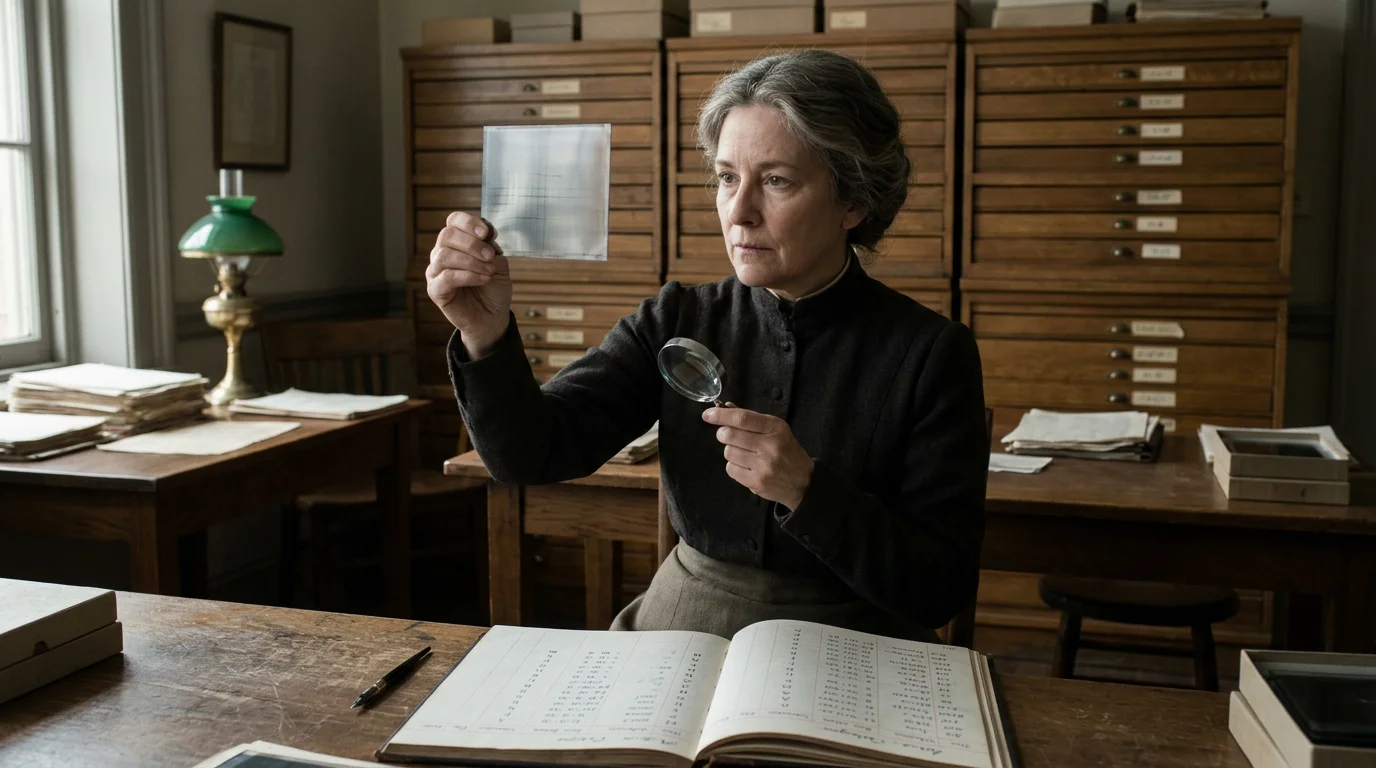
Annie Jump Cannon
1863–1941 · Astronomy
Annie Jump Cannon was an American astronomer who standardised the OBAFGKM spectral classification system that became the basis of the system still used today.
“Stars and prisms! How prophetic was this baby amusement of the profession which was destined to fill my life.”
Why is this scientist famous?
An American astronomer who standardised the stellar spectral classification system still used today.
Cannon simplified and refined earlier Harvard classification work into the enduring OBAFGKM sequence, transforming enormous photographic datasets into scientifically useful catalogues.
Annie's story
From prisms to photographic plates
Annie Jump Cannon was born on 11 December 1863 in Dover, Delaware. Her mother, Mary Jump, encouraged her interest in the night sky and taught her about constellations. As a child, Cannon was fascinated by glass prisms that split sunlight into colours. Scarlet fever left her mostly deaf, but she went on to study physics and astronomy at Wellesley College, where she earned her bachelor’s degree in 1884 as valedictorian of her class. She returned to Wellesley in 1894 for graduate study and began astronomy study at Radcliffe College in 1895.
Classifying the stars at Harvard
In 1896 Cannon began working at Harvard College Observatory while studying at Radcliffe, and she joined the Observatory staff in 1897. She worked under Edward C. Pickering, where earlier Harvard classification work had already produced systems developed by Williamina Fleming and Antonia Maury. Cannon simplified and refined this earlier work into a single sequence: O, B, A, F, G, K, M. This system became the basis of the stellar spectral classification still used by astronomers today. She became exceptionally skilled at identifying stellar spectra from photographic plates.
The Henry Draper Catalogue
Cannon played a leading role in the Henry Draper Catalogue, which was published between 1918 and 1924 and contained spectral information for about 225,000 stars. Across her career she classified hundreds of thousands of stellar spectra. She also discovered more than 300 variable stars, five novae and one spectroscopic binary. In 1911 she became Curator of Astronomical Photographs, and in 1938 she was appointed William Cranch Bond Astronomer.
Honours and legacy
In 1925 Cannon received an honorary Doctor of Science from the University of Oxford, becoming the first woman to receive an honorary doctorate from Oxford. In 1931 she received the Henry Draper Medal of the National Academy of Sciences, the first woman to do so. In 1932 she received the Ellen Richards Research Prize and used the prize money to help establish an award recognising women astronomers. The American Astronomical Society’s Annie Jump Cannon Award continues to bear her name. She died in Cambridge, Massachusetts, on 13 April 1941.
What did they discover?
The OBAFGKM spectral classification system
Cannon simplified and refined earlier Harvard classification work into the O, B, A, F, G, K, M sequence that became the enduring basis of stellar spectral classification.
The Henry Draper Catalogue
She played a leading role in the catalogue published between 1918 and 1924, which contained spectral information for about 225,000 stars.
Hundreds of thousands of stellar classifications
Across her career she classified hundreds of thousands of stellar spectra and discovered more than 300 variable stars, five novae and one spectroscopic binary.
Amazing facts
Her mother, Mary Jump, encouraged her interest in the night sky and taught her about constellations.
As a child Cannon was fascinated by glass prisms that split sunlight into colours.
Scarlet fever left her mostly deaf.
She became exceptionally skilled at identifying stellar spectra from photographic plates.
Her OBAFGKM sequence remains the basis of the stellar classification system astronomers use today.
She helped classify hundreds of thousands of stars during her career.
She discovered more than 300 variable stars as well as five novae and a spectroscopic binary.
The American Astronomical Society still presents an award carrying her name.
Timeline
Born in Dover, Delaware
Graduated from Wellesley College
Began astronomy study at Radcliffe College
Began working at Harvard College Observatory
Joined the Harvard College Observatory staff
Became Curator of Astronomical Photographs
Henry Draper Catalogue volumes containing her classification work began publication
Received an honorary doctorate from the University of Oxford
Received the Henry Draper Medal
Appointed William Cranch Bond Astronomer
Died in Cambridge, Massachusetts
Awards & honours
Related Super Scientists
Cecilia Payne-Gaposchkin
1900–1979 · Astronomer
Showed in her 1925 doctoral thesis that hydrogen and helium are enormously more abundant in stars than previously believed, laying a foundation for modern stellar astrophysics.
Caroline Herschel
1750–1848 · Comets, nebulae, star catalogues and observational astronomy
The first woman known to receive a salary for astronomical work, who discovered eight comets and made important catalogue contributions.
Edwin Hubble
1889–1953 · Astronomer
Showed that galaxies exist far beyond the Milky Way and published the distance–redshift relationship now called the Hubble–Lemaître law.