_(2).jpg)
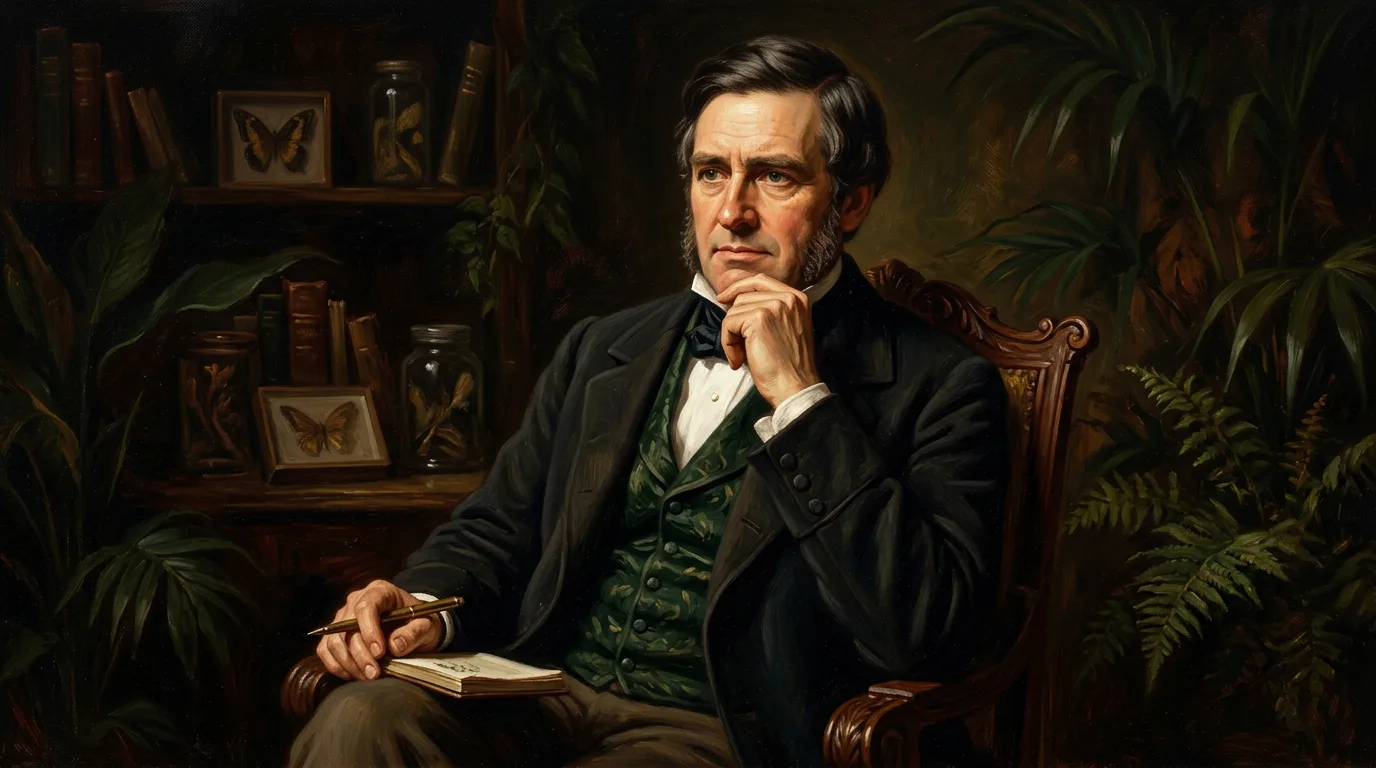
Alfred Russel Wallace
1823–1913 · Naturalist, Explorer & Biogeographer
A British naturalist and explorer who independently developed the theory of evolution by natural selection and helped found the field of biogeography.
Why is this scientist famous?
Independently developing the theory of evolution by natural selection, carrying out major fieldwork in the Amazon and Malay Archipelago, and helping establish biogeography through studies including the boundary now called Wallace's Line.
Wallace's independent co-discovery of natural selection shows how similar scientific ideas can be reached by researchers working in different places. His fieldwork and publications helped establish biogeography, and Wallace's Line remains an important concept in understanding animal distribution in Southeast Asia.
Alfred's story
Early Life and Surveying
Alfred Russel Wallace was born in Usk, Monmouthshire, Wales, on 8 January 1823. After leaving school, Wallace worked with his older brother in surveying. In 1844 he became a teacher at the Collegiate School in Leicester. There he became friends with the naturalist Henry Walter Bates, who helped deepen his interest in collecting and natural history. Wallace did not attend university or hold a formal scientific qualification.
The Amazon Expedition
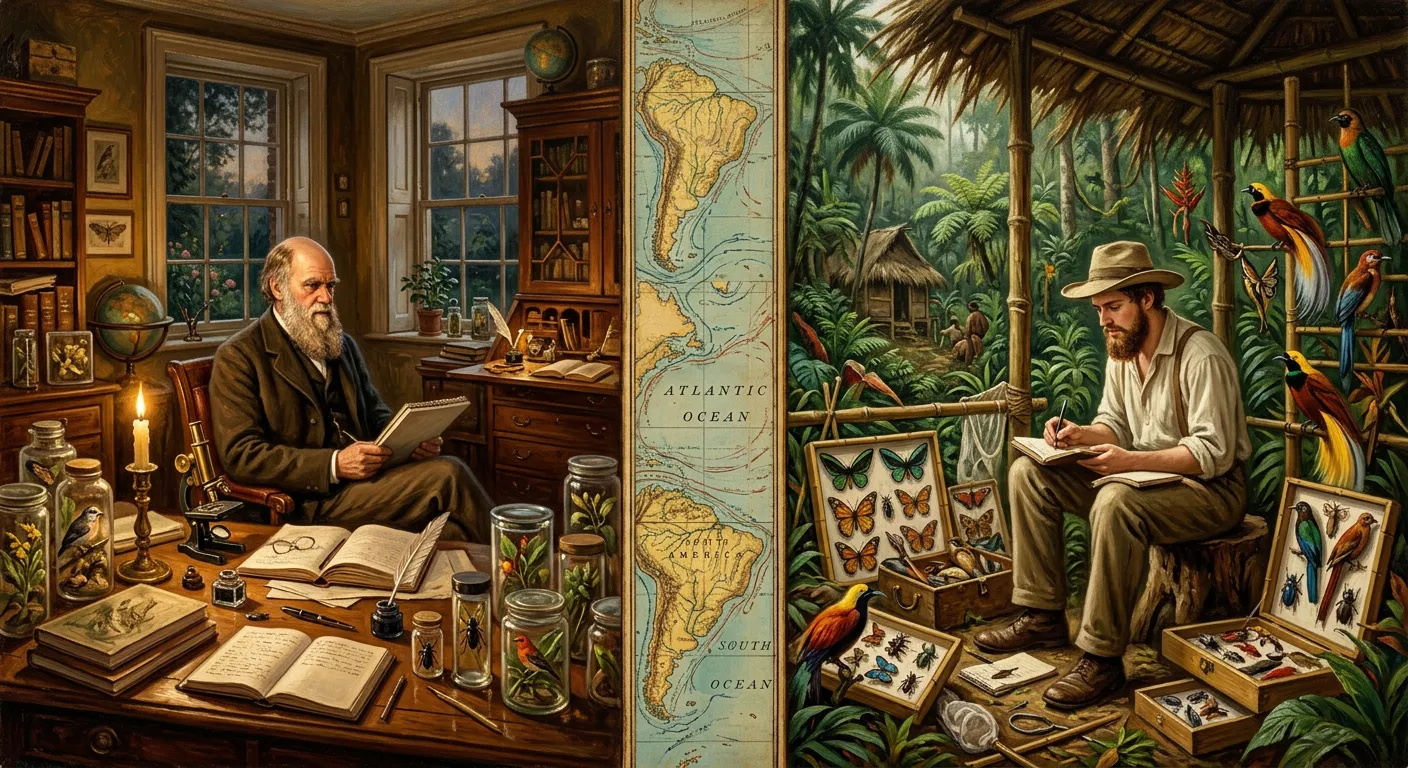
In 1848 Wallace and Henry Walter Bates travelled to the Amazon region to collect specimens and investigate the origin and distribution of species. Wallace spent more than four years collecting in the Amazon. On his return voyage to Britain in 1852, his ship caught fire and sank in the Atlantic. Most of his specimens and field notes were lost, although Wallace and the other people aboard were rescued.
The Malay Archipelago
In 1854 Wallace began a major expedition through the Malay Archipelago, in areas now including Malaysia and Indonesia. He spent about eight years travelling and collecting there. The Natural History Museum records that he accumulated 125,660 specimens, including more than 5,000 species new to Western science. Wallace acknowledged the important help of his Malay assistant Ali in his collecting work. He noticed a striking boundary in animal distribution between Asian and Australian faunas. This biogeographical boundary later became known as Wallace's Line.
Natural Selection
Wallace developed the idea of evolution by natural selection independently of Charles Darwin. In February 1858, while working in the Malay Archipelago, Wallace wrote an essay explaining his evolutionary idea and sent it to Darwin. Darwin had independently been developing natural-selection ideas for many years and was shocked by how closely Wallace's argument matched his own unpublished thinking. Charles Lyell and Joseph Dalton Hooker arranged for material from Darwin and Wallace to be presented together. Their work was read at the Linnean Society on 1 July 1858. Darwin published On the Origin of Species the following year, in 1859. Wallace continued to be an important scientific thinker in evolution and especially biogeography.
Major Publications and Later Life
Wallace published The Malay Archipelago in 1869, based on his travels and natural-history observations. In 1876 he published The Geographical Distribution of Animals, an important work in biogeography. His research on the geographical distribution of animals helped make him a foundational figure in the field. By the end of his life Wallace had written more than 20 books and over 1,000 articles and published letters. He died in Broadstone, Dorset, on 7 November 1913.
What did they discover?
Independent Theory of Natural Selection
Wallace developed the theory of evolution by natural selection independently of Darwin, writing his essay in 1858 while in the Malay Archipelago.
Wallace's Line
He identified a striking biogeographical boundary between Asian and Australian animal distributions, now known as Wallace's Line.
Fieldwork in the Malay Archipelago
He accumulated 125,660 specimens including more than 5,000 species new to Western science during about eight years of fieldwork.
The Geographical Distribution of Animals
His 1876 book helped establish biogeography as a major scientific field.
Amazing facts
Wallace independently reached a theory of natural selection remarkably similar to Darwin's.
He travelled in both the Amazon and the Malay Archipelago to collect and study animals.
Most of his Amazon specimens and field notes were destroyed when his ship caught fire and sank on the voyage home.
Wallace returned to major fieldwork within about two years of that disaster.
He collected 125,660 specimens during his years in the Malay Archipelago.
More than 5,000 of those specimens represented species new to Western science.
The famous biogeographical boundary called Wallace's Line is named after him.
He acknowledged the important collecting work of his Malay assistant Ali.
His 1858 essay helped push the theory of natural selection into public scientific discussion.
Wallace and Darwin agreed on natural selection but later disagreed about whether it could fully explain distinctive human mental abilities.
By the end of his life Wallace had written more than 20 books and over 1,000 articles and published letters.
Timeline
Born in Usk, Monmouthshire, Wales, on 8 January
Became a teacher in Leicester and formed a friendship with Henry Walter Bates
Travelled with Bates to the Amazon region
Ship carrying Wallace home caught fire and sank; most of his Amazon collections and notes were lost
Began extensive fieldwork in the Malay Archipelago
Wrote his natural-selection essay and sent it to Charles Darwin; Darwin and Wallace material was jointly presented at the Linnean Society on 1 July
Published The Malay Archipelago
Published The Geographical Distribution of Animals
Received the first Darwin Medal of the Royal Society
Elected Fellow of the Royal Society
Received the Copley Medal
Died in Broadstone, Dorset, on 7 November