_(2).jpg)
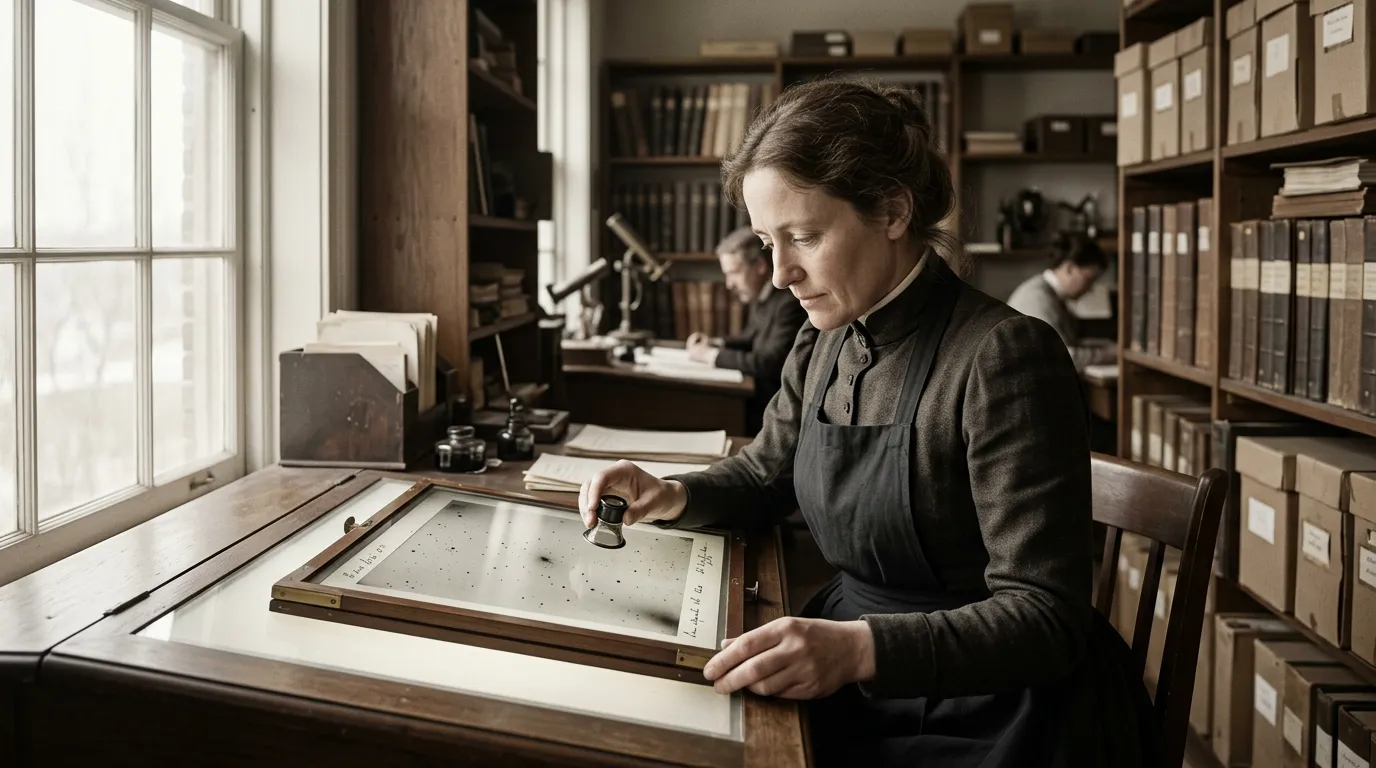
Williamina Fleming
1857–1911 · Astronomy and stellar classification
Williamina Fleming moved from domestic work to astronomy, classified more than 10,000 stars and identified the Horsehead Nebula on a Harvard photograph.
Why is this scientist famous?
Williamina Fleming classified thousands of stars using photographic plates and identified the Horsehead Nebula in 1888.
Her stellar classifications and searches through photographic plates helped lay foundations for catalogues and studies of the changing sky.
Williamina's story
A new life across the Atlantic
Williamina Fleming was born Williamina Paton Stevens in Dundee, Scotland, on 15 May 1857. She worked as a teacher before moving to the United States in 1878. After her marriage broke down, she needed to support herself and her child. She worked as a housekeeper for Edward Pickering, the director of Harvard College Observatory. The household job unexpectedly opened the way to a long career in astronomy.
Reading the sky on glass
In 1881 Pickering brought Fleming into the observatory’s team of human computers, people who studied observations and carried out painstaking calculations. Telescopes recorded the sky onto glass photographic plates, which scientists could inspect again and again. Fleming learned to examine the patterns of starlight spread into different colours, known as spectra. Those patterns contain clues about a star’s properties. Her work was a major part of a programme to sort and catalogue thousands of stars.
The shape of a horse
While inspecting astronomical photographs, Fleming identified a dark feature in the constellation Orion in 1888. It became known as the Horsehead Nebula because its outline resembles the head and neck of a horse. The dark area is a cloud of material blocking light from stars behind it, not an empty hole in space. Fleming’s discovery was recorded on a photographic plate still identified in Harvard’s archive. She also found many variable stars, whose brightness changes over time, as well as novae and nebulae.
Building a star catalogue
Fleming made a major contribution to the Draper Catalogue, published in 1890 under Pickering’s name. She classified stars using visible differences in their spectra, helping astronomers organise a growing amount of information. In 1893 she spoke about opportunities for women in astronomy at an international gathering in Chicago. She later became Harvard’s first Curator of Astronomical Photographs. In that job she helped care for the plates that preserved astronomical observations for other researchers.
A legacy stored in starlight
Fleming catalogued more than 10,000 stars during her career and identified hundreds of changing or unusual objects. In 1906 the Royal Astronomical Society elected her an honorary member, a rare distinction for a woman at the time. Her methods were later developed further by other Harvard astronomers, including Annie Jump Cannon. Fleming died in 1911, but the photographic records she worked with remain valuable sources of evidence. Her story shows how careful attention to faint details can reveal enormous discoveries.
What did they discover?
Classifying the spectra of thousands of stars
Fleming sorted and catalogued stellar spectra from photographic plates, playing a major role in the 1890 Draper Catalogue of more than 10,000 stars.
Identifying the Horsehead Nebula
She recognised the Horsehead Nebula in an 1888 photographic observation, revealing a distinctive dark cloud in the constellation Orion.
Finding variable stars and novae
She identified hundreds of variable stars and ten novae, using long-term photographic records to reveal changes in the night sky.
Caring for Harvard’s astronomical plates
As the observatory’s first Curator of Astronomical Photographs, she managed a resource that allowed observations to be checked and studied after they were taken.
Amazing facts
Her friends and colleagues often called her Mina.
She trained and worked as a teacher in Scotland before emigrating to the United States.
Her first job with Harvard observatory director Edward Pickering was as a housekeeper.
The word computer once described a person doing calculations rather than an electronic machine.
Harvard has identified the Horsehead Nebula on one of its old glass plates, numbered B02312.
She found 310 variable stars as well as 10 novae during her career.
Her sister Johanna Mackie also worked at the Harvard College Observatory.
In 1893 she publicly discussed opportunities for women to work in astronomy.
Timeline
Born in Dundee, Scotland.
Emigrated from Scotland to the United States.
Joined the Harvard College Observatory team examining astronomical photographs.
Identified the Horsehead Nebula on a photographic plate.
The Draper Catalogue, to which she made a major contribution, was published.
Presented work about women’s opportunities in astronomy in Chicago.
Was elected an honorary member of the Royal Astronomical Society.
Published a detailed photographic study of variable stars.
Died in the United States.