_(2).jpg)
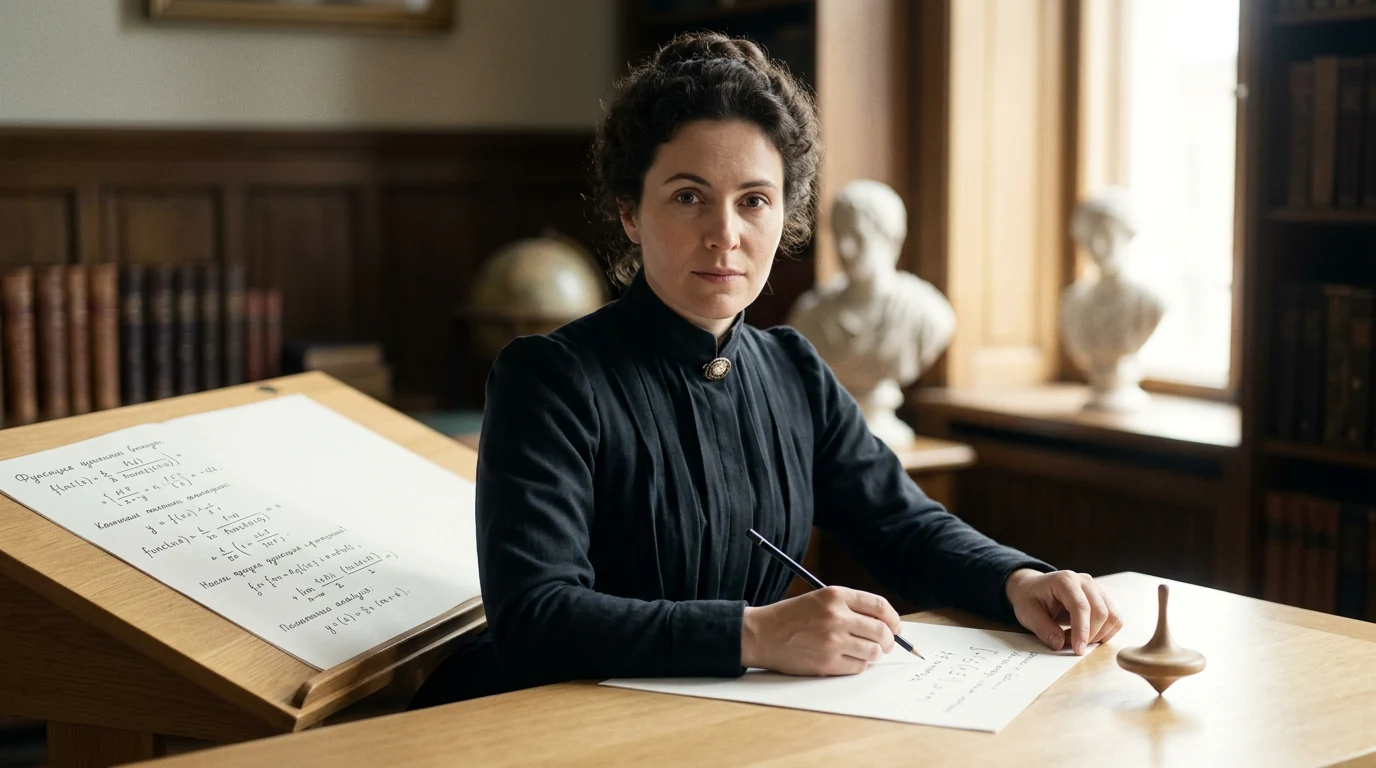
Sofia Kovalevskaya
1850–1891 · Mathematics, differential equations and mechanics
Sofia Kovalevskaya advanced differential equations and mathematical mechanics while overcoming restrictions on women’s university education.
Why is this scientist famous?
Sofia Kovalevskaya made pioneering advances in differential equations and the mathematics of rotating bodies, overcoming restrictions placed on women in universities.
Her mathematical work helps explain equations used to model changing systems, while her career helped widen opportunities for women researchers.
Sofia's story
Mathematics against the rules
Sofia Kovalevskaya was born in Moscow on 15 January 1850. Fascinated by mathematics while growing up in Russia, she lived in a period when university education was severely restricted for women. She travelled to Germany and was allowed to attend some lectures at Heidelberg unofficially. Even exceptional ability did not guarantee a place in formal classes. Her determination eventually brought her to Berlin, where the mathematician Karl Weierstrass became an important teacher.
Learning outside the lecture hall
Berlin’s university did not allow Kovalevskaya to attend ordinary mathematics lectures. Weierstrass instead worked with her privately and guided her advanced research. She studied difficult questions about differential equations, which describe how quantities change, as well as other areas of mathematical analysis. In 1874 the University of Göttingen awarded her a doctorate based on original mathematical papers. The award recognised substantial research, not merely attendance at classes.
Equations that describe change
One of her best-known achievements concerned conditions under which certain differential equations have a mathematically well-defined solution. The result is linked to the Cauchy–Kovalevskaya theorem, which builds on work by Augustin-Louis Cauchy. Later she investigated the motion of a spinning rigid body under gravity. Her work on a special solvable case became known as the Kovalevskaya top. These are advanced topics, but their central purpose is familiar: using mathematical rules to describe what changes over time.
A professor and prize-winning researcher
With support from mathematician Gösta Mittag-Leffler, Kovalevskaya began teaching in Stockholm in 1884 and gained an academic position there. Her research on the rotation of a heavy body won the French Academy of Sciences’ Prix Bordin in 1888. She became a full professor in Stockholm in 1889 and was elected a corresponding member of the St Petersburg Academy of Sciences. Both honours were striking achievements in an era of widespread exclusion.
Beyond the mathematical page
Kovalevskaya also wrote literature and autobiographical work, refusing the idea that intellectual life needed to fit one narrow path. She died in Stockholm on 10 February 1891. Her name remains attached to important mathematical ideas, but her legacy also shows how gifted people can be kept from education for reasons unrelated to ability. She made contributions that scientists and mathematicians continue to study long after the restrictions she faced.
What did they discover?
Cauchy–Kovalevskaya theorem
Advanced understanding of solutions to important classes of differential equations, building on Cauchy’s work.
Rotating rigid bodies
Found an important mathematical case for the motion of a spinning top under gravity.
Mathematical analysis
Worked on advanced problems involving integrals and related analytic methods.
Opening academic access
Demonstrated the scientific strength of women denied ordinary routes into universities.
Amazing facts
Her full given name appears in several spellings, including Sofia, Sofya and Sonya.
She attended some Heidelberg lectures only after obtaining exceptional permission.
Berlin’s university refused to admit her to regular lectures, so she studied privately with Karl Weierstrass.
In 1874 Göttingen awarded her a doctorate for original mathematical research.
An important theorem on differential equations includes her name alongside Cauchy’s.
Her work on a spinning rigid body produced the famous Kovalevskaya top.
She won the French Academy of Sciences’ Prix Bordin in 1888.
She became a full professor in Stockholm in 1889.
Timeline
Born in Moscow, Russia.
Began studying mathematics and natural sciences in Heidelberg.
Began private advanced study with Karl Weierstrass in Berlin.
Awarded a doctorate by Göttingen University.
Began teaching mathematics in Stockholm.
Won the French Academy of Sciences’ Prix Bordin.
Became a full professor in Stockholm and a corresponding academy member.
Died in Stockholm, Sweden.
Awards & honours
Related Super Scientists
Emmy Noether
1882–1935 · Mathematician
Proved Noether's theorem, linking symmetry and conservation laws — a foundation of modern physics.
Leonhard Euler
1707–1783 · Mathematician and Physicist
Making fundamental contributions across mathematics and physics, including mathematical analysis, number theory, mechanics and graph theory, while introducing or popularising notation still used today.
Carl Friedrich Gauss
1777–1855 · Mathematician & Physicist
Making groundbreaking contributions to number theory, geometry, astronomy, and statistics — often called the ‘Prince of Mathematicians.’