_(2).jpg)
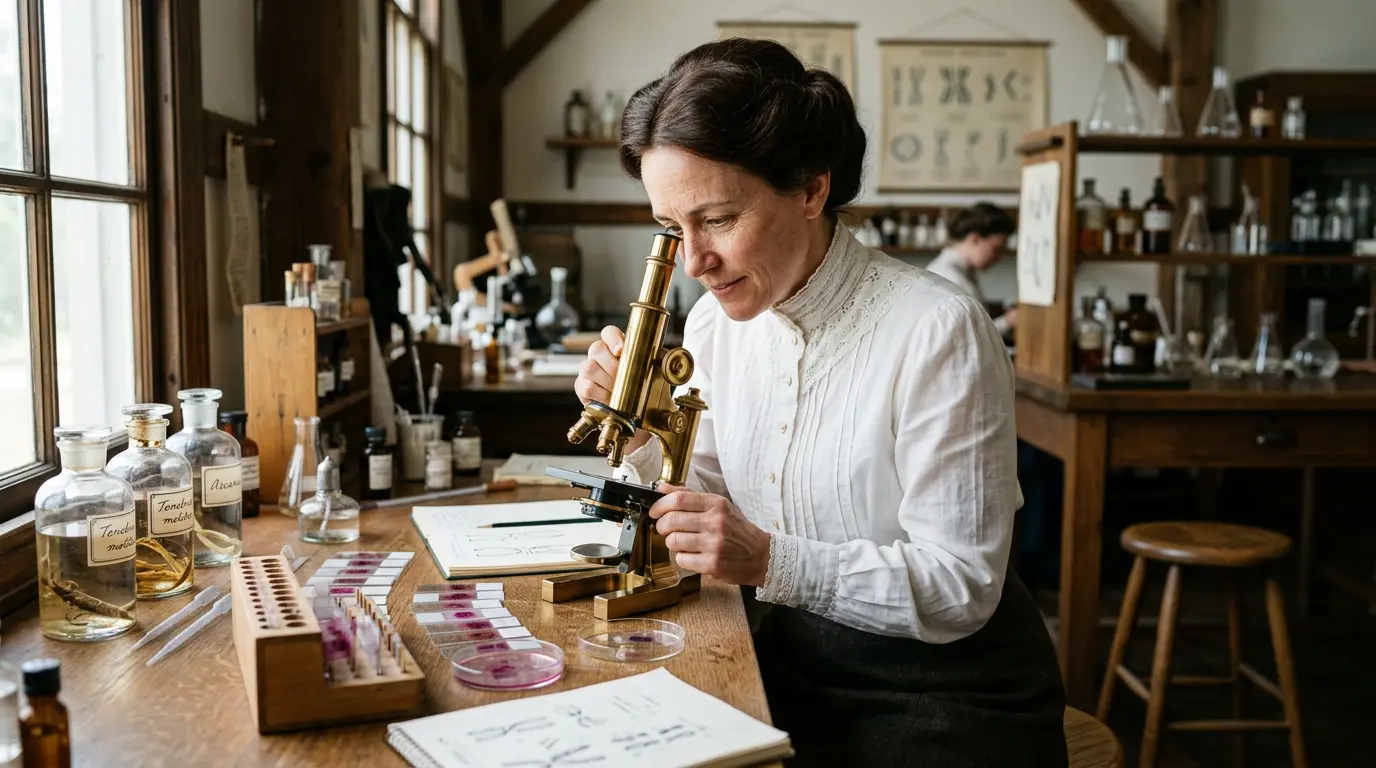
Nettie Maria Stevens
1861–1912 · Genetics and cytology
Nettie Stevens used careful observations of mealworm chromosomes to reveal a genetic mechanism of sex determination, transforming early genetics.
Why is this scientist famous?
Showed through mealworm experiments how X and Y chromosomes are linked to biological sex determination.
Her work helped establish chromosome-based explanations of inheritance.
Nettie's story
The long road into research
Nettie Stevens was born in Cavendish, Vermont, in 1861. She worked as a teacher before she could pursue the scientific education she wanted. She earned degrees from Stanford University in 1899 and 1900. She then studied at Bryn Mawr College, where she completed a doctorate in 1903.
Learning to see tiny differences
Stevens trained in careful microscope work and travelled to scientific laboratories in Europe. Her studies included the Zoological Station in Naples and the laboratory of Theodor Boveri in Germany. Scientists were debating whether chromosomes carried inherited instructions. Stevens approached the question by comparing reproductive cells in different insects.
The mealworm clue
In 1905 Stevens published research on chromosomes in mealworms. She observed that some sperm cells carried a large chromosome and others a smaller one, while the eggs carried the larger type. She connected this difference with the sex of offspring, helping demonstrate an X–Y mechanism of sex determination. Edmund Beecher Wilson also investigated sex chromosomes independently, so the discovery belongs within a broader scientific effort.
An achievement that deserved recognition
Stevens continued studying cells and development at Bryn Mawr. She produced dozens of scientific papers in a research career cut short by her death in 1912. Her work was not always given the attention it deserved, although later historians and scientists have highlighted its importance. Chromosome research became central to understanding heredity and development.
What did they discover?
X–Y sex determination
Her mealworm observations provided clear evidence that differences between sperm chromosomes are linked to the sex of offspring.
Microscope studies of reproductive cells
Compared chromosome behaviour across insect species to test ideas about heredity.
Early cytogenetics
Helped connect the visible structures of cells with inherited biological characteristics.
Amazing facts
She worked as a teacher before becoming a research scientist.
She entered Stanford University in her thirties.
She earned her Stanford bachelor's degree in 1899.
She studied marine organisms and microscopic cell structures before investigating chromosomes.
She carried out research in both Italy and Germany.
Her most famous finding came only two years after she earned her doctorate.
Her chromosome study used mealworms, which are beetles in their larval stage.
She published at least 38 scientific papers during her short research career.
Timeline
Born in Cavendish, Vermont.
Began studies at Stanford University.
Earned a bachelor's degree at Stanford.
Earned a master's degree at Stanford and entered Bryn Mawr.
Undertook advanced research in European laboratories.
Earned her doctorate from Bryn Mawr College.
Published evidence linking different sperm chromosomes to sex determination.
Included among the comparatively few women in a major directory of American scientists.
Died in Baltimore, Maryland.