_(2).jpg)
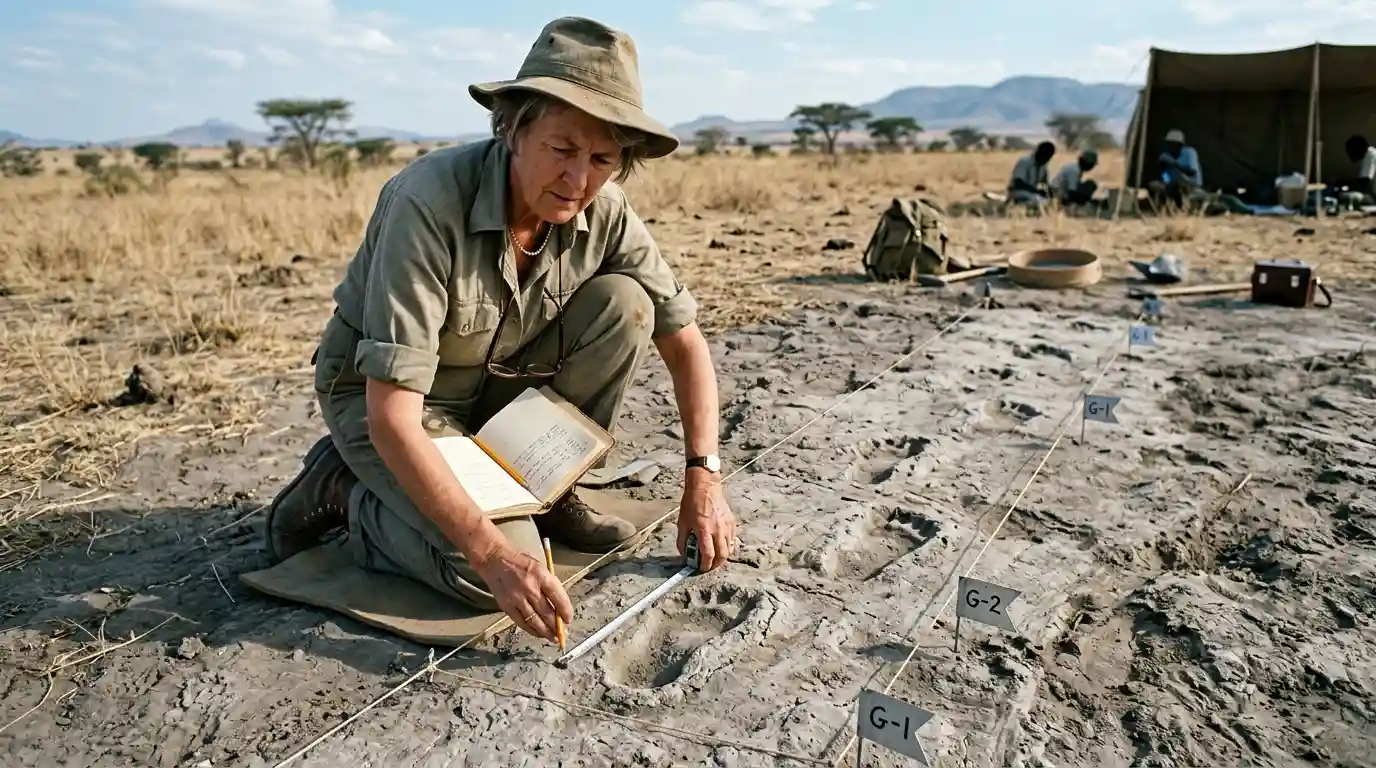
Mary Leakey
1913–1996 · Archaeology and paleoanthropology
Mary Leakey was a British archaeologist who discovered the Paranthropus boisei skull and led the Laetoli team that revealed 3.6-million-year-old hominin footprints.
“I never felt interpretation was my job.”
Why is this scientist famous?
A British archaeologist whose meticulous fieldwork in East Africa revealed crucial evidence of human origins.
Mary Leakey’s rigorous field archaeology, detailed recording and mapping helped establish East Africa as one of the most important regions for studying human origins.
Mary's story
From illustrator to field archaeologist
Mary Douglas Leakey was born Mary Douglas Nicol on 6 February 1913 in London, England. She developed significant ability as an archaeological and scientific illustrator. At age 17 she joined the Hembury excavation in Devon, where she worked with archaeologist Dorothy Liddell and gained practical experience in excavation and illustration. She met Louis Leakey in 1933, and Mary and Louis began working together at sites in Kenya and Tanzania from 1935. Her route into archaeology was through field experience rather than a conventional university degree.
Fossil discoveries at Rusinga Island and Olduvai Gorge
In 1948 Mary found an important fossil ape skull at Rusinga Island in Kenya, identified as Proconsul africanus and about 18 million years old. On 17 July 1959 she discovered fossil teeth and then a skull at Olduvai Gorge in Tanzania. The fossil was initially named Zinjanthropus boisei and is now classified as Paranthropus boisei. It was approximately 1.8 million years old. Mary and collaborator Kimoya Kimeu worked on reconstruction from many fragments. The discovery brought international attention to the Leakeys’ work.
The Laetoli footprints
In 1976 Mary Leakey’s team found animal footprints preserved in volcanic ash at Laetoli, Tanzania. Mary led the Laetoli research programme. In 1978 team member Paul Abell located the famous approximately 27-metre hominin footprint trail containing about 70 early-hominin footprints. The footprints are approximately 3.6 million years old and provide strong evidence of upright, two-legged walking. They are usually associated with Australopithecus afarensis.
A legacy of meticulous fieldwork
After Louis Leakey’s death in 1972, Mary continued her field research. She was renowned for meticulous excavation, mapping and recording. In 1962 she received the Hubbard Medal of the National Geographic Society, and in 1975 she received the Gold Medal of the Society of Woman Geographers. She also received the Linnaeus Gold Medal of the Royal Swedish Academy and four honorary degrees, including from Oxford and Yale. She died in Nairobi, Kenya, on 9 December 1996.
What did they discover?
Proconsul africanus at Rusinga Island
In 1948 Mary discovered an important approximately 18-million-year-old fossil ape skull at Rusinga Island in Kenya, identified as Proconsul africanus.
Paranthropus boisei at Olduvai Gorge
In 1959 she discovered the approximately 1.8-million-year-old skull initially named Zinjanthropus boisei, now classified as Paranthropus boisei, at Olduvai Gorge.
The Laetoli footprint trails
Mary led the Laetoli research team whose work revealed 3.6-million-year-old hominin footprints providing strong evidence of upright walking; in 1978 team member Paul Abell located the main 27-metre trail.
Amazing facts
Mary Leakey became skilled at archaeological illustration before becoming famous for fossil discoveries.
She entered archaeology largely through field experience rather than a conventional university degree.
She worked at archaeological and fossil sites in East Africa for decades.
In 1948 she discovered an approximately 18-million-year-old fossil ape on Rusinga Island.
Her 1959 Paranthropus boisei discovery at Olduvai Gorge brought international attention to the Leakeys’ work.
She was renowned for meticulous excavation, mapping and recording.
The Laetoli project she led revealed a 3.6-million-year-old trail showing that ancient human relatives walked upright.
Her fieldwork helped establish East Africa as one of the most important regions for studying human origins.
Timeline
Born Mary Douglas Nicol in London
At age 17 joined the Hembury excavation as an archaeological illustrator working with Dorothy Liddell
Met Louis Leakey
Began fieldwork with Louis Leakey in Kenya and Tanzania
Discovered a Proconsul africanus fossil on Rusinga Island
Discovered the Paranthropus boisei skull then called Zinjanthropus boisei at Olduvai Gorge
Received the Hubbard Medal
Her Laetoli team encountered preserved animal footprint evidence in volcanic ash
Team member Paul Abell located the main 27-metre hominin footprint trail during the Mary Leakey-led Laetoli project
Died in Nairobi, Kenya
Awards & honours
Related Super Scientists
Charles Darwin
1809–1882 · Naturalist & Biologist
Proposing the theory of evolution by natural selection.
Jane Goodall
1934–2025 · Primatologist & Anthropologist
Beginning one of the world's longest-running studies of wild chimpanzees and documenting behaviours including tool-making and complex social relationships.
Dian Fossey
1932–1985 · Primatologist & Conservationist
Carried out a long-term study of mountain gorillas and helped build international support for their conservation.