_(2).jpg)
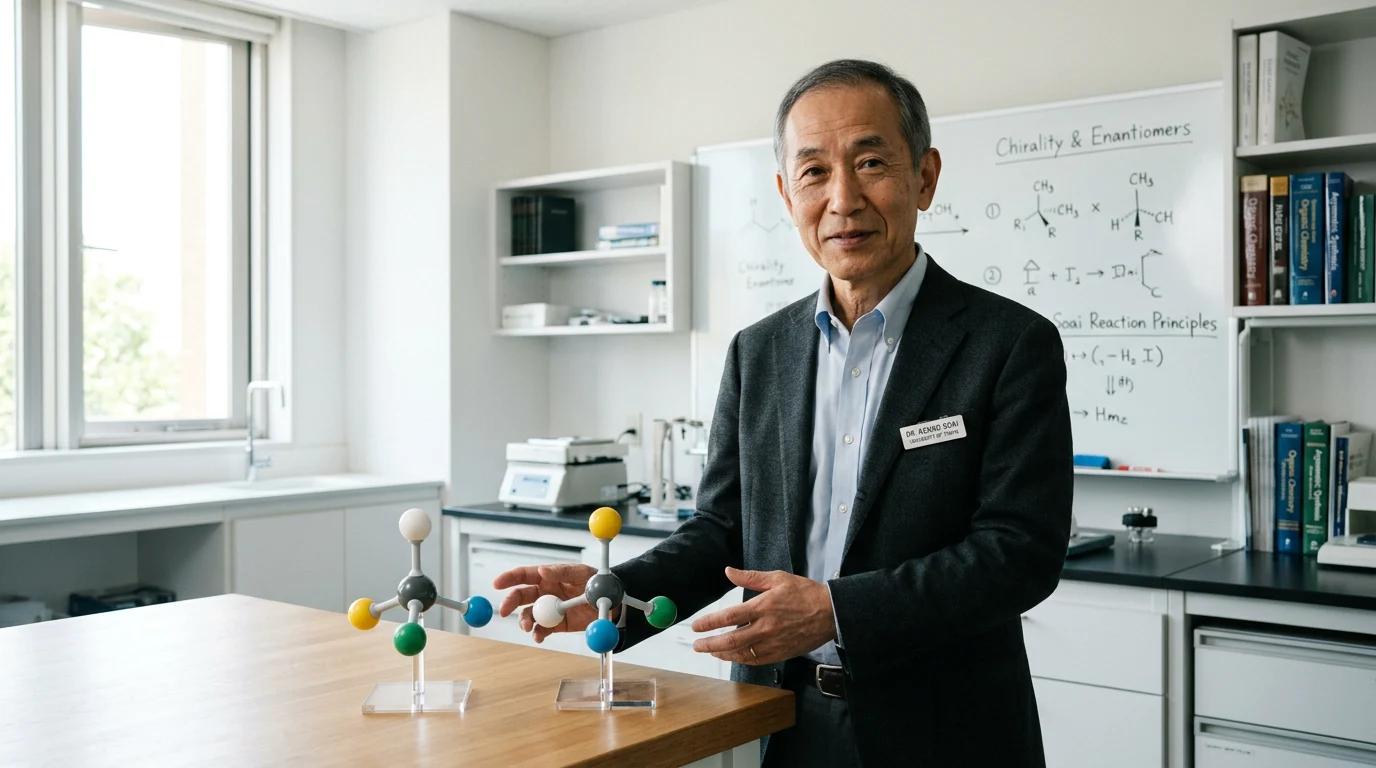
Kenso Soai
1950–present · Organic chemistry
Kenso Soai discovered asymmetric autocatalysis, a reaction whose product catalyses more of the same handed form, offering a striking example of chemical feedback.
Why is this scientist famous?
Soai discovered asymmetric autocatalysis, a reaction where the product helps make more of itself, amplifying tiny molecular imbalances into strong preferences for one mirror-image form.
His experiments show how a tiny molecular imbalance can grow into a strong preference for one mirror-image form, helping scientists think about why living chemistry favours particular handed molecules.
Kenso's story
A chemist from Hiroshima
Kenso Soai was born in 1950 in Hiroshima Prefecture, Japan. He studied chemistry at the University of Tokyo, earning a bachelor’s degree in 1974 and a master’s in 1976. He completed his doctorate there in 1979 under Teruaki Mukaiyama, then spent two years as a research associate with Ernest L. Eliel, a specialist in stereochemistry, at the University of North Carolina at Chapel Hill.
Building a research career
In 1981 Soai joined the Tokyo University of Science as a lecturer and established his own research group. He was promoted to associate professor in 1986 and full professor in 1991. Over the following decades his group explored how reactions could produce molecules with a preferred three-dimensional arrangement, a property central to much of modern chemistry.
Molecular left and right hands
Many molecules exist in mirror-image forms called chiral molecules. Like left and right hands, the two forms cannot be fitted exactly onto one another. This matters because mirror-image molecules can interact differently with living systems, even when their chemical ingredients are the same. Producing one form selectively is a major goal in chemistry.
The reaction that helps make more of itself
In 1995, Soai and colleagues reported an important experiment in asymmetric autocatalysis. In this kind of reaction, the product itself helps catalyse the production of more of the same handed form. With starting chemicals available, a small imbalance can grow into a strong preference through chemical feedback. This is not molecules creating matter from nothing; it is a reaction that amplifies its own tendency.
From tiny biases to strong preferences
Soai’s group showed that an almost imperceptible initial imbalance became a strong predominance of one mirror-image form. They also explored how external influences, including the handed structure of quartz minerals and circularly polarised light, could provide the initial nudge that the reaction then amplifies. These laboratory experiments provide models for studying homochirality, the preference for particular handed forms in biological chemistry. They do not demonstrate the actual historical origin of life.
Nobel recognition
In 2026, Soai and Henri B. Kagan shared the Nobel Prize in Chemistry for work on nonlinear effects and asymmetric autocatalysis. Kagan’s contribution concerned nonlinear catalytic effects, while Soai’s was autocatalysis. The award recognised two related but distinct advances, not a single laboratory team. The landmark 1995 publication came 31 years before the 2026 prize, illustrating how a discovery can develop and gain recognition over decades.
What did they discover?
Asymmetric autocatalysis
Discovered a reaction in which the product catalyses production of more of the same chiral form, creating a chemical feedback loop that amplifies molecular handedness.
Amplification of tiny imbalances
Demonstrated that an almost imperceptible enantiomeric excess can grow so that an almost imperceptible initial imbalance became a strong predominance of one mirror-image form.
External triggers for molecular handedness
Explored how quartz minerals and circularly polarised light can provide the initial imbalance that asymmetric autocatalysis then amplifies.
Amazing facts
His chemistry involves molecular left and right hands. Mirror-image molecules can have different interactions with living systems, making three-dimensional shape important even when the chemical ingredients match.
The product helps the reaction along. In his asymmetric autocatalysis experiments, making some product supplies a catalyst for making more of the same handed product: a real chemical feedback loop.
A minute advantage can become a large majority. His experiments showed how an almost imperceptible initial imbalance could grow into a strong predominance of one mirror-image form.
Quartz can provide a starting nudge. His group studied how the handed structure of a mineral could influence which molecular form became dominant in the reaction.
Light was another experimental starting signal. They investigated circularly polarised light, light with a rotating electric-field direction, as a possible trigger for molecular handedness.
The work connects laboratory chemistry to a deep biological puzzle. Living chemistry favours particular mirror-image building blocks; his experiments show one way an imbalance can grow, rather than proving how life began.
His training crossed the Pacific. After his doctorate in Tokyo he researched with stereochemistry specialist Ernest Eliel in North Carolina, then returned to Japan to establish his own group.
The Nobel followed a long research journey. The landmark 1995 publication came 31 years before the 2026 award, illustrating how a discovery can develop and gain recognition over decades.
Timeline
Born in Hiroshima Prefecture, Japan.
Completes his chemistry degree at the University of Tokyo.
Completes his master’s degree at the University of Tokyo.
Completes his doctorate at the University of Tokyo and begins research with Ernest L. Eliel in North Carolina.
Joins the Tokyo University of Science as a lecturer.
Becomes a full professor at the Tokyo University of Science.
Publishes the amplification experiment in asymmetric autocatalysis.
Becomes emeritus professor at the Tokyo University of Science.
Receives the Japan Academy Prize.
Shares the Nobel Prize in Chemistry with Henri B. Kagan.
Awards & honours
Related Super Scientists
Louis Pasteur
1822–1895 · Chemist and microbiologist
Helping establish germ theory, developing pasteurisation and leading pioneering work on vaccines against anthrax and rabies.
Ahmed Zewail
1946–2016 · Chemist
Pioneering femtochemistry, the use of lasers to observe chemical reactions on the timescale of femtoseconds, earning the Nobel Prize in Chemistry in 1999.