_(2).jpg)
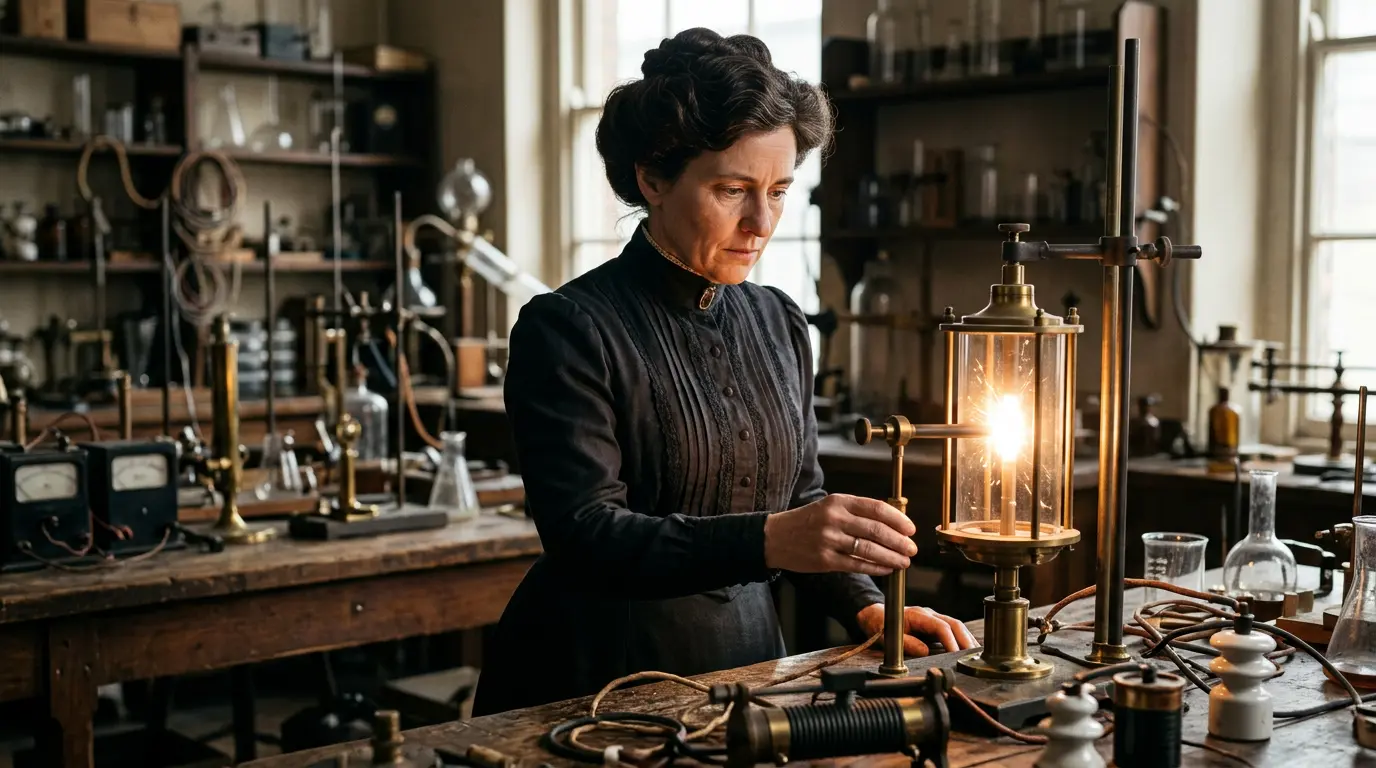
Hertha Ayrton
1854–1923 · Physics and electrical engineering
Hertha Ayrton studied electric lighting and the patterns made by water and sand, invented useful devices and won the Royal Society’s Hughes Medal.
Why is this scientist famous?
Hertha Ayrton explained the behaviour of electric arcs, studied ripples in sand and water, and invented a wartime anti-gas fan.
Her careful work on arcs and fluid motion shows how studying everyday physical effects can lead to practical engineering ideas.
Hertha's story
From Phoebe Sarah to Hertha
The scientist known as Hertha Ayrton was born Phoebe Sarah Marks on 28 April 1854 in Portsea, England. After her father died, money was scarce, but relatives helped her gain a good education. She moved to London as a child and later studied mathematics at Girton College, Cambridge. A friend gave her the name Hertha, which she adopted. Although Cambridge did not then award women degrees on the same terms as men, she kept pursuing mathematics and invention.
A ruler for dividing a line
While studying, Ayrton designed a line-divider, an instrument for dividing a length accurately into equal parts. She secured a patent for it in 1884, early evidence of her skill at turning mathematics into a practical tool. She later studied electricity at Finsbury Technical College, where her work brought her into contact with electrical engineering. Over her lifetime she obtained 26 patents. Her interests reached far beyond any single subject.
Why electric lights hiss
Electric arc lamps produced powerful light by passing electricity across a small gap, but they could hiss and flicker. Ayrton carried out experiments to understand how the arc behaved and what made it unstable. Her papers appeared in the 1890s, and she published a book called The Electric Arc in 1902. In 1899 she presented research to the Institution of Electrical Engineers and became its first female member. Her scientific explanations made important contributions to the understanding of this form of lighting.
Patterns in water and sand
Ayrton also explored why flowing water and moving air create regular ripples and swirling patterns. She used experiments to investigate ripples in sand and water rather than relying on guesswork. She presented her own paper to the Royal Society in 1904, a first for a woman. The Society awarded her the Hughes Medal in 1906 for work on electric arcs and sand ripples. A nomination for its fellowship had been rejected in 1902 because she was a married woman, showing the barriers she faced.
An inventor and campaigner
During the First World War, Ayrton devised a hand-operated fan intended to move clouds of poison gas away from soldiers in trenches. Large numbers were eventually supplied, although it took time for military authorities to accept the design. She also campaigned for women’s voting rights and supported other women seeking education and recognition. Ayrton died in 1923, after a career that joined research, invention and public action. Her life shows that scientific skill and determination were not limited by the social rules of her time.
What did they discover?
Explaining electric arcs
Ayrton investigated the behaviour of electric arc lamps, including unstable hissing and changes in the arc, and published a major study of their physics.
Experiments on ripples
She examined the motion of water and air and the formation of ripples in sand, presenting experimental research to the Royal Society.
The line-divider
Her patented instrument made it easier to divide a straight length accurately into equal parts for mathematical drawing.
The anti-gas fan
She designed a portable hand-operated fan used during the First World War to help disperse dangerous gas clouds in trench settings.
Amazing facts
She was born Phoebe Sarah Marks and adopted the name Hertha after a friend introduced it to her.
Her father was a watchmaker, but family finances became difficult after his death.
At Girton College she helped set up a mathematical club with fellow student Charlotte Scott.
Girton College also records that she organised a student fire brigade.
Her line-divider was her first patent, and she eventually held 26 patents.
She became the Institution of Electrical Engineers’ first female member in 1899.
In 1902 a Royal Society fellowship nomination was rejected because she was married.
Thousands of her hand-operated fans were supplied for use during the First World War.
Timeline
Born Phoebe Sarah Marks in Portsea, England.
Began studying mathematics at Girton College, Cambridge.
Patented her mathematical line-divider.
Published research on the behaviour of electric arcs.
Became the first woman elected to the Institution of Electrical Engineers.
Published The Electric Arc.
Presented her own scientific paper to the Royal Society.
Received the Royal Society’s Hughes Medal.
Developed an anti-gas fan during the First World War.
Died in England.