_(2).jpg)
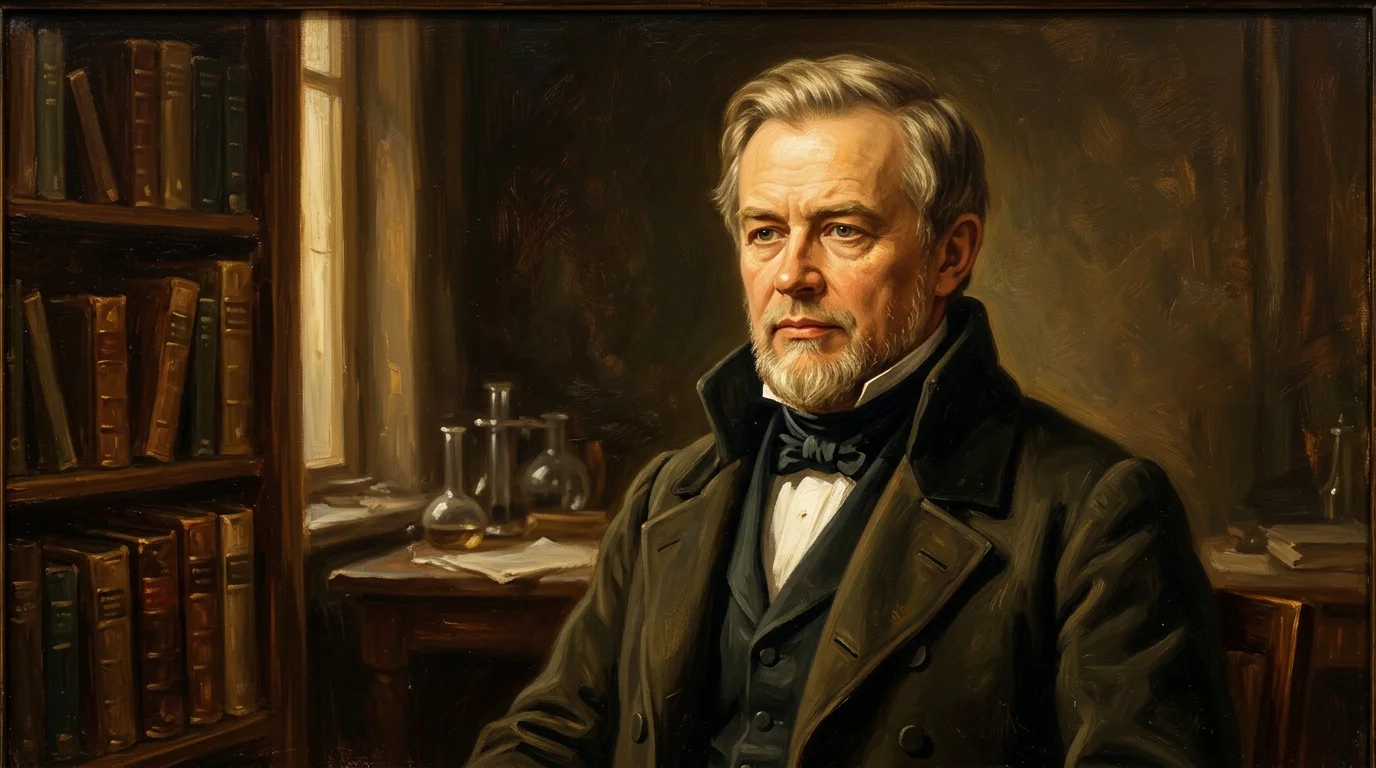
Heinrich Lenz
1804–1865 · Physicist & Geophysicist
A physicist who formulated Lenz's law to determine the direction of an induced current and independently established the Joule-Lenz law of electrical heating.
Why is this scientist famous?
Formulating Lenz's law, which determines the direction of an induced current, and independently establishing the electrical heating relationship also associated with James Prescott Joule, known as the Joule-Lenz law.
Lenz's law remains a standard part of electromagnetism and is used to understand generators, transformers, motors and induction. His work fits naturally alongside Faraday because Faraday established the phenomenon of electromagnetic induction while Lenz supplied an essential rule for predicting the direction of the resulting current. His career also links laboratory physics with geophysics and scientific exploration.
Heinrich's story
Early Life and Education
Heinrich Friedrich Emil Lenz was born on 24 February 1804 in Dorpat, then in the Russian Empire and today known as Tartu, Estonia. Historical sources using the calendar then in use locally may give 12 February 1804, but this is the same date expressed in a different calendar system. Lenz studied at the University of Dorpat, now the University of Tartu. His studies included natural sciences and theology. He studied physics with Georg Friedrich Parrot, who recommended the young Lenz for a major scientific expedition.
Voyage Around the World
From 1823 to 1826, Lenz served as the physicist on Otto von Kotzebue's voyage around the world. During expedition work he carried out physical, hydrographic and geomagnetic observations. This means his scientific career began not only with electricity but also with geophysics and measurements of the natural world. He later carried out further field observations, including work connected with the Caspian Sea.
St Petersburg and Electromagnetism
Lenz subsequently worked in St Petersburg. He became associated with the St Petersburg Academy of Sciences and was elected a full academician in 1834. From the early 1830s onward he carried out extensive research on electromagnetism. His electromagnetic experiments continued for many years. He also carried out extensive experiments involving electromagnets, motors and generators.
Lenz's Law
In 1833 Lenz formulated the principle now called Lenz's law. Lenz's law explains the direction of the current produced by electromagnetic induction. An induced current flows in a direction that creates a magnetic effect opposing the change that produced the current. This opposition is represented by the negative sign in the usual mathematical form of Faraday's law of electromagnetic induction. Lenz's law is consistent with the conservation of energy: if an induced current assisted the change that produced it instead of opposing that change, energy could apparently be created without work being done. Michael Faraday had discovered electromagnetic induction. Lenz's major contribution was to give a clear rule for determining the direction of the induced current.
The Joule-Lenz Law and Later Life
Lenz also investigated the heating effect of electric current. In 1843 he established a relationship describing electrical heating independently of James Prescott Joule's related work. The relationship is therefore often known as the Joule-Lenz law. Lenz died in Rome, Italy, on 10 February 1865.
What did they discover?
Lenz's Law
In 1833, Lenz formulated the principle that an induced current flows in a direction that creates a magnetic effect opposing the change that produced it, consistent with the conservation of energy.
The Joule-Lenz Law
In 1843, Lenz independently established the relationship between electrical current and heating, also associated with James Prescott Joule and known as the Joule-Lenz law.
Voyage Around the World
From 1823 to 1826 he served as physicist on Kotzebue's voyage, carrying out physical, hydrographic and geomagnetic observations.
Amazing facts
Lenz was born in the city now called Tartu in Estonia.
He studied both natural sciences and theology.
While still a young man, he travelled around the world as the physicist on a scientific expedition.
Before becoming famous for electromagnetism, he carried out geomagnetic and hydrographic measurements.
Lenz's law tells scientists the direction of an induced current rather than merely whether a current is produced.
The law provides a particularly clear example of the conservation of energy.
His research also included electric motors and generators.
His work on electrical heating is remembered in the name Joule-Lenz law.
Timeline
Born in Dorpat, now Tartu, Estonia, on 24 February (Gregorian)
Began serving as physicist on Kotzebue's voyage around the world
Returned from the voyage and continued scientific work
Began major electromagnetic research in St Petersburg
Formulated what became known as Lenz's law
Elected a full member of the St Petersburg Academy of Sciences
Established an electrical-heating relationship independently associated with Joule's work
Died in Rome on 10 February
Related Super Scientists
Michael Faraday
1791–1867 · Physicist & Chemist
Discovered electromagnetic induction and created pioneering devices that became the foundations of the electric motor, transformer and generator.
James Prescott Joule
1818–1889 · Physicist
Measured the mechanical equivalent of heat, discovered the electrical heating law bearing his name and made major contributions to the development of energy conservation and thermodynamics.
Heinrich Hertz
1857–1894 · Physicist
Experimentally demonstrated electromagnetic waves in the late 1880s, confirming key predictions of James Clerk Maxwell's electromagnetic theory. The unit hertz (Hz) is named after him.