Friedrich Wöhler
1800–1882 · Organic and inorganic chemistry
Friedrich Wöhler synthesised urea from ammonium cyanate in 1828, challenging a strict divide between living and non-living chemistry while advancing chemical education.
Why is this scientist famous?
Friedrich Wöhler became famous for forming urea from ammonium cyanate in 1828. The transformation showed that a familiar compound associated with living animals could be produced through ordinary laboratory chemistry, without a living organ.
His result contributed to a long shift away from rigid ideas about "organic" and "inorganic" chemistry. Wöhler also worked on metallic elements, chemical structure and training chemists, helping establish laboratory chemistry as a systematic science.
Friedrich's story
A medical student drawn into chemistry
Friedrich Wöhler was born in Eschersheim near Frankfurt in 1800. He studied medicine and chemistry in Marburg and Heidelberg and received a medical doctorate (Dr. med.) from Heidelberg in 1823. Rather than remain in medical practice, he went to Stockholm to study with Jöns Jacob Berzelius, one of the most influential chemists of the age. Wöhler learned rigorous methods of chemical analysis and later translated and edited Berzelius’s chemical writing for German readers. Those interests guided him into a career teaching and investigating substances whose composition and behaviour were still poorly understood.
Two substances, one startling puzzle
As a chemistry teacher at the Berlin Gewerbeschule from 1825 and later at the Higher Gewerbeschule in Kassel from 1831, Wöhler was also an experimentalist. An important puzzle arose from chemicals with the same basic composition but very different properties. Wöhler studied cyanate compounds, while Justus von Liebig studied dangerously explosive fulminates. Their apparent chemical similarity helped fuel debate about what determines a substance’s identity. The two chemists moved from scientific disagreement to an enduring friendship and collaboration. Later chemists would understand the crucial difference as the arrangement of atoms, not just the kinds and numbers present. The story illustrates how surprising substances forced chemistry to become more structural.
The experiment that made urea
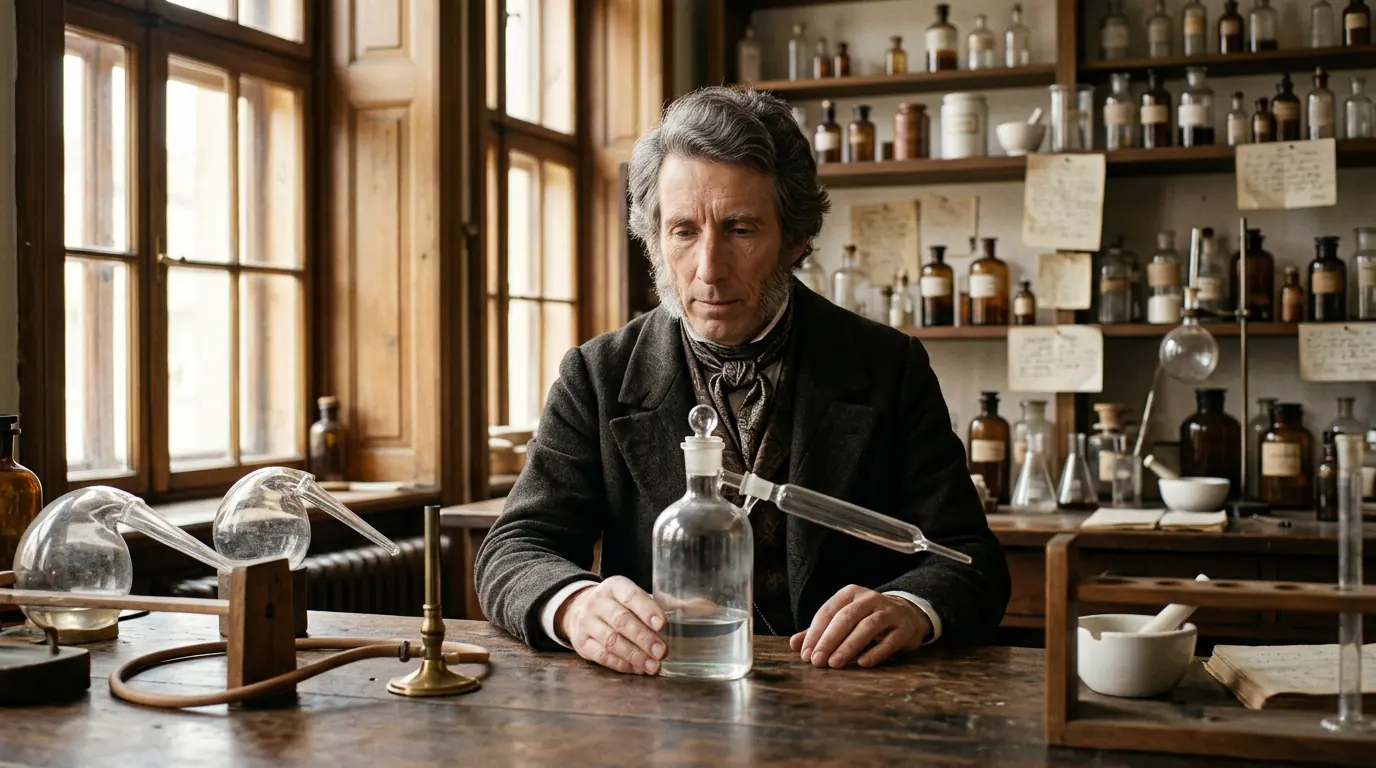
In 1828 Wöhler was studying ammonium cyanate, a salt that can transform into the compound urea under suitable conditions. The change produced a substance previously associated with the chemistry of living organisms, including the urea found in urine. No kidney or living tissue was required in that particular reaction. It became a celebrated challenge to the belief that organic substances always needed a special “vital force” to form. However, that older view did not vanish overnight, and earlier experiments had already complicated it. The real achievement was a clear, reproducible chemical transformation.
Metals, molecules and a new way to think
Wöhler’s achievements reached beyond one experiment. In 1827 he obtained aluminium in a comparatively pure metallic form, building on Hans Christian Ørsted’s earlier, less pure preparation. In 1828 Wöhler and French chemist Antoine Bussy independently isolated beryllium metal from its compounds. These distinctions matter: Wöhler did not discover either element single-handedly. With Liebig he studied bitter almond oil and its derivatives; their 1832 work on the benzoyl group helped chemists recognise that groups of atoms could persist through different reactions. Wöhler also researched silicon compounds and calcium carbide. These projects connected inorganic and organic chemistry and helped prepare the ground for the later development of structural chemical theory.
A laboratory that taught the world
In 1836 Wöhler became professor at Göttingen, where he taught and researched for the rest of his life. The chemical laboratory grew into an internationally admired centre where students learned by performing experiments rather than only reading descriptions. He and Liebig helped make organic chemistry a disciplined research subject, not simply a list of substances extracted from plants and animals. Wöhler died in Göttingen in 1882. His urea synthesis is still taught, but his wider legacy includes metal chemistry, scientific collaboration and the training methods that helped shape modern chemical laboratories.
What did they discover?
Urea synthesis
Showed in 1828 that ammonium cyanate could be transformed into urea without a living organism; this challenged strict vitalist claims but did not instantly end vitalism.
Metal isolation
Obtained comparatively pure aluminium in 1827 after Ørsted’s earlier work; independently isolated beryllium in 1828, alongside Antoine Bussy’s separate discovery.
Benzoyl-group investigations
With Justus von Liebig, studied the chemistry of bitter almond oil and related compounds in 1832, advancing thinking about persistent groups of atoms.
Chemistry laboratory education
Developed Göttingen’s laboratory into an influential centre for practical chemical teaching and research.
Amazing facts
He earned a medical doctorate in 1823 but chose chemical research and teaching rather than medical practice.
He trained in Stockholm with Berzelius and later translated that chemist’s textbooks for German readers.
He and Liebig worked on substances with similar compositions but radically different properties, including an explosive fulminate and a cyanate compound.
His famous urea result came while investigating ammonium cyanate, not while trying to imitate a kidney.
Long before his professional training, he collected minerals as a young student with a growing interest in chemistry.
He obtained comparatively pure aluminium in 1827, building on Ørsted’s earlier, impure preparation.
With Liebig, he helped identify the benzoyl group as a useful recurring group of atoms in organic reactions.
In 1828 he isolated beryllium independently of Antoine Bussy, while also researching silicon compounds and calcium carbide.
Göttingen’s laboratory under his leadership attracted chemistry students from many countries.
In 1872 the Royal Society awarded him its Copley Medal, one of its major scientific honours.
Timeline
Born in Eschersheim near Frankfurt on 31 July.
Earned a medical doctorate at Heidelberg and began further training with Berzelius.
Became a chemistry teacher at Berlin’s Gewerbeschule.
Obtained metallic aluminium in comparatively pure form after Ørsted’s earlier work.
Synthesised urea from ammonium cyanate.
Took a teaching post at the Higher Gewerbeschule in Kassel.
Collaborated with Liebig on the benzoyl group.
Became professor of chemistry at Göttingen.
Was elected a foreign member of the Royal Society.
Died in Göttingen on 23 September.
Awards & honours
Sources & references
- Science History Institute — Justus von Liebig and Friedrich Wöhler
- University of Göttingen — Friedrich Wöhler
- Deutsche Biographie — Friedrich Wöhler
- Leopoldina — Friedrich Wöhler member record
- Royal Society of Chemistry — Beryllium (element history)
- Royal Society of Chemistry — Aluminium (element history)