_(2).jpg)
Fei-Fei Li
1976–present · Computer vision and artificial intelligence
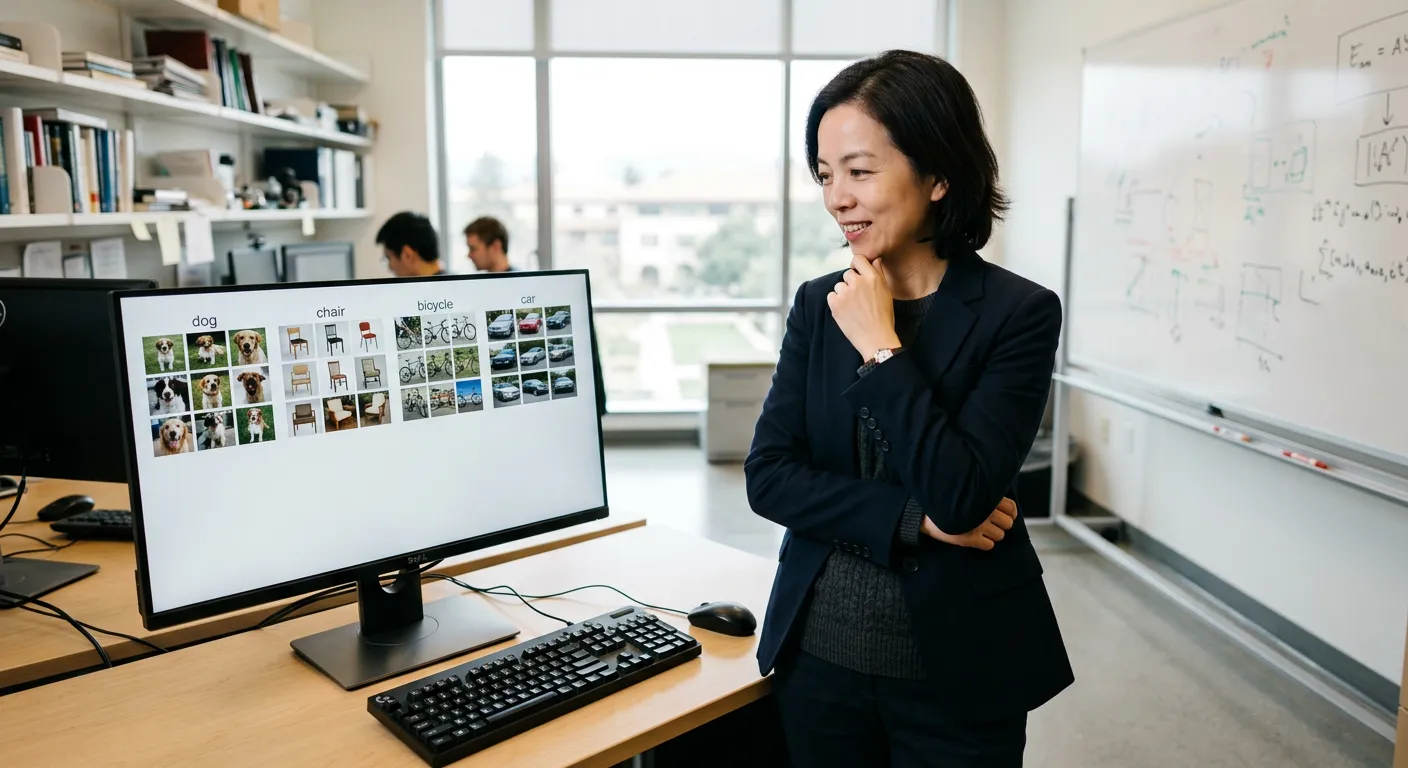
Fei-Fei Li led the creation of ImageNet, a major labelled image dataset that helped researchers train computers to recognise objects in pictures.
“AI has the potential to radically transform every industry and every society.”
Why is this scientist famous?
Li helped demonstrate the importance of large, carefully labelled image datasets for computer vision. She also works to put human needs at the centre of artificial intelligence.
Li's work helped make large, organised datasets central to modern computer-vision research. Her educational and interdisciplinary work asks how those technical achievements can serve people.
Fei-Fei's story
Learning about vision
A child can recognise a dog in many different pictures, even when its size, colour or position changes. Getting a computer to perform such a task has been a major scientific challenge. Fei-Fei Li's research helped change how scientists approached it.
Li moved from China to the United States during high school. As a student at Princeton, she also helped with her family's dry-cleaning business. She earned a physics degree in 1999, then completed a doctorate in electrical engineering at the California Institute of Technology in 2005. At Caltech, her advisers Pietro Perona and Christof Koch brought together expertise in computing and neuroscience.
Building ImageNet
Artificial intelligence (AI) includes computer systems designed to perform tasks such as recognising patterns. In computer vision, researchers need examples with which to train and test their systems. Li helped address this need by leading the creation of ImageNet, launched in 2009.
The project gathered a large collection of images organised into categories, with people contributing annotations and quality checks. Such a resource lets researchers train systems on examples and compare how well they recognise unfamiliar images. Its importance came from the combination of data, organisation and a shared research task, rather than from being a single all-purpose computer program.
Working across disciplines
Li joined Princeton's computer science faculty in 2007 and moved to Stanford in 2009. ImageNet involved many researchers; its senior team includes Jia Deng, Olga Russakovsky, Alex Berg and Kai Li as well as Li herself. Computer vision's progress also depended on advances in algorithms and computing hardware.
Keeping people in the picture
Li co-founded the educational nonprofit AI4ALL, which works to increase diversity in AI, and helped establish Stanford's Institute for Human-Centered Artificial Intelligence in 2019. This brings technical research together with questions from the social sciences and humanities. Her research has also explored applications in healthcare.
Her work encourages readers to consider two questions together: what can machines learn to do, and how should people use those capabilities responsibly?
What did they discover?
ImageNet
Led the creation of ImageNet (launched 2009), a large collection of human-labelled images organised into categories that became a shared resource for training and evaluating computer-vision systems.
Human-centred AI research
Co-established Stanford's Institute for Human-Centered Artificial Intelligence, bringing together technical AI research with social science and humanities perspectives.
AI diversity education
Co-founded AI4ALL, a nonprofit working to increase diversity in artificial intelligence through educational programmes for underrepresented students.
Amazing facts
Her undergraduate degree was in physics.
Her doctoral training connected computing and neuroscience.
ImageNet relies on human-labelled images.
ImageNet is a dataset, not a robot or a chatbot.
She has worked to widen access to AI education.
Her memoir is called The Worlds I See: Curiosity, Exploration, and Discovery at the Dawn of AI.
Timeline
Graduates from Princeton in physics.
Completes her Caltech doctorate in electrical engineering.
Joins Princeton's computer science faculty.
Moves to Stanford; ImageNet is launched.
Begins directing the Stanford Artificial Intelligence Laboratory.
Concludes her term directing the Stanford Artificial Intelligence Laboratory.
Helps establish Stanford's Institute for Human-Centered Artificial Intelligence.
Receives Princeton's Woodrow Wilson Award.