Esther Miriam Lederberg
1922–2006 · Microbial genetics
Esther Lederberg discovered bacteriophage lambda and co-developed replica plating, giving geneticists powerful tools to study bacteria, mutation and gene exchange.
Why is this scientist famous?
Esther Miriam Lederberg discovered bacteriophage lambda, a virus that can remain dormant in bacterial DNA, and jointly developed replica plating with Joshua Lederberg. She also contributed to research on the F factor involved in bacterial gene transfer.
These techniques and discoveries made bacteria useful experimental models for understanding gene regulation, mutation and the movement of genetic information. Her work helped researchers ask questions that later became central to molecular genetics.
Esther's story
From the Bronx to the laboratory
Esther Miriam Zimmer grew up in the Bronx, New York, in a family with limited financial resources. She earned her undergraduate degree at Hunter College in 1942 and pursued genetics at Stanford, receiving a master’s degree in 1946. After moving to the University of Wisconsin she completed a doctorate in 1950. At a time when women faced serious obstacles in research careers, she developed exceptional skills in experimental microbiology: the patient business of growing, identifying and comparing tiny bacterial populations. She married Joshua Lederberg in 1946, and their scientific collaborations were important, but her own discoveries must be credited to her separately.
A virus hiding inside bacteria
While investigating *Escherichia coli* strains at Wisconsin, Esther Lederberg observed unusual patterns of infection that led to bacteriophage lambda, a virus capable of infecting bacteria. She first reported lambda in 1951. Unlike viruses that immediately burst their host cells, lambda can follow a quiet route called lysogeny: its DNA integrates into the bacterial chromosome and can be passed on as the bacterium divides. Later research using lambda helped scientists understand switches controlling gene activity and how DNA recombines. Lederberg’s discovery gave geneticists an unusually informative experimental system, not just another virus to catalogue.
A velvet stamp that changed experiments
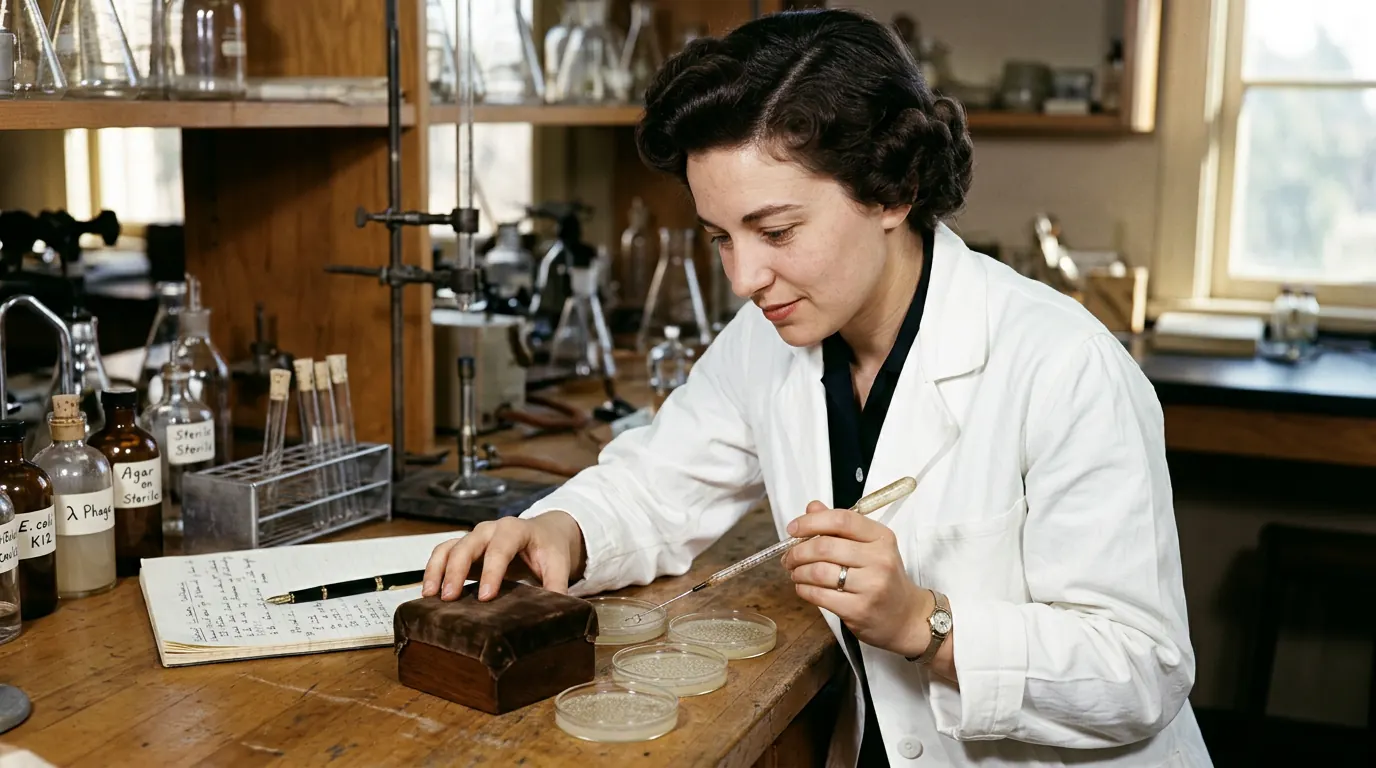
Together with Joshua Lederberg she developed replica plating; their paper appeared in the *Journal of Bacteriology* in March 1952. A sterile velvet surface could be pressed onto a plate of bacterial colonies and then used to transfer a matching pattern onto other plates. The technique allowed researchers to compare colonies grown on ordinary medium with corresponding colonies on medium containing an antibiotic or lacking a nutrient. Crucially, surviving colonies could be traced back to bacteria present on the original plate. This strengthened earlier evidence that resistant mutants can already exist before a selection pressure appears; it did not replace the earlier fluctuation work of Luria and Delbrück.
How bacteria exchange genetic information
Lederberg also contributed to the study of the bacterial fertility factor, usually called the F factor, which enables some cells to transfer genetic information to others by conjugation. Her experiments were part of a collaborative field of researchers trying to understand how organisms as small as bacteria can exchange genes. After returning to Stanford in 1959, she continued research and built valuable collections of bacterial strains and plasmids. Her meticulous records and practical methods helped other scientists reproduce and extend experimental findings. This quiet infrastructure was itself an important contribution to the growth of molecular biology.
Science, music and recognition
From 1976 Lederberg directed Stanford’s Plasmid Reference Center, continuing that work through 1986, a year after her formal retirement. She was active in early music and established the Mid-Peninsula Recorder Orchestra in 1962. She also supported conservation and was a charter member of the Monterey Bay Aquarium. Her achievements were often discussed less publicly than those of Joshua Lederberg, who received a Nobel Prize in 1958; she did not share that award. More recent scholarly histories have made her experimental innovations easier to recognise on their own terms. She died in Stanford in 2006. The enduring reason to remember her is the ingenious, dependable research she gave to generations of geneticists.
What did they discover?
Discovery of bacteriophage lambda
Identified the temperate bacterial virus lambda, reported in 1951, which became a major system for studying DNA and genetic regulation.
Replica plating
With Joshua Lederberg, published the 1952 velvet-transfer method for copying positions of bacterial colonies between plates.
Evidence about mutation
Used replica plating to strengthen earlier research showing that resistant bacterial variants can pre-exist selection rather than arise because they are needed.
F-factor and reference-strain work
Contributed to understanding bacterial gene exchange and later led Stanford’s Plasmid Reference Center, supporting experiments by other scientists.
Amazing facts
Lambda phage can live quietly in a bacterium instead of immediately destroying its host.
Replica plating used sterile velvet almost like a stamp to copy the positions of many bacterial colonies at once.
Because researchers could return to the original plate, replica plating helped reveal resistant mutants that already existed before exposure to an antibiotic.
Her work on the F factor helped illuminate how bacteria can pass genetic material to one another.
Colleagues praised her ability to remember and catalogue the details of valuable bacterial strains.
She headed Stanford’s Plasmid Reference Center from 1976 to 1986, continuing after formal retirement in 1985.
She founded the Mid-Peninsula Recorder Orchestra in 1962 and played early music on historical instruments.
She received an American Cancer Society Senior Dernham Fellowship for 1968–1970.
Outside genetics she supported conservation and was a charter member of the Monterey Bay Aquarium.
Timeline
Born Esther Miriam Zimmer in the Bronx on 18 December.
Completed a master’s degree at Stanford and married Joshua Lederberg.
Completed a doctorate at the University of Wisconsin.
First reported bacteriophage lambda.
Co-developed replica plating with Joshua Lederberg.
Returned to Stanford School of Medicine.
Founded the Mid-Peninsula Recorder Orchestra.
Began directing Stanford’s Plasmid Reference Center.
Retired formally, while continuing reference-centre work.
Died at Stanford on 11 November.
Awards & honours
Sources & references
- Stanford Medicine — Esther Lederberg obituary
- Peer-reviewed review — Pioneer of bacterial genetics: Esther Lederberg
- National Women’s History Museum — Esther Lederberg
- Peer-reviewed historical review — Little Lambda, Who Made Thee?
- Original research paper — Joshua and Esther M. Lederberg, Replica Plating and Indirect Selection of Bacterial Mutants (1952)