_(2).jpg)
Edwin H. Land
1909–1991 · Optics, polarising materials and instant photography
Edwin H. Land created practical polarising filters and led the Polaroid team behind instant photography, changing how people captured and shared pictures.
Why is this scientist famous?
Edwin H. Land pioneered inexpensive polarising filters and led the development of Polaroid instant cameras that could produce photographs in minutes.
His work helped develop optical filters, instant photographic chemistry and ideas about how the human visual system perceives colours.
Edwin's story
Learning to control light
Edwin Herbert Land was born on 7 May 1909 in Bridgeport, Connecticut, in the United States. He attended Norwich Free Academy and began studying at Harvard University, but his curiosity about light soon carried him into independent experiments. He wanted to make a practical filter that would allow light vibrating in one direction through while blocking light vibrating in other directions. Instead of relying on large, costly crystals, he found ways to create thin polarising sheets using many tiny aligned particles. His work made it easier to produce filters useful in sunglasses, scientific instruments and photography.
A laboratory becomes Polaroid
In 1932 Land and his Harvard physics instructor George Wheelwright formed Land-Wheelwright Laboratories to develop and sell polarising materials. The organisation became the Polaroid Corporation in 1937. Its researchers worked on products that used controlled light, from lenses and camera filters to equipment for specialised jobs. During the Second World War the company also worked on optical devices for the military. Land did not create these technologies alone: inventing useful products required chemists, engineers, technicians and other colleagues.
A photograph without the long wait
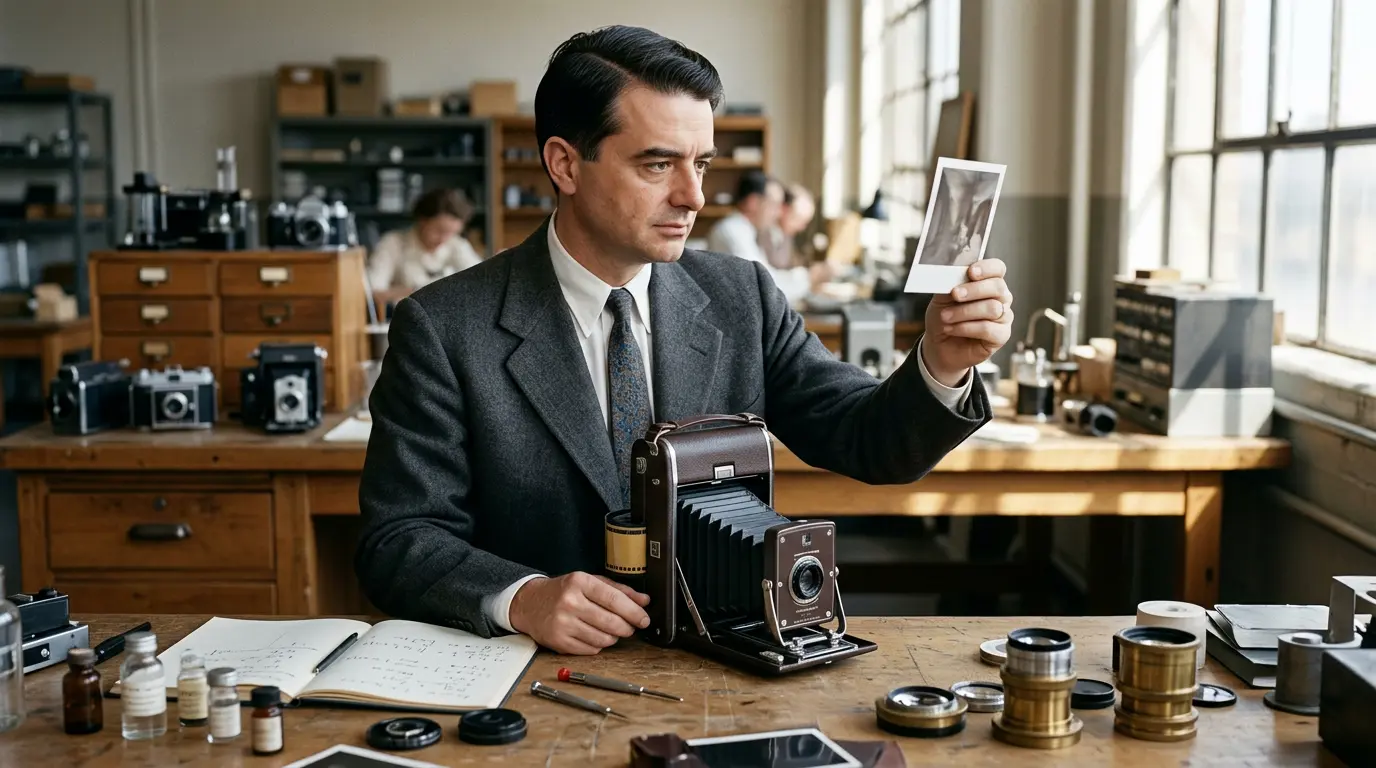
Taking a photograph once usually meant waiting for film to be developed outside the camera. Land led an effort to build a camera and film system that could create a print quickly after the picture was taken. On 21 February 1947 he demonstrated instant photography at a meeting of the Optical Society of America. The first commercial Polaroid Land Camera Model 95 went on sale in 1948. The technology changed photography by letting people see the result of a photograph almost immediately instead of waiting for a separate processing service.
Making pictures easier to use
The early instant process still involved steps that later Polaroid systems would simplify. Land and colleagues continued improving the film, camera and chemical processes, including instant colour film introduced during the 1960s. In 1972 the SX-70 system offered a more integrated type of instant photography in which a print developed without being peeled away from a separate negative. These achievements depended on teams solving problems in chemistry, optics and mechanical design. Land’s leadership helped bring those different kinds of research together into products people could use.
The science of seeing
Land also investigated colour vision, including why objects can appear to have much the same colour under very different lighting. His Retinex ideas explored how the visual system interprets colour using information from across a scene. He received major honours for his optical work and was inducted into the National Inventors Hall of Fame in 1977. Land died in 1991 after a career linking scientific experiments with inventions and business. His story demonstrates that a familiar object, such as a camera, can contain years of collaboration and careful scientific testing.
What did they discover?
Practical sheet polarisers
Land developed inexpensive, useful films that filter light according to its polarisation, opening many possibilities for lenses and optical instruments.
Instant photographic systems
He led the research effort that produced the first successful Polaroid instant camera and photographic process demonstrated in 1947 and sold from 1948.
Advances in instant colour photography
He guided multidisciplinary Polaroid teams developing new film chemistry and increasingly convenient camera systems, including the SX-70.
Retinex theories of colour perception
Land investigated how the visual system maintains impressions of colour despite changes in illumination, influencing later research on colour vision.
Amazing facts
Land left Harvard without completing a degree, but continued experimenting and later became a leading inventor.
He and his instructor George Wheelwright co-founded a laboratory in 1932, before it was called Polaroid.
The polarising sheets he developed used many tiny aligned particles rather than one huge crystal.
Polaroid’s research also helped produce optical equipment during the Second World War.
Land demonstrated instant photography to an audience of optical scientists on 21 February 1947.
The original Model 95 went on sale at a Boston department store in November 1948.
Photographer Ansel Adams later worked as a photographic and technical adviser to Polaroid.
A museum preserves an early Model 95 camera bearing Land’s own initials.
Timeline
Born in Bridgeport, Connecticut, United States.
Graduated from Norwich Free Academy.
Co-founded Land-Wheelwright Laboratories with George Wheelwright.
The business became the Polaroid Corporation.
Demonstrated instant photography on 21 February.
The Polaroid Land Camera Model 95 went on sale.
Photographer Ansel Adams became an artistic and technical consultant to Polaroid.
Polaroid introduced instant colour film.
The SX-70 camera and integrated film system were released.
Was inducted into the National Inventors Hall of Fame.
Died in Cambridge, Massachusetts.