_(2).jpg)
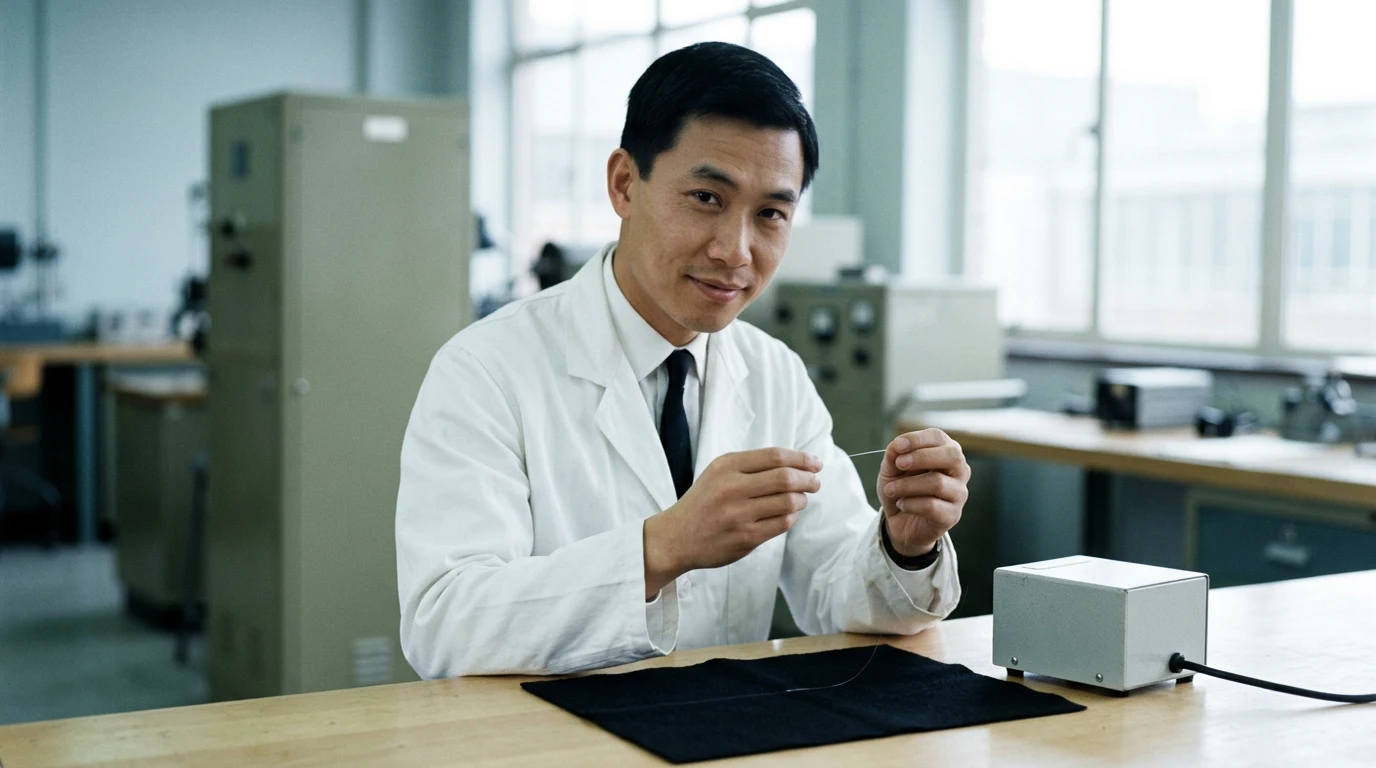
Charles K. Kao
1933–2018 · Optical fibre communications and electrical engineering
Charles K. Kao showed that exceptionally pure glass fibres could carry information by light, paving the way for modern global communications.
“Ideas do not always come in a flash, but by diligent trial-and-error experiments that take time and thought.”
Why is this scientist famous?
Charles Kao helped make long-distance optical-fibre communications practical by identifying the need for exceptionally pure glass and guiding a 1966 breakthrough.
Fibre-optic cables carry vast amounts of internet and telephone data, supporting communications across cities, oceans and continents.
Charles's story
From Shanghai to a laboratory in England
Charles Kuen Kao was born in Shanghai on 4 November 1933. His family later moved to Hong Kong, and Kao continued his education in Britain. After studying electrical engineering at Woolwich Polytechnic, he joined Standard Telecommunication Laboratories in Harlow. Engineers were exploring whether light could carry much greater amounts of information than traditional electrical communication systems. Kao became convinced that tiny strands of glass could help, despite major technical obstacles.
Why did light disappear?
Early glass fibres lost too much light to carry messages over long distances. Kao investigated whether the problem was a fundamental limitation of glass or caused by unwanted impurities. Working with George Hockham, he argued that exceptionally pure glass could transmit light with far less loss. Their 1966 paper showed a realistic path towards optical communication. Kao did not single-handedly manufacture the later commercial fibre cables; materials scientists and engineers, including teams at Corning, developed crucial low-loss glass fibres.
A thread that could carry a message
An optical fibre is a narrow glass strand that guides light along its length. Information can be encoded in rapidly changing light signals, which travel through long sections of carefully manufactured cable. An optical fibre has a glass core surrounded by cladding that helps keep light guided within it, while outer protective layers guard against damage. Kao’s central insight was that lowering absorption and scattering could make these signals useful over great distances, transforming an interesting laboratory possibility into an engineering goal.
Engineering across continents
Kao helped establish an electronics department at the Chinese University of Hong Kong in the 1970s and later held senior engineering roles in the telecommunications industry. Practical low-loss fibres arrived as manufacturing and laser technologies improved. Long-distance networks were built by many companies and research teams over subsequent decades. Kao’s work is a strong example of a scientist identifying the right problem, choosing measurements carefully and making a persuasive prediction before the final technology existed.
Light and the modern internet
Kao received the 2009 Nobel Prize in Physics for ground-breaking achievements in transmitting light through fibres. He died in Hong Kong on 23 September 2018. Today, fibre-optic networks carry communications beneath streets and oceans and connect computers, telephone systems and research centres. Wireless devices may look cable-free, but much of the information they exchange still travels along fibres somewhere in the network.
What did they discover?
Low-loss optical-fibre concept
Showed that unwanted glass impurities, rather than glass itself, were a major obstacle to long-distance optical transmission.
1966 fibre-optics proposal
With George Hockham, explained a technically plausible approach to useful optical waveguides.
Telecommunications engineering
Helped guide the shift from electrical communication channels to information carried by light.
Optics and materials
Linked optical physics to the need for high-purity manufactured glass.
Amazing facts
He was born in Shanghai in 1933 and later studied electrical engineering in Britain.
He joined Standard Telecommunication Laboratories in Harlow.
He investigated why early glass fibres lost light so rapidly.
He and George Hockham published an influential optical-fibre paper in 1966.
He proposed that very pure glass could reduce losses enough for long-distance signals.
He helped establish electronics teaching at the Chinese University of Hong Kong in the 1970s.
Manufacturers and other scientists later achieved the low-loss fibres that made his vision practical.
He received half of the 2009 Nobel Prize in Physics for fibre-optic communication research.
Timeline
Born in Shanghai, China.
Joined the telecommunications industry after study at Woolwich Polytechnic.
Published a landmark optical-communications paper with George Hockham.
Began work establishing electronics education at the Chinese University of Hong Kong.
Received the IEEE Morris N. Liebmann Memorial Award.
Received the Nobel Prize in Physics for fibre-optic communications.
Died in Hong Kong.
Awards & honours
Related Super Scientists
Tim Berners-Lee
1955–present · Computer scientist
Inventing the World Wide Web and creating its core technologies: URIs, HTTP and HTML.
Alexander Graham Bell
1847–1922 · Inventor & Scientist
Inventing the telephone and founding the company that became AT&T.
Heinrich Hertz
1857–1894 · Physicist
Experimentally demonstrated electromagnetic waves in the late 1880s, confirming key predictions of James Clerk Maxwell's electromagnetic theory. The unit hertz (Hz) is named after him.