_(2).jpg)
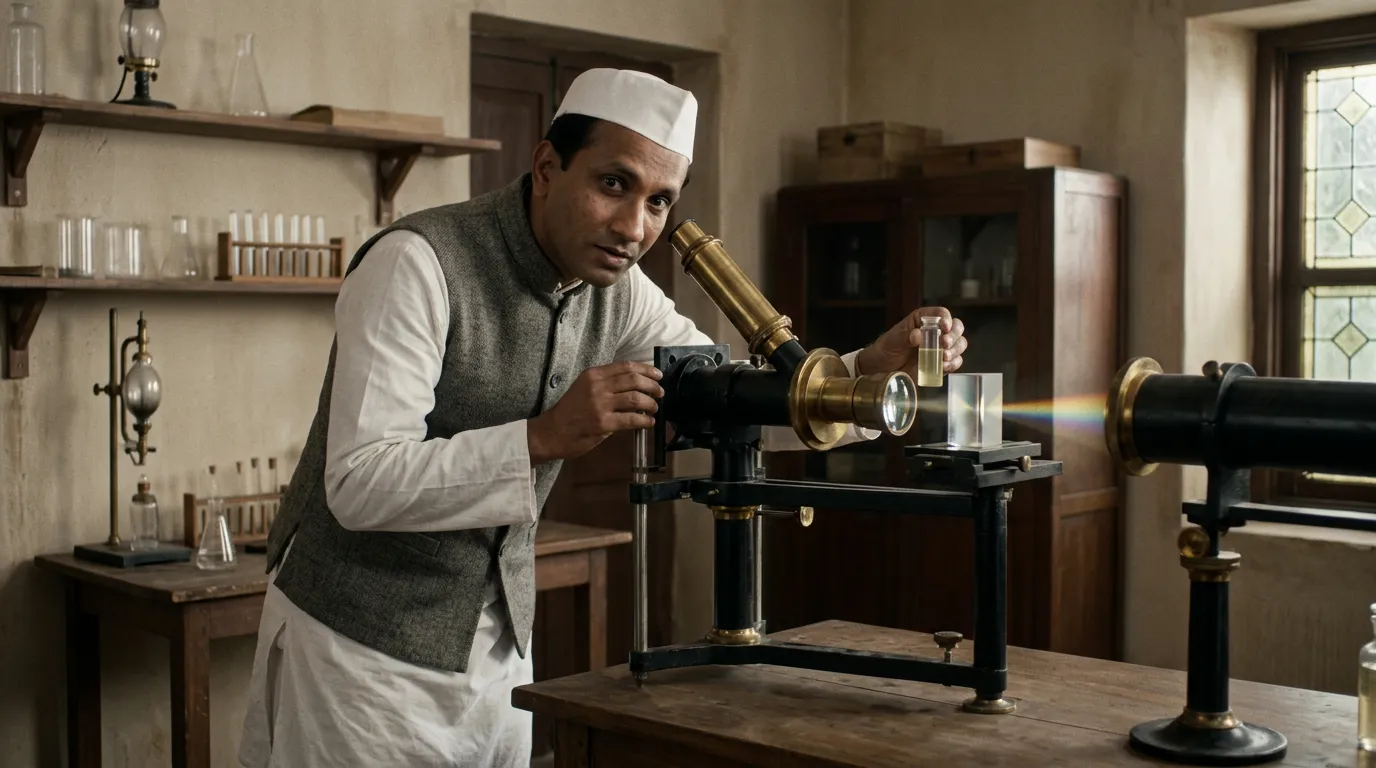
Chandrasekhara Venkata Raman
1888–1970 · Optics, acoustics and light scattering
C. V. Raman discovered how light can change colour after interacting with molecules, opening a way to identify materials through Raman spectroscopy.
Why is this scientist famous?
C. V. Raman discovered the Raman effect, showing that some light changes energy when scattered by molecules and revealing clues about matter.
Raman spectroscopy identifies substances through tiny changes in scattered light and is used to study materials without destroying samples.
Chandrasekhara's story
A young scientist in India
Chandrasekhara Venkata Raman was born on 7 November 1888 in Tiruchirappalli, in southern India. His father taught mathematics and physics, and Raman went on to study at Presidency College in Madras, now Chennai. He completed a bachelor’s degree in 1904 and a master’s degree in 1907. Raman investigated scientific questions while still a student, particularly problems involving light and sound. He would later study how musical instruments produce their distinctive tones.
Physics after office hours
A research career was not an easy option for him at the time, so in 1907 he began working for the Indian Finance Department in Calcutta, now Kolkata. After his regular office duties, he carried out experiments at the Indian Association for the Cultivation of Science. He studied vibrations, sound and optical effects with persistence and ingenuity. In 1917 he left government employment to become a professor of physics at the University of Calcutta. This gave him more time to lead a growing programme of research.
Why does light change colour?
During a sea journey in 1921, Raman became especially interested in why the sea appeared blue. He explored how light is scattered by matter and, with colleagues including K. S. Krishnan, studied light passing through liquids. On 28 February 1928 they established that a tiny portion of scattered light had changed wavelength compared with the light entering the sample. The change occurs because light can exchange energy with molecules, giving clues about how those molecules vibrate or rotate. The finding became known as the Raman effect.
A fingerprint made of light
Different substances give different patterns of wavelength changes when they scatter light. Scientists can study those patterns as a kind of molecular fingerprint, a method called Raman spectroscopy. The original effect was faint and difficult to measure with the equipment available in the 1920s. Raman and his co-workers used filtered light and optical instruments to show that the changed wavelengths were real. He received the Nobel Prize in Physics in 1930 for the discovery, which rapidly became an important tool in physics and chemistry.
Building scientific institutions
Raman became the first Indian director of the Indian Institute of Science in Bangalore, now Bengaluru, in 1933. He helped develop physics research there and founded the Indian Academy of Sciences in 1934. In 1948 he established the Raman Research Institute, where he continued studying light, crystals and colour. He died in 1970, leaving both a scientific discovery and institutions that supported later research. His story shows how asking questions about familiar sights can lead to new ways of examining the world.
What did they discover?
The Raman effect
Raman and colleagues demonstrated that a small fraction of scattered light has changed frequency because it exchanges energy with molecules.
A method for molecular identification
The shifted-light patterns of Raman spectroscopy help researchers identify substances and explore how their molecules move.
Investigations of sound and musical instruments
Before his famous light-scattering work, Raman researched vibrations and the acoustic behaviour of stringed and percussion instruments.
Strengthening physics research in India
He developed physics programmes, helped found the Indian Academy of Sciences and established the Raman Research Institute.
Amazing facts
Raman completed his bachelor’s degree at the age of sixteen.
Before teaching physics full-time, he worked in government finance and experimented after office hours.
He investigated the sounds made by Indian instruments such as the veena, tabla and mridangam.
A sea voyage in 1921 helped inspire his questions about the colours seen in water.
His research team studied about sixty liquids while investigating altered scattered light.
Only a tiny proportion of the scattered light shows the wavelength change associated with his effect.
The experiment used filtered light and a spectrograph, not the lasers found in many modern demonstrations.
He established the Raman Research Institute in 1948 and continued his investigations there for the rest of his life.
Timeline
Born in Tiruchirappalli, southern India.
Graduated with a bachelor’s degree from Presidency College, Madras.
Completed his master’s degree and joined the Indian Finance Department.
Became a professor of physics at the University of Calcutta.
Began investigating light scattering after observations during a sea journey.
Was elected a Fellow of the Royal Society.
With colleagues, demonstrated the Raman effect on 28 February.
Received the Nobel Prize in Physics.
Became the first Indian director of the Indian Institute of Science.
Founded the Indian Academy of Sciences.
Established the Raman Research Institute.
Died in Bangalore, India.