_(2).jpg)
Annie Easley
1933–2011 · Computer programming, mathematics and aerospace research
Annie Easley moved from hand calculations to computer programming at NASA, supporting Centaur rockets, battery research and opportunities for others.
“If I can't work with you, I will work around you.”
Why is this scientist famous?
Annie Easley programmed and analysed research at NASA, contributing to rocket systems and alternative-energy technology after beginning as a human computer.
Her mathematical computing contributed to rocket systems and energy research while her mentoring helped broaden access to technical careers.
Annie's story
A new career in Cleveland
Annie Easley was born in Birmingham, Alabama, on 23 April 1933, when segregation affected everyday life for Black Americans. She studied pharmacy at Xavier University in New Orleans before moving with her husband to Cleveland, Ohio. In 1955 she read a newspaper article about twin sisters who worked as human computers at a government aviation laboratory. She applied for a job and was hired within two weeks. Her workplace belonged to the National Advisory Committee for Aeronautics, or NACA, which became part of NASA in 1958.
A computer was once a person
At the Cleveland laboratory, human computers carried out mathematical work for scientists and engineers. Easley used calculating machines and checked results that researchers needed for experiments. One early assignment involved calculations for the proposed Plum Brook Reactor Facility. As electronic computers became more common, she learned programming rather than leaving the changing field. Her career followed a major transformation from numbers written on paper to instructions processed by machines.
Code for rockets and energy
Easley developed and tested programs that helped researchers study the performance of complex systems. Her work included software used in research on the Centaur rocket upper stage, which helped launch spacecraft into space. She also analysed energy conversion and electrical battery technologies, including work relevant to later hybrid vehicles. Programming languages she used included Fortran, designed for scientific calculations, and an assembly programming system. These were contributions made within large teams of scientists and engineers, not rockets or vehicles she designed alone.
Learning while working
Easley returned to university while continuing her demanding full-time job. In 1977 she earned a bachelor's degree in mathematics from Cleveland State University. She had already proved her ability to solve practical technical problems, but gaining a degree strengthened her formal mathematical training. At NASA she also faced discrimination and worked to improve opportunities for employees. As an equal employment opportunity counsellor, she helped address concerns involving race, sex and age.
A voice for the next generation
Easley spoke to students and joined outreach programmes to show that technical careers could be open to them. She retired from NASA in 1989 after thirty-four years of service, yet continued supporting educational and professional activities. Her 2001 oral-history interview preserved memories of the transition from human computing to software and of workplace inequalities. Easley died on 25 June 2011. In 2015 she was inducted into NASA Glenn Research Center's Hall of Fame, and in 2021 a crater on the Moon was officially named Easley in her honour. Her story connects the hidden mathematics of space research with the people who wrote, checked and improved the code.
What did they discover?
Computing for aerospace research
Easley began as a human computer before developing software to analyse engineering and scientific problems at NACA and NASA.
Centaur rocket programmes
She helped write and test computer code for research related to the Centaur upper-stage launch vehicle, a part of several space missions.
Battery and energy research
She worked on alternative power and energy-conversion studies, including research linked to later battery developments for hybrid vehicles.
Fairness and science education
As a counsellor and public speaker, she advocated for fair opportunity and inspired students to consider technical work.
Amazing facts
The newspaper story that first attracted her to NACA described twin sisters who worked as human computers.
She was one of only four Black employees at her Cleveland laboratory when she began work in 1955.
Some early calculations were made on large mechanical machines whose results had to be recorded by hand.
She studied pharmacy at Xavier University of Louisiana before entering mathematical computing.
In 2021, a crater on the Moon measuring about nine kilometres across was named in her honour.
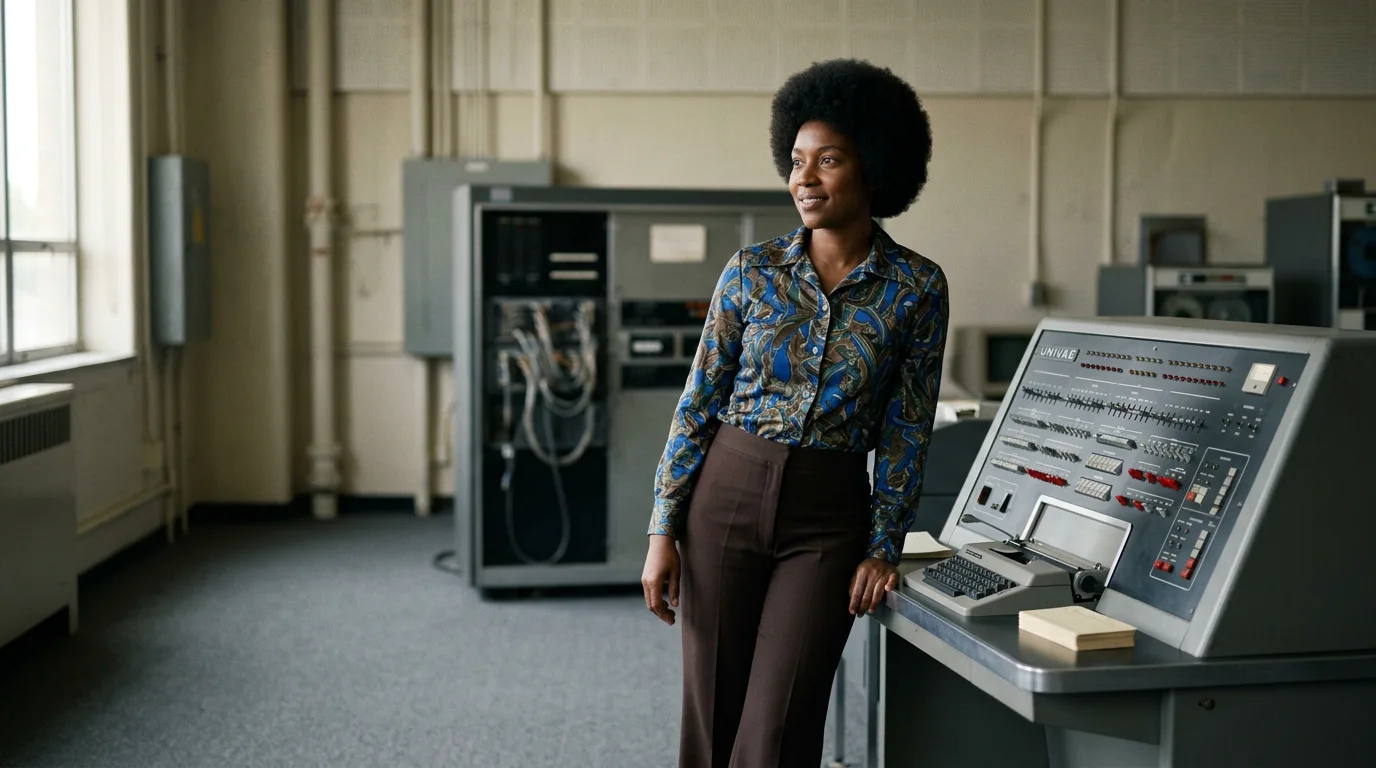
NASA photographs show her beside a UNIVAC 1100/40 computer in 1976, a real machine from her working era.
A NASA photograph records her receiving a Special Achievement Award at the centre in June 1970.
In 1970, she and a colleague challenged workplace clothing expectations by wearing trouser suits to work.
Timeline
Born in Birmingham, Alabama, United States.
Joined NACA's Cleveland laboratory as a human computer.
Her workplace became part of NASA when the space agency was founded.
Received a Special Achievement Award at NASA's Lewis Research Center.
Was photographed working beside a UNIVAC computer at NASA Lewis.
Earned a mathematics bachelor's degree from Cleveland State University.
Continued work in NASA's engineering and computing facilities and educational outreach.
Retired after thirty-four years with NACA and NASA.
Gave a detailed NASA oral-history interview about her career.
Died after a career in computing, engineering research and education.
Awards & honours
Related Super Scientists
Alan Turing
1912–1954 · Mathematician & Computer Scientist
Making foundational contributions to theoretical computer science and artificial intelligence, and playing a major role in Allied codebreaking during the Second World War.
Ada Lovelace
1815–1852 · Mathematician
Publishing influential 1843 Notes on Charles Babbage's Analytical Engine, including a detailed algorithm for calculating Bernoulli numbers and a visionary description of uses beyond arithmetic.