
Abu Rayhan al-Biruni
c. 973–after 1050 · Astronomy, mathematics, geodesy and history of science
Al-Biruni combined careful observation, mathematics and comparison to study astronomy, geography and the sciences of the medieval world.
“The rotation of the earth does in no way impair the value of astronomy.”
Why is this scientist famous?
Abu Rayhan al-Biruni was a scholar of astronomy, mathematics, geography and other sciences. He used observation and calculation to study the Earth and sky, and wrote detailed works comparing scientific and cultural knowledge across regions.
Al-Biruni’s work shows how scientific ideas travelled through translation, measurement and comparison. His geodesy and astronomical writing helped preserve and develop knowledge from Greek, Persian, Indian and Arabic-language traditions. Historians still study his books as evidence of the interconnected history of science.
Abu's story
A scholar from Khwarazm
Al-Biruni was born in or near Kath, in Khwarazm, a historical region around the Aral Sea. He studied mathematics, astronomy, medicine, language and other subjects, and learned from the mathematician and astronomer Abu Nasr Mansur. Modern national borders do not fit neatly onto his life: “Khwarazmian” describes his regional origin more accurately than assigning him a modern nationality. Sources agree on his birth around 973, although exact day and month claims are not secure enough for this biography. His death year is disputed: some sources give 1048, while Encyclopaedia Iranica notes evidence that he was still writing after 1050. The public date is therefore qualified rather than presented as a precise year.
Measuring place and sky
As a young scholar, al-Biruni calculated the latitude of Kath from the Sun’s altitude. He studied map projections, timekeeping, astronomical instruments and methods for locating places. In geodesy—the measurement of Earth’s shape and size—he described a way to estimate Earth’s radius using the height of a mountain and the angle at which the horizon appears from its summit. The method joined geometry with careful observation rather than relying only on inherited tables.
Learning across languages and traditions
Al-Biruni wrote mainly in Arabic, the major language of scholarship in much of the region, and also wrote in Persian. His works drew on Greek, Persian and Indian learning. In his book on India, he described religious practices, languages, mathematics and astronomy, often comparing texts rather than treating unfamiliar ideas as curiosities. His writing reflects the assumptions of his own time and should be read critically, but it preserves important records of knowledge exchange.
Books designed to explain
Among his many works was Al-Tafhīm, a question-and-answer introduction to mathematics and astronomy composed in Arabic and Persian versions. He also wrote a major astronomical work, al-Qānūn al-Masʿūdī, and books on chronology, mineralogy and pharmacology. Al-Biruni made lists of his own writings; a later scholarly catalogue estimates around 180 works, although many are lost. His range shows that medieval scholarship did not divide “science” into today’s separate university departments.
A legacy of method and comparison
Al-Biruni lived through political upheaval and spent much of his later career in the Ghaznavid court. He did not work with modern instruments or concepts, and it would be misleading to describe him as a scientist in the present-day institutional sense. Yet his habit of stating where information came from, comparing accounts and testing measurements remains of interest to historians. His books are valuable both for their calculations and for the evidence they preserve about scientific traditions across Central and South Asia.
What did they discover?
Geodesy
Described a trigonometric approach to estimating Earth’s radius from mountain height and the observed dip of the horizon.
Astronomical observation
Calculated latitude and compiled detailed astronomical tables and observations.
Mathematics and instruments
Wrote about geometry, map projections, astrolabes, timekeeping and mathematical methods.
Comparative scholarship
Recorded and compared Indian scientific and cultural traditions with other bodies of knowledge, preserving material that might otherwise have been lost.
Science education
Wrote Al-Tafhīm in a question-and-answer form to introduce mathematical and astronomical ideas.
Amazing facts
By about age 17, al-Biruni was already using observations of the Sun to calculate the latitude of Kath.
He studied map projections while still a young scholar and discussed methods developed by earlier geographers.
His method for estimating Earth’s radius used a mountain, its height and the angle of the horizon, turning a local observation into a measurement of the planet.
One specialist history gives his estimate of Earth’s radius as about 6,340 kilometres, close to the modern mean radius, though the exact value depends on which reconstruction of his calculation is used.
He wrote most of his scientific works in Arabic but also composed a major teaching work in Persian, helping develop scientific writing in that language.
Al-Tafhīm was framed as questions and answers, an accessible format for explaining astronomy and mathematics to learners.
In his work on India, he compared written sources and learned about Sanskrit scholarship rather than relying only on second-hand stories.
Al-Biruni’s own bibliography listed 103 completed works and 10 unfinished ones by 1036; later scholars have estimated around 180 works in total.
His writings covered subjects now separated into astronomy, mathematics, geography, mineralogy, pharmacology, history and linguistics.
Timeline
Born in the region of Kath, Khwarazm (c. 973); exact day and month are uncertain
Calculates the latitude of Kath from solar observations (c. 990)
Writes early works on map projections and related mathematical topics (before 995)
Continues research amid political upheaval in Khwarazm and the wider region (early 11th century)
Composes Al-Tafhīm, an introduction to mathematics and astronomy in Arabic and Persian versions (c. 1029)
Completes major works on India and astronomy, including al-Qānūn al-Masʿūdī
Lists 103 completed and 10 unfinished works in a bibliography of his writings
Probably dies in Ghazni (after 1050, date disputed); some reference works give 1048, while other evidence places his final work after 1050
Related Super Scientists
Pythagoras
c. 570 BCE–c. 490 BCE · Mathematician and Philosopher
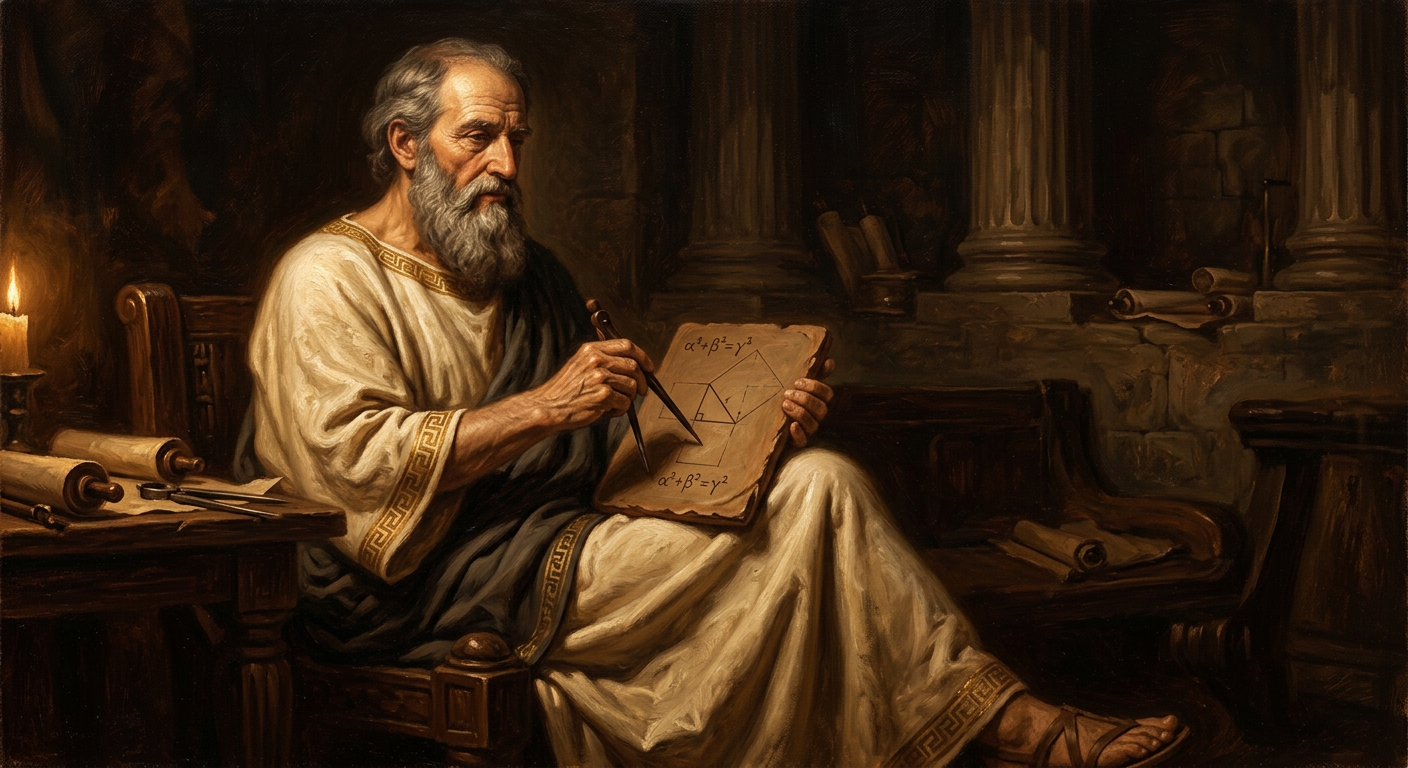
Pythagoras is famous for the theorem that bears his name: in a right-angled triangle, a² + b² = c². The mathematical relationship was known in earlier cultures, and historians cannot prove that Pythagoras himself discovered or first proved it. His school nevertheless became highly influential in the history of mathematics, music, philosophy and the idea that patterns in nature can be understood using numbers.
Ibn al-Haytham
c. 965–1040 · Mathematician, Physicist & Astronomer
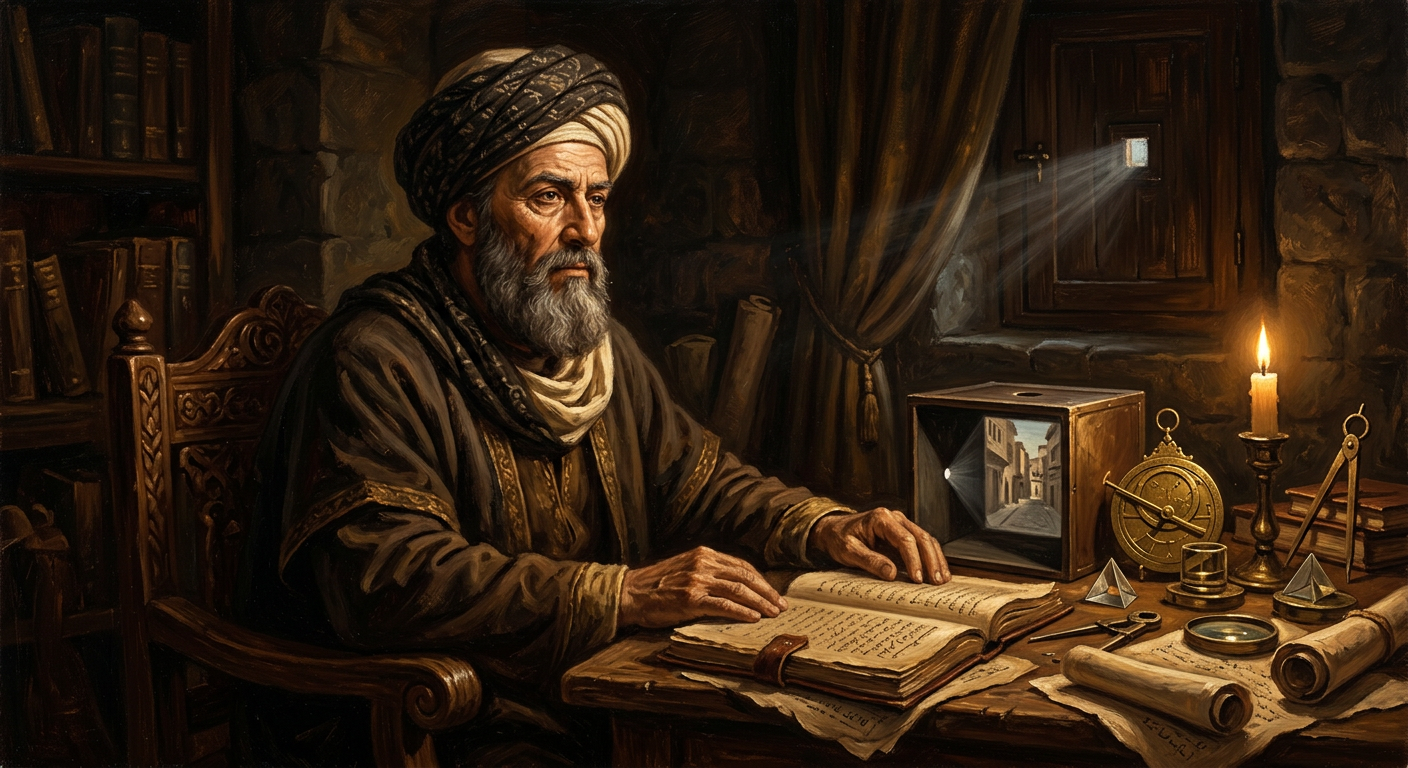
Transforming the study of optics through his Book of Optics and pioneering a rigorous experimental and mathematical approach to investigating light and vision.
Leonardo da Vinci
1452–1519 · Polymath: Artist, Engineer, Anatomist, and Inventor
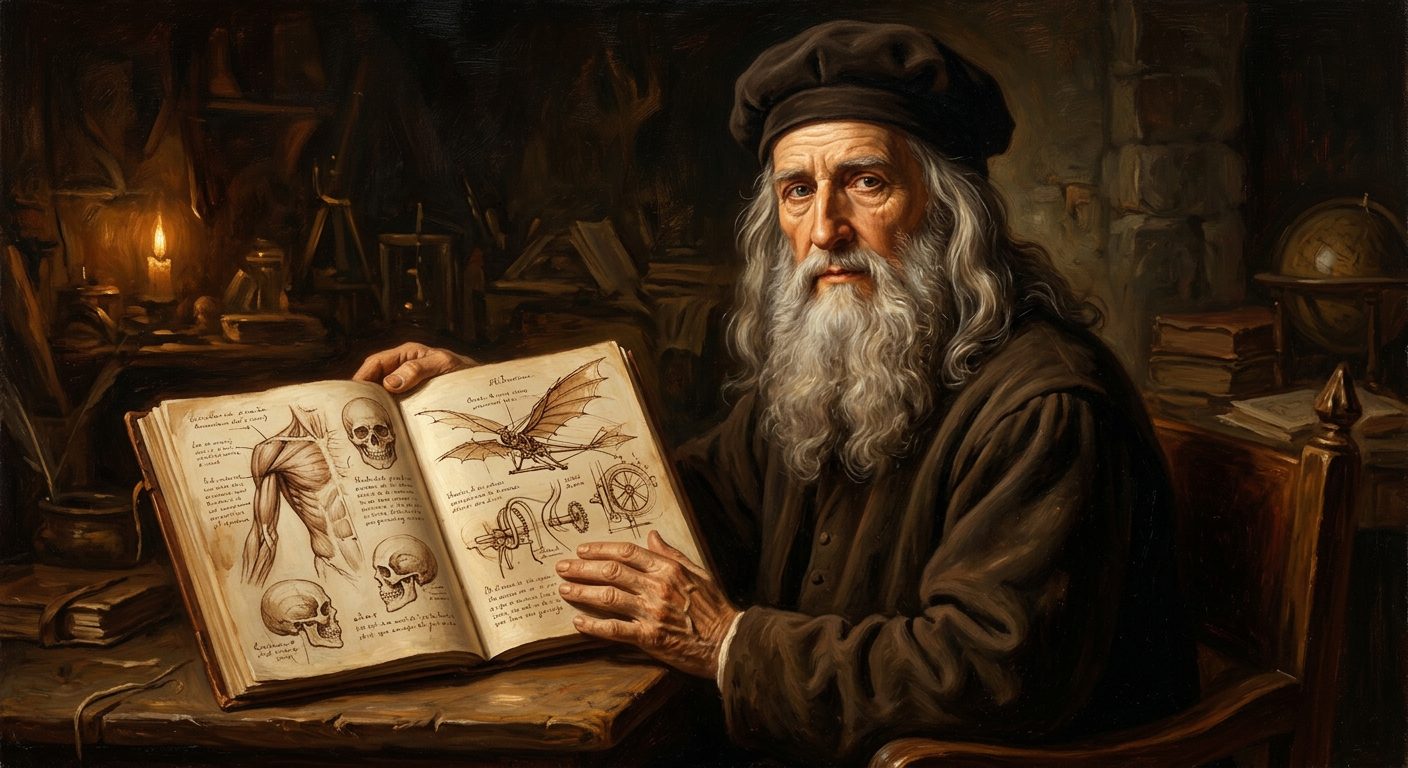
Combining extraordinary artistic achievement with wide-ranging investigations of anatomy, engineering, mechanics and the natural world, recorded in thousands of drawings and notes.
Sources & references
- Bīrūnī, Abū Rayḥān — i. Life, Encyclopaedia Iranica
- Al-Biruni, MacTutor History of Mathematics, University of St Andrews (reports 1048; exact death year is disputed)
- Al-Biruni, a universal genius in Central Asia a thousand years ago, The UNESCO Courier (1974)
- Alberuni’s India, translated by Eduard Sachau (1910 edition; primary text in translation)