_(2).jpg)
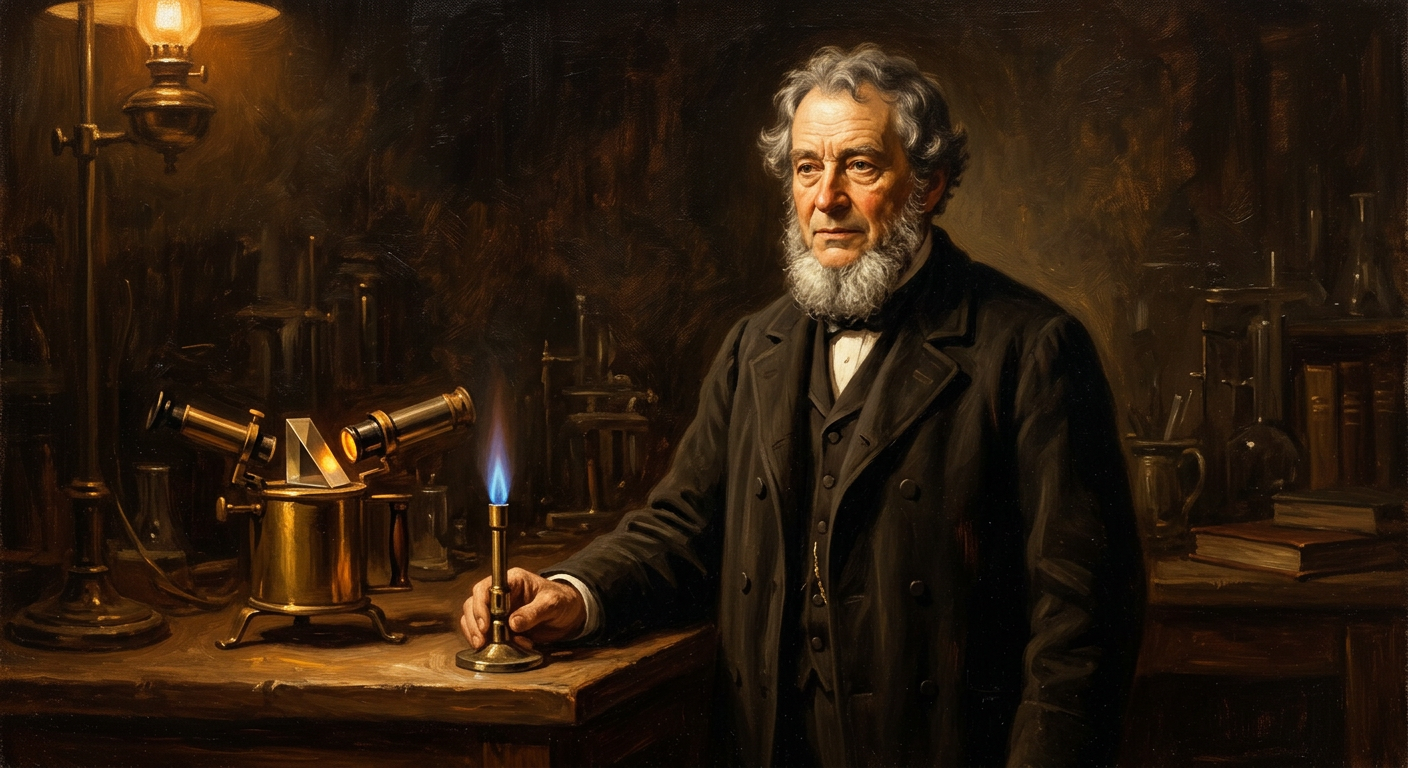
Robert Bunsen
1811–1899 · Chemist
A German chemist whose name is familiar to every child who has ever used a Bunsen burner in a school science lab.
Bunsen lost the sight in his right eye in a laboratory explosion and nearly died from arsenic poisoning — but he kept experimenting with dangerous substances anyway.
Why is this scientist famous?
Invented the Bunsen burner and co-discovered the elements caesium and rubidium using spectroscopy.
Robert's story
A Young Professor in Göttingen
Robert Wilhelm Eberhard Bunsen was born in 1811 in Göttingen, Germany, the youngest of four sons in a well-educated family. His father was a professor of modern languages at the University of Göttingen. Robert grew up in an academic household and showed an early talent for chemistry. He studied at the University of Göttingen, where he earned his doctorate at the age of nineteen. After travelling through Germany, France, and Austria to visit laboratories and meet other chemists, he took up a teaching post at the University of Göttingen in 1834. He quickly built a reputation as a brilliant experimentalist with a fearless approach to dangerous chemicals. One of his early projects was investigating arsenic compounds called cacodyl derivatives, which were so toxic and explosive that several chemists had been killed studying them. Bunsen pressed ahead anyway. He lost the sight in his right eye when a cacodyl cyanide compound exploded in his face, and he nearly died of arsenic poisoning on at least two occasions. He described the symptoms of arsenic poisoning from his own experience in a scientific paper — a contribution that was useful to medicine as well as chemistry.
The Bunsen Burner
In 1852, Bunsen was appointed professor of chemistry at the University of Heidelberg, one of the most prestigious scientific institutions in Germany. He wanted to study the chemical reactions that take place at very high temperatures, but the laboratory burners available at the time produced a smoky, sooty flame that was too dirty and too cool for his experiments. Working with his laboratory technician Peter Desaga, Bunsen designed a new type of burner that mixed gas with air before burning it, producing a clean, hot, nearly invisible blue flame. This was the Bunsen burner — a device so simple, reliable, and useful that it became standard equipment in every chemistry laboratory in the world, and remains so today. Every child who has ever adjusted the air hole on a Bunsen burner to change the flame from orange to blue has used Bunsen’s invention. But the burner was just a tool — Bunsen built it to do the science he really cared about: studying what substances are made of by analysing the light they give off when they burn.
Spectroscopy and New Elements
Bunsen noticed that different chemicals produced different colours when heated in a flame — sodium gave a bright yellow, potassium a lilac, calcium a brick red. But distinguishing between similar colours was difficult with the naked eye. In 1859, he teamed up with a physicist colleague, Gustav Kirchhoff, who suggested using a prism to split the light into its component colours, producing a spectrum with characteristic dark or bright lines for each element. Together, they invented the spectroscope — an instrument that could identify elements by the unique pattern of light they emitted. It was one of the most powerful analytical tools ever invented, and it is still used today. Using the spectroscope, Bunsen and Kirchhoff discovered two entirely new elements that no one had ever seen before. In 1860, they detected a bright blue line in the spectrum of a mineral water from Durkheim — a line that belonged to no known element. They named the new element caesium, from the Latin word for sky blue. The following year, they found a dark red line in the same mineral water and named the second new element rubidium, from the Latin word for deepest red. The discovery of two new elements from mineral water was astonishing, and it demonstrated the incredible power of spectroscopy.
A Life of Quiet Generosity
Bunsen was one of the most admired and beloved teachers of his generation. He was known for his kindness, his wit, and his generosity to students — he never patented any of his inventions, including the Bunsen burner, because he believed science should serve everyone. He taught at Heidelberg for thirty-seven years and trained a generation of chemists who went on to lead laboratories across Europe. He never married, devoting his life entirely to science and his students. In his later years, he gradually lost his sight — a cruel affliction for a man who had spent his life observing the colours of burning elements — but he continued to work and teach with the help of assistants. He died peacefully in 1899, aged eighty-eight, in Heidelberg. He had never sought fame or fortune, and he refused most of the honours offered to him. But his name became one of the most famous in science — not because of a great theory, but because of a simple, beautiful blue flame that sits on the bench of every chemistry classroom in the world.
What did they discover?
The Bunsen Burner
Bunsen designed a laboratory burner that mixes gas with air to produce a clean, hot, blue flame. It became the standard heat source in every chemistry laboratory worldwide and is still used in classrooms today.
Invention of the Spectroscope
With Gustav Kirchhoff, Bunsen invented the spectroscope, an instrument that identifies elements by splitting the light they emit into a spectrum. It revolutionised chemical analysis and is still used in laboratories and astronomy today.
Discovery of Caesium and Rubidium
Using the spectroscope, Bunsen and Kirchhoff discovered two new elements in 1860 and 1861 — caesium (named for its blue spectral line) and rubidium (named for its red line). It was the first time new elements were discovered by their light.
Photochemical Research with Hugo von Roscoe
Bunsen collaborated with the physicist H. E. Roscoe on the chemistry of light, measuring how light drives chemical reactions and laying early foundations for photochemistry.
Amazing facts
Bunsen lost the sight in his right eye in a laboratory explosion involving an arsenic compound.
He never patented the Bunsen burner or any of his inventions, believing that science should be freely available to everyone.
He and Kirchhoff discovered caesium and rubidium by analysing the light given off by mineral water from a spa in Durkheim.
Caesium was named after the Latin word for sky blue, and rubidium after the Latin for deepest red — the colours of their spectral lines.
He taught at the University of Heidelberg for thirty-seven years and trained many of Europe’s leading chemists.
He never married and devoted his life entirely to science and his students.
Timeline
Born in Göttingen, Germany
Earns his doctorate in chemistry at the University of Göttingen at age nineteen
Begins teaching at the University of Göttingen and begins dangerous experiments with arsenic compounds
Appointed professor at the University of Marburg
Appointed professor of chemistry at the University of Heidelberg
Invents the Bunsen burner with his laboratory technician Peter Desaga
Invents the spectroscope with Gustav Kirchhoff
Discovers the element caesium using spectroscopy
Discovers the element rubidium
Elected a Fellow of the Royal Society
Awarded the Davy Medal jointly with Gustav Kirchhoff
Dies in Heidelberg, aged 88
Awards & honours
Related Super Scientists
Dmitri Mendeleev
1834–1907 · Chemist & Inventor
Created the Periodic Table of Elements and predicted the existence of undiscovered elements.
Fritz Haber
1868–1934 · Physical Chemist
A brilliant chemist who discovered how to make fertiliser from air, saving billions from starvation — and then turned his genius to poison gas, creating chemical warfare.
Marie Curie
1867–1934 · Physicist & Chemist
Discovering radioactivity and two new elements: radium and polonium.
Sources & references
Books and educational kits about Robert Bunsen coming soon