_(2).jpg)
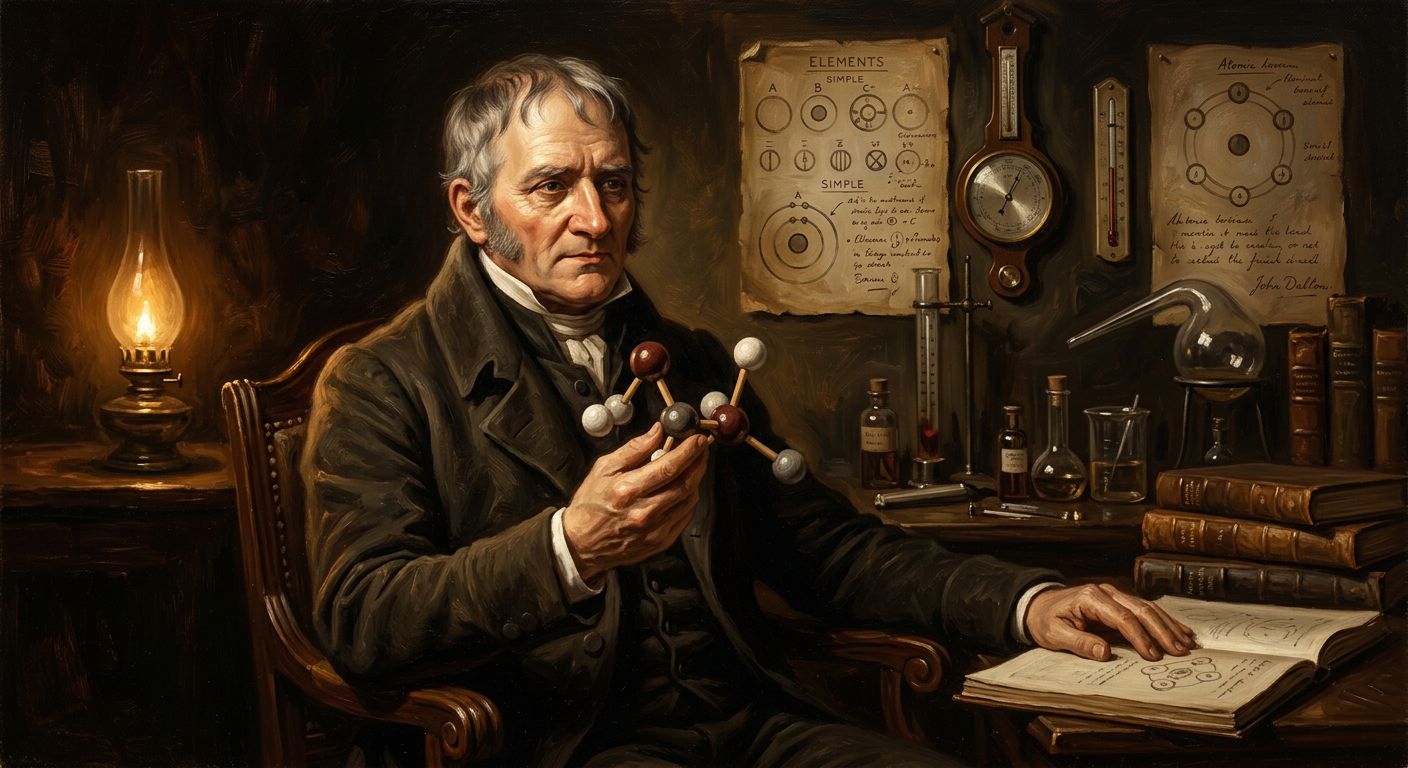
John Dalton
1766–1844 · Chemist
An English chemist who revived the ancient idea of atoms and gave it a scientific foundation, while also describing the condition he himself had: colour blindness.
“To chew well, I eat, and to think well, I ponder.”
Dalton was colourblind himself and asked a friend to examine his own eyeball after his death to find the cause — unfortunately, the examination found nothing unusual.
Why is this scientist famous?
Proposed that all matter is made of atoms and was the first to describe colour blindness.
John's story
A Quaker Boy from the Lakes
John Dalton was born in 1766 in the small village of Eaglesfield, in the Lake District of north-west England. His family were Quakers — a religious group that was treated with suspicion at the time and barred from attending the great universities of Oxford and Cambridge. Dalton’s father was a poor weaver who could barely afford to send his children to school. From the age of eleven, John was earning his keep as a teaching assistant at the local Quaker school. He was a quiet, serious boy with an insatiable curiosity about the natural world. At fifteen, he and his older brother took over the running of a Quaker school in the nearby town of Kendal. Dalton had almost no access to formal scientific education, but he read voraciously and taught himself mathematics, meteorology, and Latin. He kept a weather diary every single day for fifty-seven years, right up to the day he died — a habit that trained him to think like a scientist: observe, measure, record, look for patterns.
Colour Blindness and the Quaker Scholar
In 1793 Dalton moved to Manchester to teach mathematics at a dissenting academy called New College. Manchester was a booming industrial city, full of factories, smoke, and new wealth — a place where practical science was valued. Dalton continued his weather observations and began lecturing on topics from grammar to mechanics. It was around this time that he realised he saw colours differently from other people. He confused red with green and thought a red academic gown was grey. He investigated the condition carefully, even writing a scientific paper about it in 1794. For a long time, colour blindness was known as “Daltonism”, and in some languages it still is. Dalton suspected the cause lay in the fluid inside his eyeball, which he believed was tinted blue. He asked his assistant to dissect his eyes after his death and check. The fluid turned out to be perfectly normal — Dalton’s theory was wrong — but his careful study of his own condition was one of the first scientific descriptions of colour blindness ever published.
The Atomic Theory
Dalton’s most important work grew out of his weather studies. He had been investigating how gases mix and how water evaporates into air, and he realised that gases must be made of tiny separate particles that combine in fixed proportions. In 1803, he proposed something radical: that every element — hydrogen, oxygen, carbon, gold, and so on — is made of tiny, indivisible particles called atoms, and that all the atoms of a given element are identical in weight. He argued that chemical reactions are simply atoms rearranging themselves into new combinations. This was not a completely new idea — the ancient Greek philosopher Democritus had proposed atoms two thousand years earlier — but Dalton was the first to turn it into a proper scientific theory with measurable predictions. He even tried to work out the relative weights of different atoms, creating the first table of atomic weights. In 1808 he published his book A New System of Chemical Philosophy, setting out the theory in full. It was not perfect — some of his weights were wrong, and atoms turned out to be divisible after all — but the core idea transformed chemistry from a collection of observations into a science with a solid theoretical foundation.
A Life of Quiet Devotion
Dalton never married and lived a frugal, disciplined life devoted almost entirely to science. He was famously plain in his habits — he wore Quaker clothing throughout his life and once refused a nomination to the Royal Society because he thought it would cost too much. He was eventually elected a Fellow in 1822 anyway, and went on to receive many honours, including a government pension. In his later years he became something of a Manchester institution. He continued his daily weather observations and his teaching, and would walk the streets of Manchester with a small umbrella regardless of the weather. He died in 1844, aged 77, and was given a public funeral attended by an estimated 40,000 people — an extraordinary tribute for a quiet Quaker schoolteacher. His atomic theory remains the foundation of all chemistry teaching today: every child who learns that everything is made of atoms is learning a idea that John Dalton first turned from philosophy into science.
What did they discover?
Atomic Theory
Dalton proposed that all matter is made of tiny particles called atoms, that atoms of the same element are identical, and that chemical reactions are atoms rearranging into new combinations. This transformed chemistry from observation into a theoretical science.
First Table of Atomic Weights
He produced the first table comparing the relative weights of different atoms, allowing chemists to predict how elements would combine. Though some values were incorrect, the approach was revolutionary.
Scientific Description of Colour Blindness
Dalton was the first to carefully study and describe colour blindness, a condition he had himself. His 1794 paper was one of the earliest scientific accounts of the condition, which became known as “Daltonism”.
Law of Partial Pressures
He discovered that in a mixture of gases, each gas exerts pressure independently of the others — now known as Dalton’s Law. It is still used in chemistry and physics today.
Amazing facts
Dalton kept a daily weather diary for fifty-seven years, from 1787 until the day he died, recording over 200,000 observations.
He could not attend Oxford or Cambridge because Quakers were barred from both universities at the time.
Colour blindness is still called “Daltonism” in several languages, including French and Russian.
He asked his assistant to dissect his eyeball after his death to test his theory about the cause of colour blindness — the fluid was perfectly normal.
He once turned down a nomination to the Royal Society because he thought the membership fee was too expensive.
An estimated 40,000 people attended his funeral in Manchester in 1844.
Timeline
Born in Eaglesfield, Cumberland, England
Begins teaching at a Quaker school in Eaglesfield at age twelve
Takes over a school in Kendal with his brother; begins daily weather diary
Moves to Manchester to teach at New College and joins the Literary and Philosophical Society
Publishes first scientific description of colour blindness
Formulates the Law of Partial Pressures for gases
First proposes the atomic theory and creates a table of atomic weights
Publishes A New System of Chemical Philosophy, setting out the atomic theory in full
Elected a Fellow of the Royal Society
Dies in Manchester, aged 77; his funeral is attended by 40,000 people
Awards & honours
Related Super Scientists
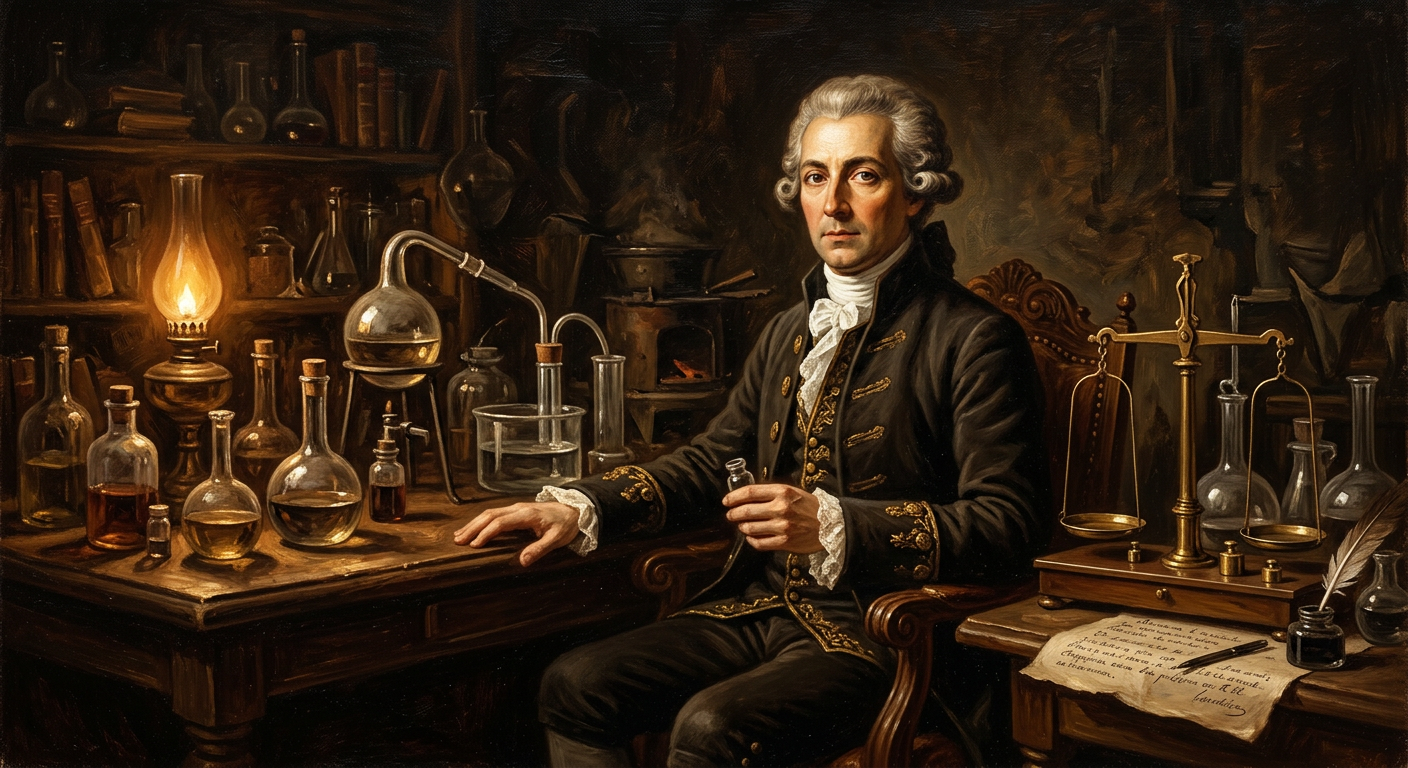
Antoine Lavoisier
1743–1794 · Chemist
The father of modern chemistry who overturned the phlogiston theory and established the law of conservation of mass.
Dmitri Mendeleev
1834–1907 · Chemist & Inventor
Created the Periodic Table of Elements and predicted the existence of undiscovered elements.
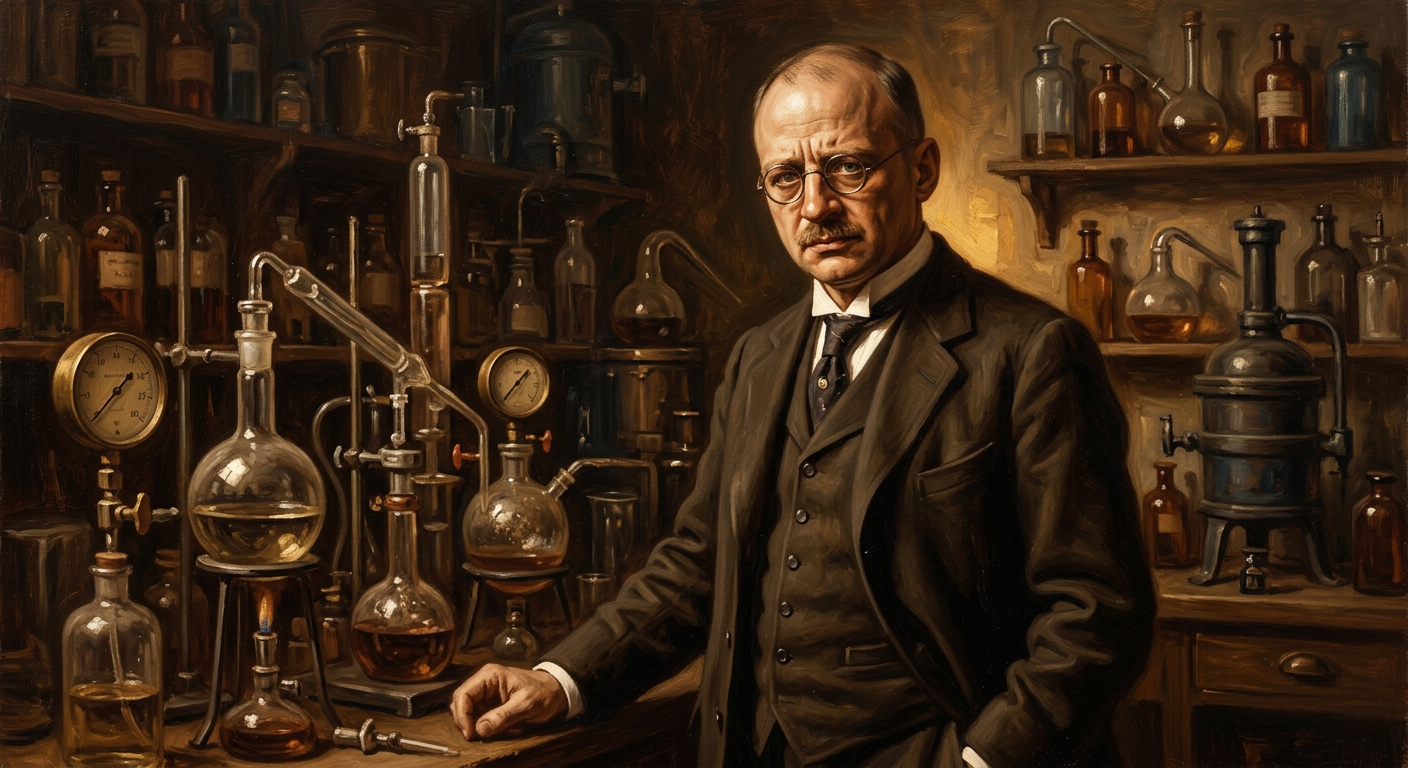
Fritz Haber
1868–1934 · Physical Chemist
A brilliant chemist who discovered how to make fertiliser from air, saving billions from starvation — and then turned his genius to poison gas, creating chemical warfare.
Sources & references
Books and educational kits about John Dalton coming soon