_(2).jpg)
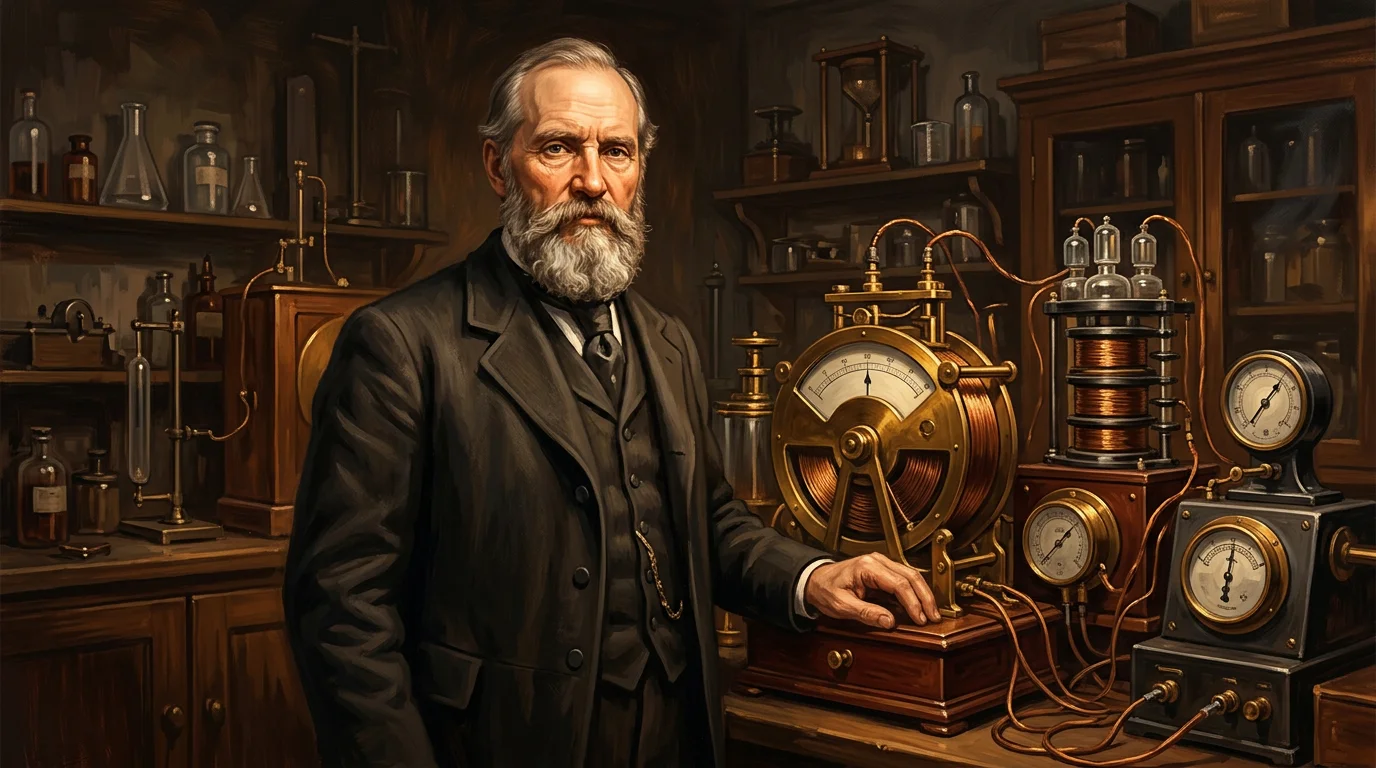
William Thomson, Lord Kelvin
1824–1907 · Physicist and Engineer
A prodigy who became one of the most influential physicists of the nineteenth century, uniting theory and engineering in ways that transformed both science and industry.
“When you can measure what you are speaking about, and express it in numbers, you know something about it.”
Kelvin was only 10 years old when he entered the University of Glasgow, and he published his first scientific paper at 16.
Why is this scientist famous?
Developed the absolute temperature scale measured in kelvins (K), made major contributions to thermodynamics, and played a key role in the laying of the transatlantic telegraph cable.
William's story
A Prodigy's Beginning
William Thomson was born in Belfast, Ireland, the son of a mathematics professor. His father taught at the Royal Belfast Academical Institution before being appointed to the University of Glasgow when William was still a child. The young Thomson showed staggering intellectual ability from an early age. He entered the University of Glasgow at the age of 10 — not unheard of in the Scottish system of the time, but remarkable even so — and soon excelled in mathematics and natural philosophy. His father recognised his genius and personally supervised his education, taking the family on tours of continental Europe so William could meet leading scientists and experience the best laboratories firsthand.
Cambridge and Paris
Thomson went to Cambridge University in 1841 to study mathematics, graduating as Second Wrangler — second in his year — in 1845. But Cambridge mathematics was abstract and purely theoretical, and Thomson yearned for experimental work. After graduation he went to Paris, where he worked in the laboratory of Victor Regnault, one of the leading experimental physicists of the day. The Paris experience transformed him. He learned the techniques of precise measurement and the French approach to mathematical physics, which combined rigorous theory with experiment. This combination of Cambridge mathematics and Parisian experimental technique made Thomson uniquely equipped to tackle the biggest unsolved problems in physics.
Professor at Glasgow
In 1846, at the age of just 22, Thomson was appointed to the chair of natural philosophy at the University of Glasgow, a position he would hold for 53 years. He transformed the department, creating one of the first purpose-built physics laboratories in any university. His approach was revolutionary: he insisted that students perform experiments as well as learn theory, and he filled his laboratory with the finest instruments available. Under his influence Glasgow became a leading centre for experimental physics. It was at Glasgow that Thomson did his most important theoretical work, particularly on thermodynamics and the absolute temperature scale.
The Absolute Temperature Scale
Thomson's most enduring contribution to science was the absolute temperature scale, which he proposed in 1848. Building on the work of Joule and Carnot, he realised that temperature could be defined in terms of energy alone, independent of the properties of any particular substance. The scale set absolute zero — the point at which all thermal motion stops — as its zero point. This scale, now measured in kelvins (K), is fundamental to physics and engineering. A temperature of 0 K is absolute zero, the coldest possible temperature in the universe, approximately minus 273.15 degrees Celsius. The Kelvin scale is used in every physics laboratory and in countless industrial processes worldwide.
The Transatlantic Telegraph
Thomson was not just a theorist — he was a practical engineer who solved real-world problems. His greatest engineering achievement was his role in the transatlantic telegraph cable, which first connected Europe and North America by instant communication in 1858. The project was an engineering nightmare: the cable was thousands of miles long, and electrical signals weakened and distorted over such distances. Thomson designed a sensitive mirror galvanometer that could detect the faint signals arriving from across the Atlantic, making the system practical. He was knighted for his work on the cable in 1866, and later elevated to the peerage as Baron Kelvin in 1892, taking his title from the River Kelvin that flowed past his laboratory at Glasgow.
Legacy
Thomson died in 1907 at the age of 83, having been one of the most famous and honoured scientists of the Victorian age. He was buried in Westminster Abbey near Isaac Newton. The Kelvin temperature scale, the unit of temperature measured in kelvins, and his numerous contributions to thermodynamics, electromagnetism, and engineering all endure. He was one of the last great classical physicists — a man who could design a delicate instrument in the morning, derive a mathematical theorem in the afternoon, and solve a cable-laying problem in the evening. Though some of his later pronouncements about the age of the Earth and the limits of physics proved wrong, his confidence in measurement and experiment set the standard for physics for generations.
What did they discover?
The Absolute Temperature Scale
Proposed in 1848, the Kelvin scale defines temperature in terms of absolute zero — the point where all thermal motion stops. It is the SI unit of temperature, used in every physics laboratory and essential to thermodynamics, cryogenics, and materials science.
The Transatlantic Telegraph Cable
Thomson designed the mirror galvanometer that detected the faint electrical signals sent across the Atlantic, making the first transatlantic telegraph cable practical in 1858. This achievement connected Europe and North America with instant communication for the first time.
The Second Law of Thermodynamics
Thomson was one of the first to formulate the second law of thermodynamics — the principle that heat always flows from hot to cold and that no process can convert all heat into work. This law underlies our understanding of engines, refrigerators, and the arrow of time itself.
The Mirror Galvanometer
His sensitive galvanometer used a tiny mirror attached to a magnet suspended by a silk fibre, reflecting a beam of light to magnify tiny electrical currents. It was the key instrument that made long-distance telegraphy possible and a masterpiece of precision engineering.
Amazing facts
Kelvin entered the University of Glasgow at the age of 10 and published his first scientific paper at 16.
He held the chair of natural philosophy at Glasgow for 53 years, from age 22 until his retirement at 75.
He was elevated to the peerage as Baron Kelvin in 1892 — his title came from the River Kelvin that flowed past his Glasgow laboratory.
He is buried in Westminster Abbey near Sir Isaac Newton, one of the few scientists given that honour.
Kelvin's mirror galvanometer could detect electrical currents so faint that no previous instrument could measure them — it made transatlantic telegraphy possible.
He estimated the Earth's age at between 20 and 400 million years based on its cooling rate, a calculation later overturned by the discovery of radioactivity, which provides the Earth's internal heat.
His famous dictum about measurement — 'When you can measure what you are speaking about, and express it in numbers, you know something about it' — remains a guiding principle of experimental physics.
Timeline
Born in Belfast, Ireland
Entered the University of Glasgow at the age of 10
Went to Cambridge University to study mathematics
Graduated from Cambridge and went to Paris to work in Regnault's laboratory
Appointed professor of natural philosophy at the University of Glasgow, aged 22
Proposed the absolute temperature scale, later named the Kelvin scale
Contributed to the first successful transatlantic telegraph cable
Knighted for his work on the transatlantic cable
Elevated to the peerage as Baron Kelvin of Largs
Died in Largs, Ayrshire, Scotland, aged 83
Awards & honours
Related Super Scientists
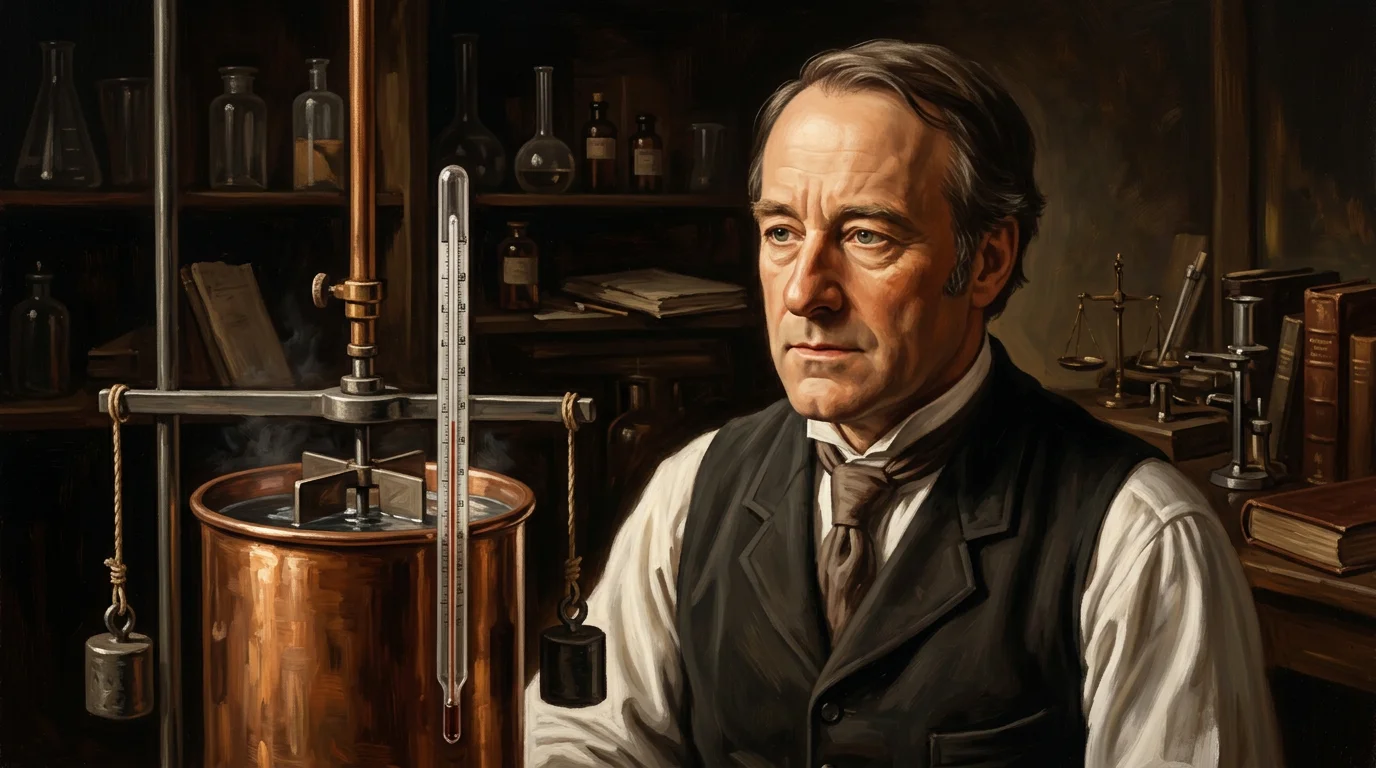
James Prescott Joule
1818–1889 · Physicist
Showed that heat is a form of energy and established the mechanical equivalent of heat. The SI unit of energy, the joule (J), is named after him.
Michael Faraday
1791–1867 · Physicist & Chemist
Discovered electromagnetic induction and built the first electric motor and generator.
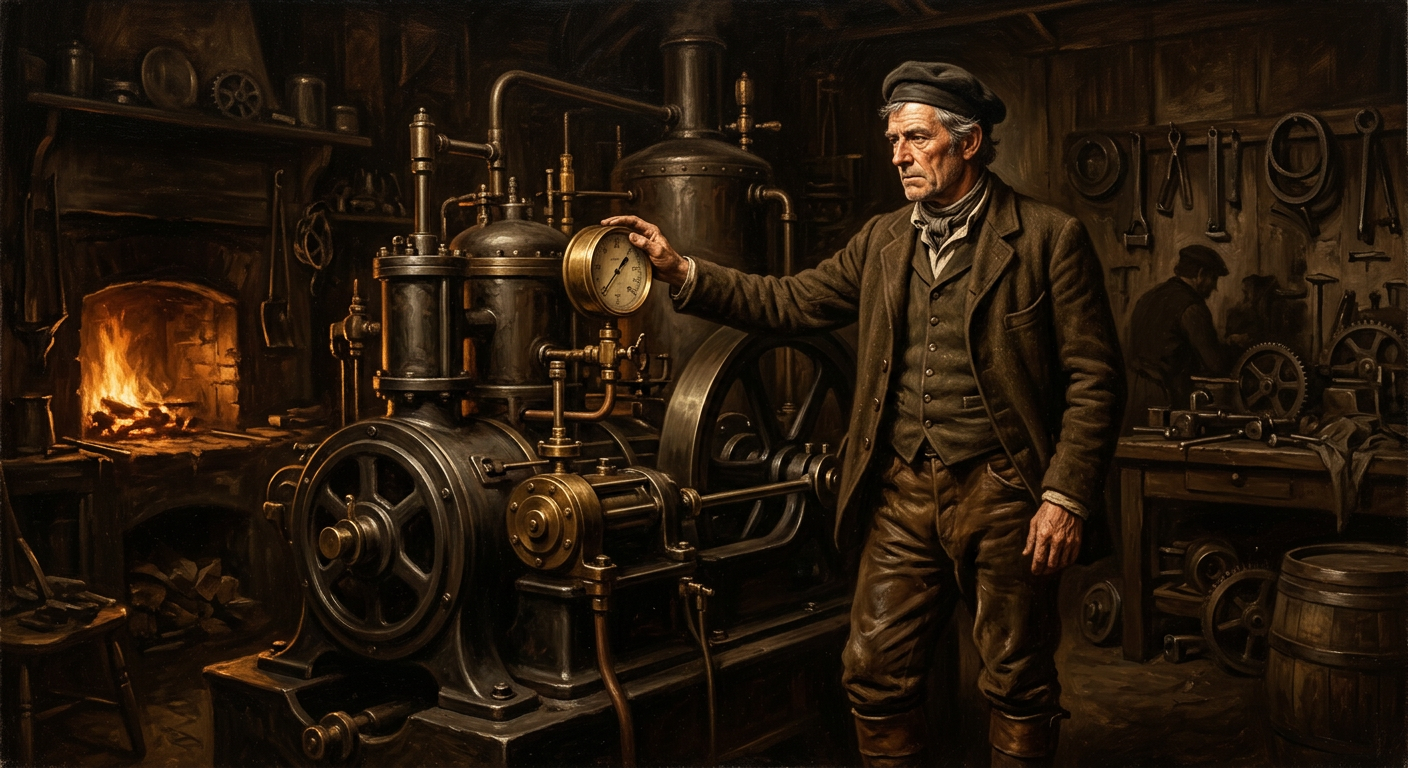
James Watt
1736–1819 · Engineer & Inventor
Improving the steam engine so dramatically that his work powered the Industrial Revolution.
Sources & references
Books and educational kits about William Thomson, Lord Kelvin coming soon