_(2).jpg)
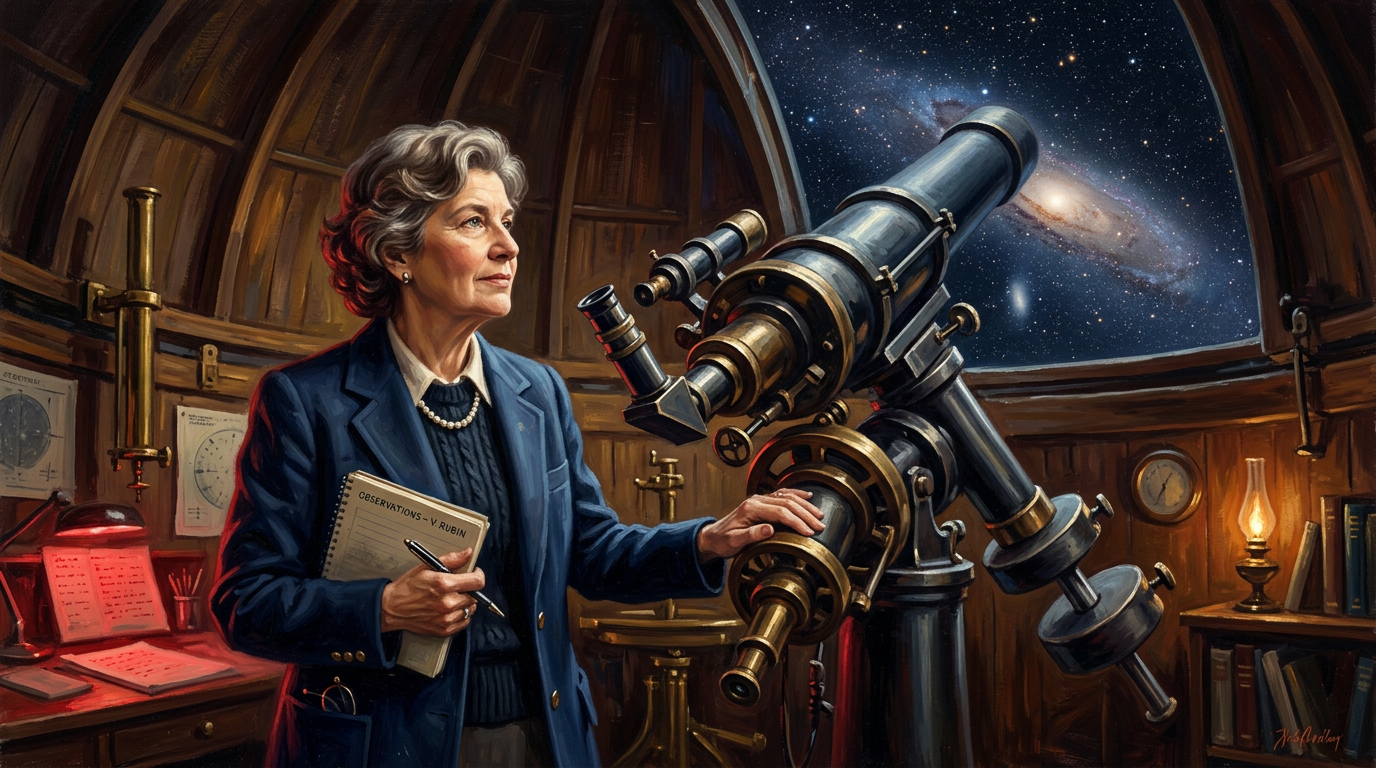
Vera Rubin
1928–2016 · Astronomer
Vera Rubin was an American astronomer whose careful measurements of how stars move inside galaxies showed that the universe contains far more matter than we can see — the first strong evidence for dark matter.
“There is no science question that is not answerable.”
Vera Rubin never won a Nobel Prize, even though her galaxy rotation measurements provided the most compelling evidence for dark matter — one of the greatest discoveries in 20th-century astronomy.
Why is this scientist famous?
Providing the most compelling early evidence for the existence of dark matter through galaxy rotation measurements.
Vera Rubin found strong evidence that most of the universe is made of invisible "dark matter" by measuring how fast stars in galaxies rotate. Without dark matter, galaxies would fly apart. Her discovery changed cosmology forever and remains one of the biggest unsolved mysteries in physics. Every search for dark matter — in underground detectors and particle colliders — follows the trail of her careful observations.
Vera's story
Early Life
Born in Philadelphia, Rubin developed a fascination with the night sky as a child, watching stars from her bedroom window in Washington, D.C. She built her own telescope with a cardboard tube and was the only astronomy major to graduate from Vassar College in 1948. She was rejected by Princeton's graduate programme because women were not accepted until 1975, and instead earned a PhD from Georgetown University in 1954 under George Gamow.
The Rotation Problem
In the 1970s, Rubin and instrument maker Kent Ford began measuring how stars orbit the centres of spiral galaxies. According to Newton's laws, stars far from the galactic centre should orbit much more slowly than stars near the centre — just as distant planets orbit the Sun more slowly. But Rubin found that outer stars moved just as fast as inner ones. The only explanation was that galaxies are surrounded by vast haloes of invisible matter — dark matter — whose gravity holds them together.
Champion of Women in Science
Rubin faced persistent barriers throughout her career. She was the first woman allowed to use the 200-inch Hale Telescope at Palomar Observatory in 1965 — previously reserved for men, with no women's restroom on site. She became a fierce advocate for women in astronomy, pushing for their inclusion in observatories, journals, and conferences. She once said that she hoped by the next century it would be unremarkable for a woman to win a Nobel Prize.
Legacy
Although she never received a Nobel Prize — a widely noted omission — Rubin's work transformed cosmology. Dark matter is now estimated to make up about 27 percent of the universe, and its nature remains one of the biggest unsolved problems in physics. The Vera C. Rubin Observatory in Chile, designed to map the entire night sky every few nights, is named in her honour. She died in 2016 at the age of 88.
What did they discover?
Galaxy Rotation Curves
Measured the orbital speeds of stars in spiral galaxies and found that they do not slow down at the edges, providing the most direct evidence that galaxies contain far more mass than is visible — dark matter.
Evidence for Dark Matter
Her observations showed that roughly 90 percent of a galaxy's mass is invisible, establishing dark matter as one of the central problems in modern astrophysics.
Galactic Structure Studies
Conducted some of the first systematic studies of how gas and stars are distributed in galaxies, advancing understanding of galactic dynamics.
Amazing facts
She was the first woman permitted to use the 200-inch Hale Telescope at Palomar Observatory.
Princeton's graduate astronomy programme rejected her because it did not accept women until 1975.
She never received a Nobel Prize, despite her work being one of the most important discoveries in 20th-century astronomy.
The Vera C. Rubin Observatory in Chile is named after her.
Asteroid 5726 Rubin is named in her honour.
She once said a satisfactory life is one where the number of women elected to the National Academy exceeds one per year.
Timeline
Born in Philadelphia, Pennsylvania
Graduated from Vassar College as the only astronomy major
Earned a PhD in astronomy from Georgetown University
Became the first woman to use the Palomar Observatory Hale Telescope
Published the first galaxy rotation curves revealing evidence for dark matter
Received the National Medal of Science
Awarded the Gold Medal of the Royal Astronomical Society — the first woman in 168 years
Died in Princeton, New Jersey, age 88
Awards & honours
Related Super Scientists
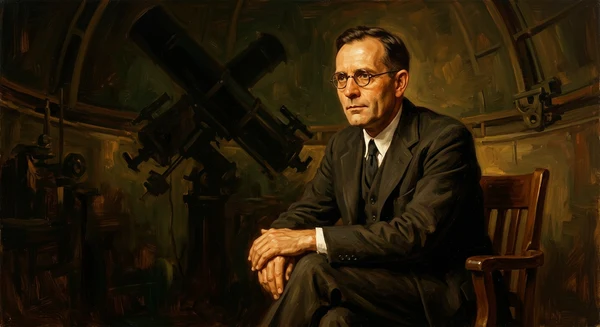
Edwin Hubble
1889–1953 · Astronomer
Proved that the universe is expanding and that other galaxies exist beyond our own.
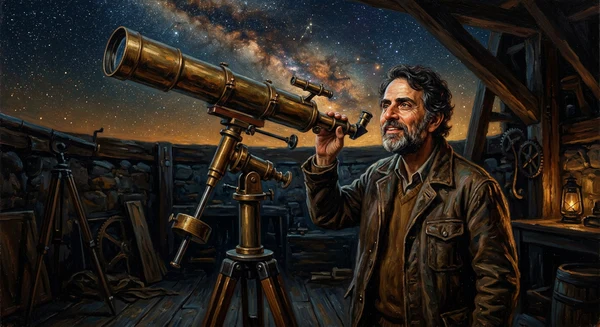
Carl Sagan
1934–1996 · Astronomer & Science Communicator
Created the Voyager Golden Record, wrote Cosmos, and inspired millions to love science.
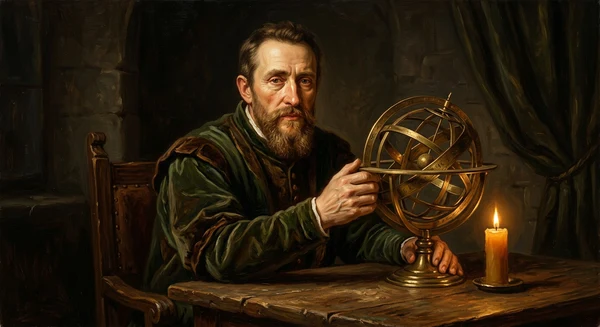
Johannes Kepler
1571–1630 · Astronomer & Mathematician
Discovered the three laws of planetary motion that proved planets orbit in ellipses, not circles.
Articles about this scientist
Sources & references
Books and educational kits about Vera Rubin coming soon