_(2).jpg)
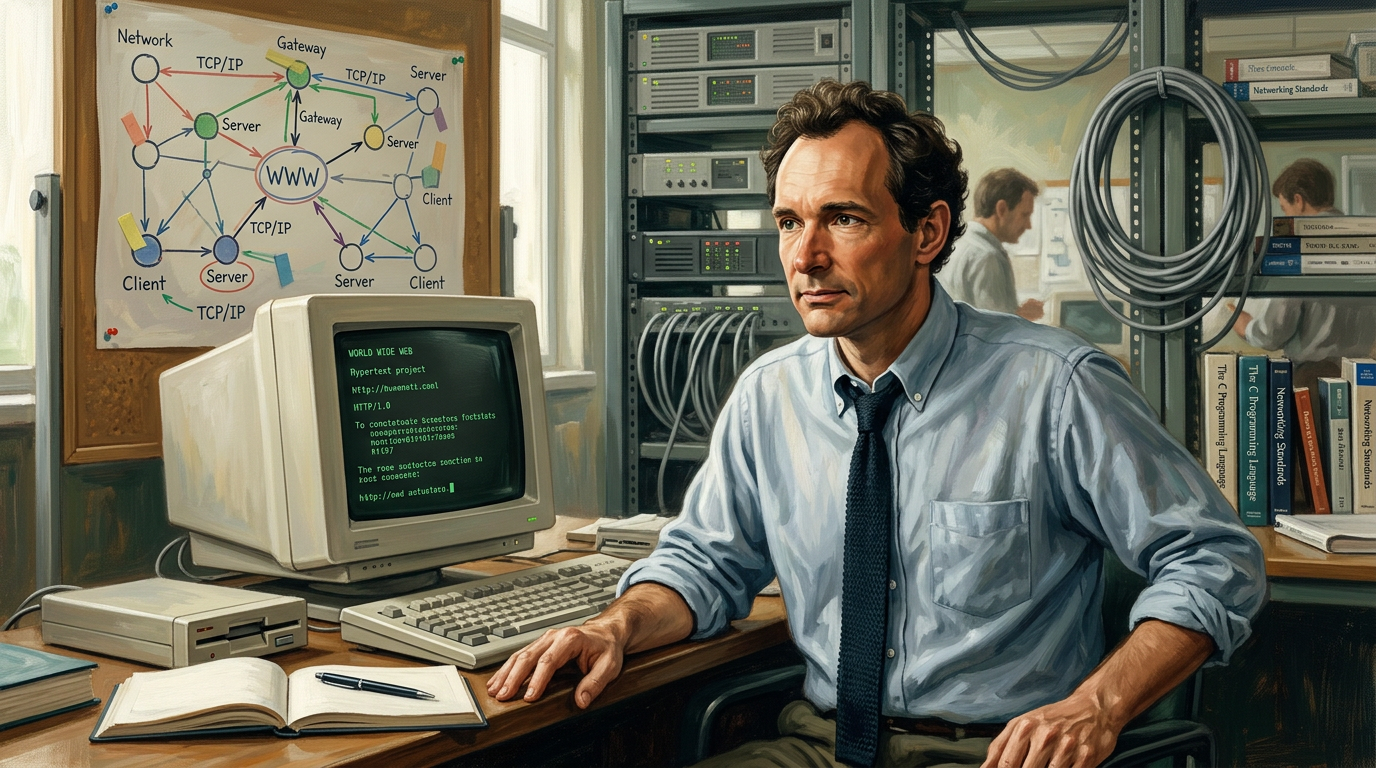
Tim Berners-Lee
1955–present · Computer scientist
Tim Berners-Lee is a British computer scientist who invented the World Wide Web in 1989, creating the system of linked documents that billions of people use every day, and chose to give it away freely.
“The Web is more a social creation than a technical one.”
Tim Berners-Lee invented the World Wide Web in 1989 and gave it away for free — if he had patented it, the web as we know it might never have existed.
Why is this scientist famous?
Inventing the World Wide Web and creating its foundational protocols, HTTP, HTML, and URLs.
Tim Berners-Lee invented the World Wide Web — the system of websites and links you are using right now. He gave it away for free so that anyone could use it. Every webpage, online store, and video stream exists because of his decision to share rather than patent. He believed the web should be open and free for everyone, a principle that still shapes debates about who controls the internet.
Tim's story
Early Life
Born in London, Berners-Lee grew up in a household where computing was part of daily life — both his parents had worked on the Ferranti Mark 1, one of the first commercial computers. He studied physics at the University of Oxford, graduating in 1976. While at Oxford he built his first computer out of an old television and a soldering iron, and was caught hacking — officially reprimanded but allowed to continue.
The Idea at CERN
In 1984 Berners-Lee took a position at CERN, the European particle physics laboratory in Switzerland. Frustrated by the difficulty of keeping track of information across different computers, he noticed that the growing internet already provided a way to send data between machines — what was missing was a way to link and organise information. In March 1989 he wrote a proposal for a 'mesh' of hypertext documents that could be browsed by anyone on the network. His supervisor scrawled 'vague but exciting' in the margin.
Building the Web
Over the next two years, Berners-Lee wrote the first web browser (which was also the first web editor), the first web server, HTTP, HTML, and the first web page — a simple text page at info.cern.ch explaining what the World Wide Web was. On 6 August 1991 the web was made publicly available. Crucially, Berners-Lee and CERN decided not to patent the technology, so it could be used freely by anyone — a decision that allowed the web to grow explosively.
Legacy
In 1994 Berners-Lee founded the World Wide Web Consortium (W3C) at MIT to develop open web standards and ensure the web remained free and interoperable. He was knighted by Queen Elizabeth II in 2004 and awarded the Turing Award in 2016. He has since campaigned for a free and open web, founding the Solid project to give users more control over their own data. He is a professor at MIT and Oxford, and remains a vocal advocate for the web as a public good.
What did they discover?
The World Wide Web
Invented the system of linked hypertext documents accessed via the internet, including the first web browser, first web server, and the first website at info.cern.ch.
HTTP and HTML
Created the HyperText Transfer Protocol (HTTP) and HyperText Markup Language (HTML), the foundational protocols and language that make web pages possible.
Uniform Resource Locators
Designed the URL addressing system that gives every resource on the web a unique, retrievable address.
Amazing facts
His supervisor at CERN wrote 'vague but exciting' on his original web proposal.
The first web page was simply a text document explaining what the World Wide Web was.
He and CERN decided not to patent the web, so it could be used freely by anyone.
He was knighted by Queen Elizabeth II in 2004.
He received the Turing Award, often called the Nobel Prize of computing, in 2016.
Both his parents worked on the Ferranti Mark 1, one of the first commercial computers.
Timeline
Born in London, England
Graduated in physics from the University of Oxford
Joined CERN as a software engineer
Wrote the proposal for the World Wide Web
Wrote the first web browser, web server, and web page
Made the World Wide Web publicly available
Founded the World Wide Web Consortium (W3C) at MIT
Knighted by Queen Elizabeth II
Received the Turing Award
Awards & honours
Related Super Scientists
Alan Turing
1912–1954 · Mathematician & Computer Scientist
Breaking Nazi codes and founding the science of artificial intelligence.
Ada Lovelace
1815–1852 · Mathematician
Writing the first computer algorithm, a century before electronic computers existed.
Grace Hopper
1906–1992 · Computer Scientist & Naval Admiral
Inventing the first compiler and making programming accessible with English-like languages.
Articles about this scientist
Sources & references
Books and educational kits about Tim Berners-Lee coming soon