_(2).jpg)
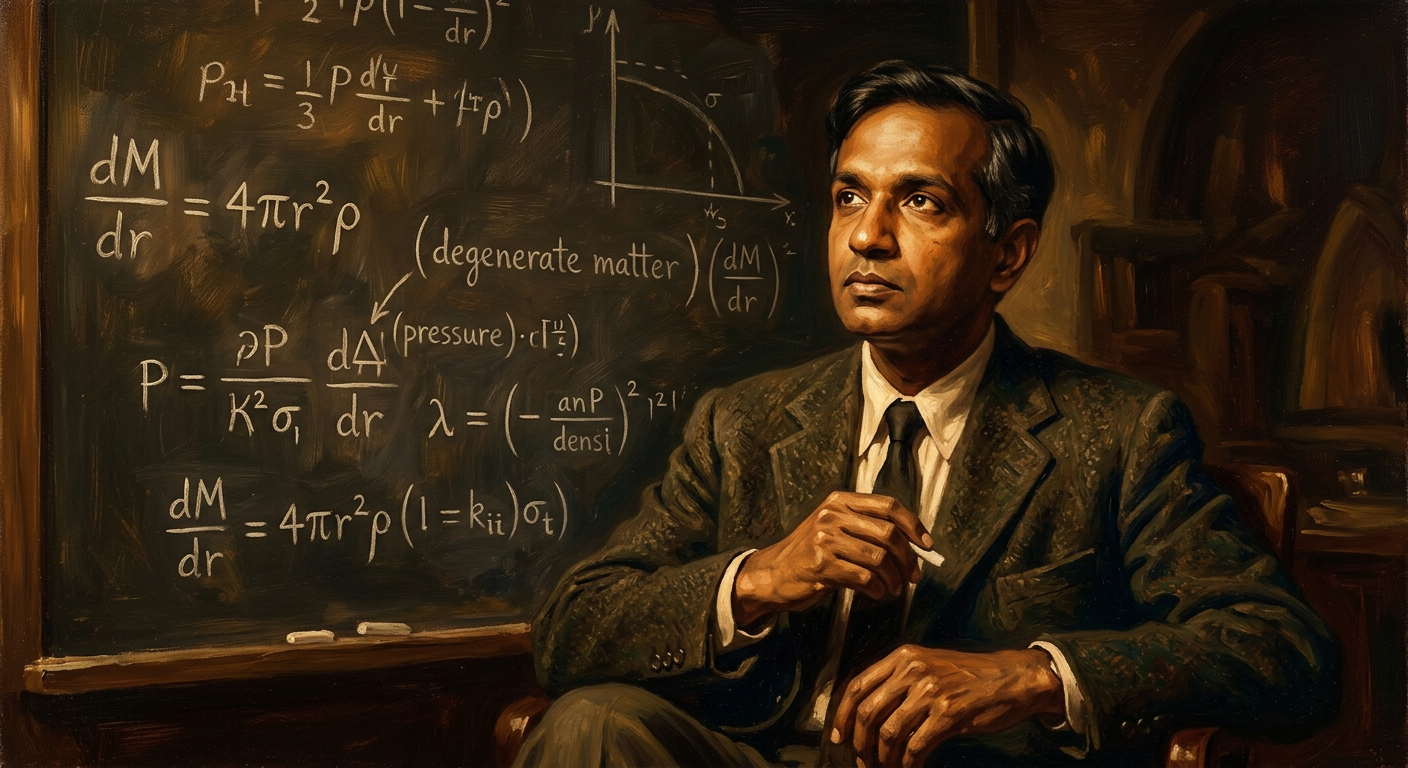
Subrahmanyan Chandrasekhar
1910–1995 · Astrophysicist
Subrahmanyan Chandrasekhar was a Nobel Prize-winning astrophysicist who worked out the fate of stars at age 19, was attacked for it by the leading astronomer of his day, and was vindicated decades later. NASA named a space telescope after him.
“The black holes of nature are the most perfect macroscopic objects there are in the universe: the only elements in their construction are our concepts of space and time.”
He worked out the Chandrasekhar limit — the maximum mass of a white dwarf star — at age 19, during a two-week sea voyage from India to Cambridge, and was attacked for it by the leading astronomer of his day.
Why is this scientist famous?
Discovering the Chandrasekhar limit, the maximum mass of a white dwarf star, and making fundamental contributions to our understanding of stellar evolution.
Subrahmanyan's story
A Prodigy from Lahore
Subrahmanyan Chandrasekhar was born on October 19, 1910, in Lahore, then part of British India and now in Pakistan. He came from a family of remarkable intellectuals. His father was a civil servant and scholar, his uncle was the Nobel Prize-winning physicist C. V. Raman, and his mother was a devoted pianist who encouraged his curiosity. Known to his family as ‘Chandra,’ he showed extraordinary mathematical talent from childhood. He read advanced physics textbooks on his own and by his teenage years was mastering the mathematics of quantum mechanics and relativity. He studied physics at Presidency College in Madras, now Chennai, where he quickly outpaced his professors. In 1930, at the age of 19, he won a scholarship to study at Cambridge University in England, and he boarded a ship for the long voyage from India to Britain with nothing but time and his mathematics.
The Voyage That Changed Astronomy
During the two-and-a-half-week sea voyage to England, Chandrasekhar did something extraordinary. He turned his cabin into a workspace and, armed with notebooks and a deep understanding of quantum mechanics and relativity, he calculated what happens to a star when it runs out of fuel. He worked out that a white dwarf star — the dense remnant left behind after a star like our Sun dies — can only support itself against gravity up to a certain mass. Above that mass, now called the Chandrasekhar limit, about 1.4 times the mass of our Sun, the star cannot remain a white dwarf. It must collapse further into something far denser — a neutron star, or even a black hole. This was a revolutionary insight, worked out by a 19-year-old on a ship, and it would prove to be one of the most important ideas in astrophysics.
The Battle with Eddington
When Chandrasekhar presented his findings in Cambridge, he expected excitement and admiration. Instead, he met resistance from the most powerful astronomer in Britain, Sir Arthur Eddington. Eddington was a towering figure who had confirmed Einstein’s theory of general relativity during a 1919 solar eclipse. But the idea that a star could collapse into something as bizarre as a black hole was too radical for him. At a major meeting of the Royal Astronomical Society in 1935, Eddington publicly ridiculed Chandrasekhar’s work, calling it ‘stellar buffoonery’ and saying there was no law of physics that would allow a star to collapse to a point. The attack was devastating. Chandrasekhar was only 24, far from home, and the most respected astronomer in the world was mocking his life’s work in front of the entire British astronomical community. Most young scientists would have given up. Chandrasekhar did not.
A Life in America
Unable to get proper recognition in Britain, Chandrasekhar accepted a position at the University of Chicago in 1937, where he would spend the rest of his career, 58 years in total. He became one of the most respected astrophysicists in the world, publishing books on stellar structure, the dynamics of star clusters, the physics of black holes, and the gravitational waves predicted by Einstein. He was known for his extraordinary mathematical precision and his insistence that physics should be beautiful as well as correct. He mentored dozens of young scientists, many of whom went on to major discoveries of their own. He worked right up until his death, finishing his last paper on the day he died.
Vindication
It took nearly 50 years for Chandrasekhar’s ideas about collapsing stars to be fully accepted. By the 1960s, astronomers had discovered neutron stars and were finding evidence for black holes, exactly as his 1930 calculations had predicted. In 1983, at the age of 73, he was awarded the Nobel Prize in Physics for his work on the physical processes that govern the structure and evolution of stars. He shared the prize with William Fowler. The Nobel was a recognition not just of a single discovery but of a lifetime of work that had reshaped astrophysics. NASA named its Chandra X-ray Observatory, launched in 1999, in his honour, one of the agency’s four Great Observatories alongside the Hubble Space Telescope.
Legacy
Chandrasekhar died on August 21, 1995, in Chicago, at the age of 84. He left behind a body of work so vast and so precise that it fills entire shelves of library space, covering almost every area of theoretical astrophysics. He proved that a single person, working with nothing but mathematics and physical insight, could predict the fate of stars billions of miles away and billions of years in the future. His story is also a lesson in intellectual courage: he was attacked by the most powerful figure in his field, and he refused to abandon an idea he knew was right. He worked out the Chandrasekhar limit at age 19 on a ship, was told he was wrong, and waited 50 years to be told he was right. The Chandra X-ray Observatory, orbiting Earth and sending back images of black holes and exploding stars, carries his name into the cosmos he spent his life understanding.
What did they discover?
The Chandrasekhar Limit
He calculated that a white dwarf star cannot exceed about 1.4 times the mass of the Sun without collapsing further into a neutron star or black hole. This limit, worked out at age 19, is fundamental to our understanding of how stars die.
Stellar Dynamics
His work on the dynamics of star clusters — how stars move and interact under gravity within galaxies — became the standard reference in the field and is still used by astronomers today.
The Mathematical Theory of Black Holes
His comprehensive mathematical treatment of black holes, published as a book in 1983, described how space and time are distorted around these objects and laid the groundwork for modern gravitational physics.
Radiative Transfer in Stars
He made fundamental contributions to understanding how radiation travels through the atmosphere of stars, solving complex mathematical equations that describe how light moves through hot, glowing gas.
Gravitational Waves
Late in life, he worked on the mathematical theory of gravitational waves, ripples in spacetime predicted by Einstein, decades before they were directly detected in 2015.
Amazing facts
He worked out the Chandrasekhar limit at age 19 during a two-and-a-half-week sea voyage from India to Cambridge.
He was the nephew of C. V. Raman, who won the Nobel Prize in Physics in 1930, making them one of the few Nobel-winning uncle-nephew pairs.
Sir Arthur Eddington publicly ridiculed his work at a Royal Astronomical Society meeting in 1935, calling it ‘stellar buffoonery.’
He waited nearly 50 years to be vindicated and receive the Nobel Prize in 1983.
He spent 58 years at the University of Chicago, one of the longest academic careers in physics.
He finished his last scientific paper on the day he died, August 21, 1995.
NASA named the Chandra X-ray Observatory after him, one of its four Great Observatories alongside Hubble.
He was known for his extraordinary mathematical precision and his belief that physics should be beautiful as well as correct.
He mentored dozens of young astrophysicists who went on to make major discoveries of their own.
His collected research papers fill several library shelves, covering almost every area of theoretical astrophysics.
Timeline
Born in Lahore, British India (now Pakistan)
Graduated from Presidency College in Madras and won a scholarship to Cambridge University
During the sea voyage to England, calculated the Chandrasekhar limit at age 19
Completed his PhD at Cambridge University
Eddington publicly ridiculed his work at the Royal Astronomical Society, calling it ‘stellar buffoonery’
Joined the University of Chicago, where he would spend 58 years
Published his landmark book on stellar structure
Awarded the Nobel Prize in Physics for his work on stellar structure and evolution
Finished his last scientific paper on the day he died, August 21, age 84
NASA launched the Chandra X-ray Observatory, named in his honour
Awards & honours
Related Super Scientists
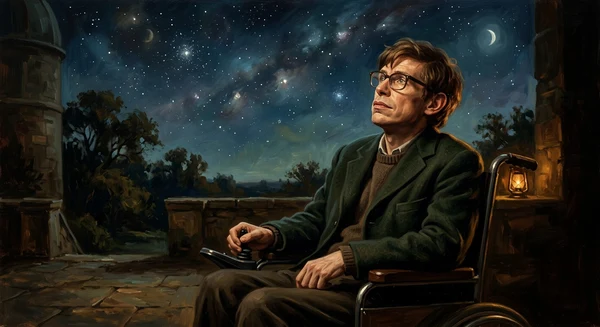
Stephen Hawking
1942–2018 · Theoretical Physicist & Cosmologist
Discovering that black holes emit radiation and writing "A Brief History of Time."
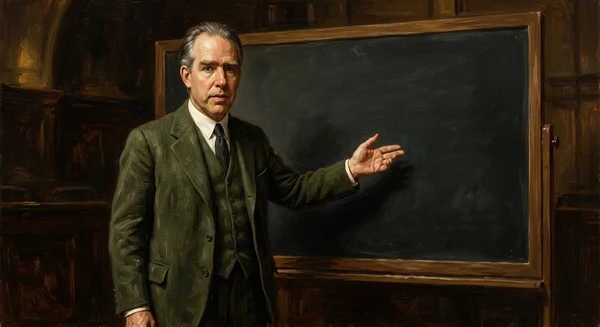
Niels Bohr
1885–1962 · Physicist
Developed the Bohr model of the atom and made foundational contributions to quantum mechanics.
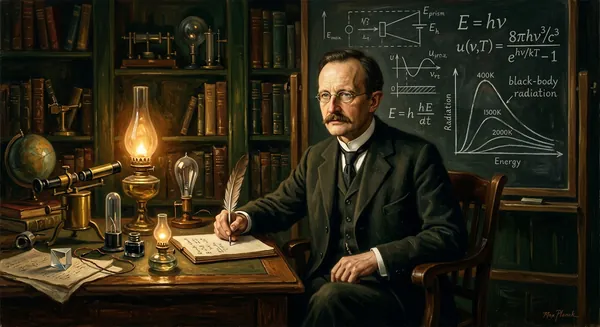
Max Planck
1858–1947 · Theoretical Physicist
Discovering that energy is emitted in discrete packets called quanta, launching the field of quantum physics.
Sources & references
Books and educational kits about Subrahmanyan Chandrasekhar coming soon