_(2).jpg)
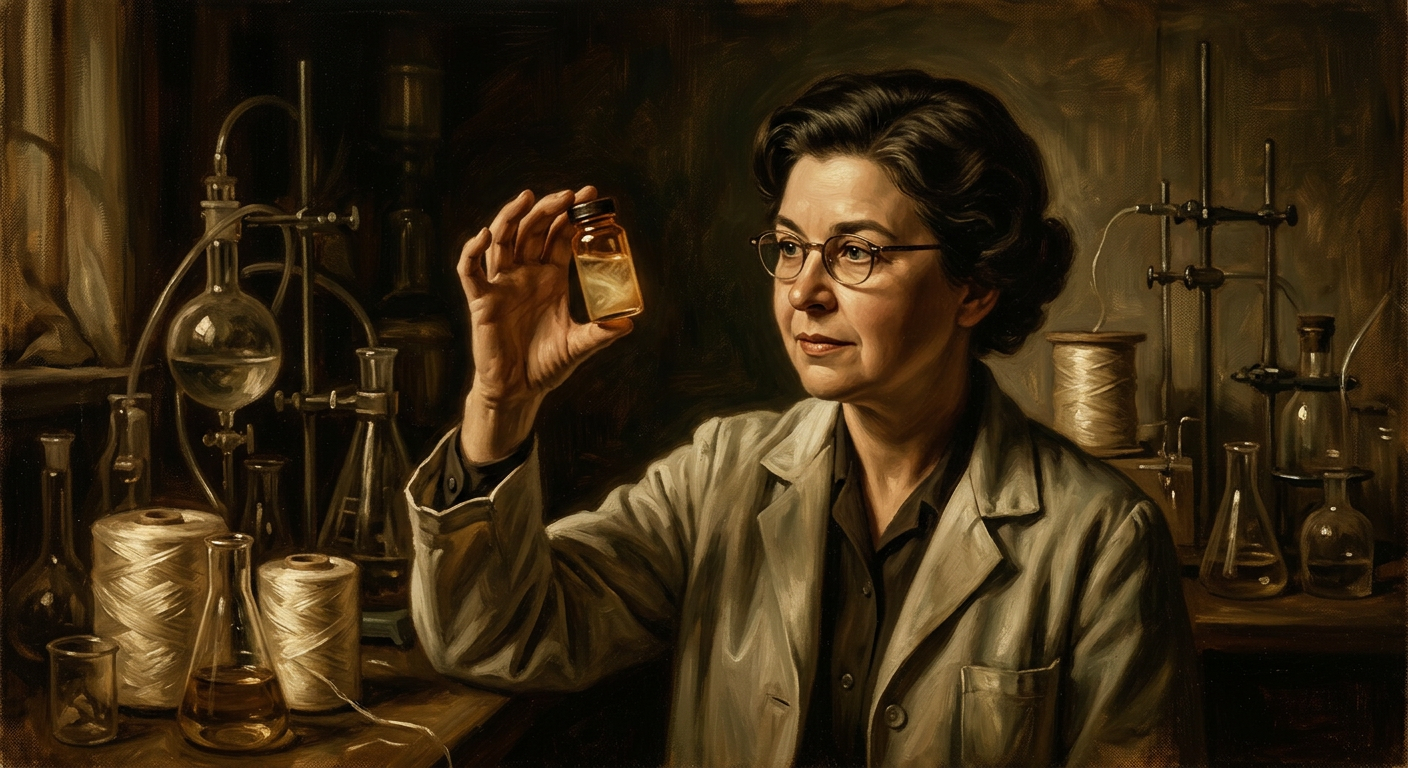
Stephanie Kwolek
1923–2014 · Chemist
Stephanie Kwolek was a chemist at DuPont who invented Kevlar, a fiber so strong it stops bullets. Her discovery, born from a cloudy mixture that nearly got thrown away, has saved thousands of lives and is used in everything from body armor to spacecraft.
“All sorts of things can happen when you’re open to new ideas and playing with things you don’t know anything about.”
She took the job at DuPont only as a temporary way to save money for medical school, then stayed more than 40 years and invented Kevlar.
Why is this scientist famous?
Inventing Kevlar, a synthetic fiber five times stronger than steel by weight, used in bulletproof vests and countless life-saving applications.
Stephanie's story
Early Life and a Love of Science
Stephanie Kwolek was born on July 31, 1923, in New Kensington, Pennsylvania, a small industrial town near Pittsburgh. Her father, an amateur naturalist, took her on walks through the woods and taught her to identify plants, insects, and birds, sparking a lifelong love of science. He died when she was only 10, but his curiosity lived on in her. She studied chemistry at Margaret Morrison Carnegie College, the women’s college of what is now Carnegie Mellon University, graduating in 1946. She planned to go to medical school, but she needed money to pay for it, so she applied for a temporary job at the chemical company DuPont, thinking she would save up and move on.
Finding Her Place at DuPont
The temporary job at DuPont changed everything. Kwolek was assigned to a research group working on synthetic polymers, the long-chain molecules used to make plastics and fibers. She discovered that she loved the work — the puzzle of designing new molecules, the challenge of turning a chemical formula into a real material you could hold in your hand. She was so good at it that she abandoned her medical school plans and stayed at DuPont for 41 years. She specialized in finding ways to create polymers that could be spun into fibers at low temperatures, a difficult and innovative approach that most chemists avoided because the solutions were hard to work with.
The Discovery of Kevlar
In 1965, Kwolek was trying to create a new lightweight fiber for reinforcing tires, part of a project to find alternatives to steel in vehicle manufacturing. She prepared a polymer solution that behaved strangely: instead of the usual clear, syrupy liquid, it was cloudy and thin, almost watery. A colleague who saw it said it looked like it would not spin into a fiber and suggested throwing it away. Kwolek insisted on testing it. When the solution was spun through a machine and the resulting fiber was tested, the results were astonishing: it was five times stronger than steel by weight, lighter than fiberglass, and heat-resistant. The fiber, later named Kevlar, was unlike anything that had ever been made. It did not melt, it did not stretch, and it could stop a bullet.
Legacy
Kevlar went into production in the early 1970s and quickly found uses far beyond tires. It became the material of choice for bulletproof vests, saving the lives of thousands of police officers and soldiers. It is used in suspension bridge cables, spacecraft, racing sails, skis, and even the gloves used to protect hands from cuts and bites. Kwolek herself remained humble about the discovery, always crediting the team that helped develop Kevlar into a commercial product. She became a mentor to other women in chemistry and a passionate advocate for science education. She received the National Medal of Technology in 1996 and was inducted into the National Inventors Hall of Fame in 1995, only the fourth woman to receive that honour. She died on June 18, 2014, in Wilmington, Delaware, at the age of 90, having invented a material that has saved countless lives and changed the world in ways she never imagined.
What did they discover?
Invention of Kevlar
Kwolek discovered that a cloudy, low-viscosity polymer solution could be spun into a fiber five times stronger than steel by weight. Kevlar is used in bulletproof vests, spacecraft, bridge cables, and thousands of other applications.
Low-Temperature Polymer Processing
She pioneered techniques for creating and spinning polymer solutions at low temperatures, an approach other chemists avoided because the solutions were difficult to work with but which produced fibers with extraordinary strength.
Amazing facts
She took the job at DuPont only as a temporary way to save money for medical school, then stayed 41 years and invented Kevlar.
Her father was an amateur naturalist who sparked her love of science on walks through the woods before he died when she was 10.
The Kevlar solution looked so strange — cloudy and watery instead of clear and syrupy — that a colleague suggested throwing it away.
Kevlar is five times stronger than steel by weight, lighter than fiberglass, and can stop a bullet.
She was only the fourth woman inducted into the National Inventors Hall of Fame.
She received the National Medal of Technology in 1996, America’s highest honour for technological achievement.
Kevlar is used in bulletproof vests, suspension bridge cables, spacecraft, racing sails, skis, and cut-resistant gloves.
She always credited the team that helped develop Kevlar into a commercial product, never claiming the achievement alone.
She mentored young women in chemistry and became a passionate advocate for science education.
Timeline
Born in New Kensington, Pennsylvania
Graduated in chemistry from Margaret Morrison Carnegie College and joined DuPont as a temporary employee
Made the DuPont research team permanent, abandoning her plans for medical school
Discovered the polymer solution that would become Kevlar, insisting on testing a cloudy mixture others wanted to discard
Kevlar went into commercial production, initially for tire reinforcement
Kevlar was adopted for bulletproof vests, beginning to save police officers’ lives
Inducted into the National Inventors Hall of Fame, only the fourth woman to receive the honour
Received the National Medal of Technology, America’s highest honour for technological achievement
Died in Wilmington, Delaware, on June 18, age 90
Awards & honours
Related Super Scientists
Marie Curie
1867–1934 · Physicist & Chemist
Discovering radioactivity and two new elements: radium and polonium.
Rosalind Franklin
1920–1958 · Chemist & X-ray Crystallographer
Taking the photograph that revealed the double-helix structure of DNA.
Alexander Fleming
1881–1955 · Bacteriologist
Discovered penicillin, the world's first antibiotic, saving hundreds of millions of lives.
Sources & references
Books and educational kits about Stephanie Kwolek coming soon