_(2).jpg)
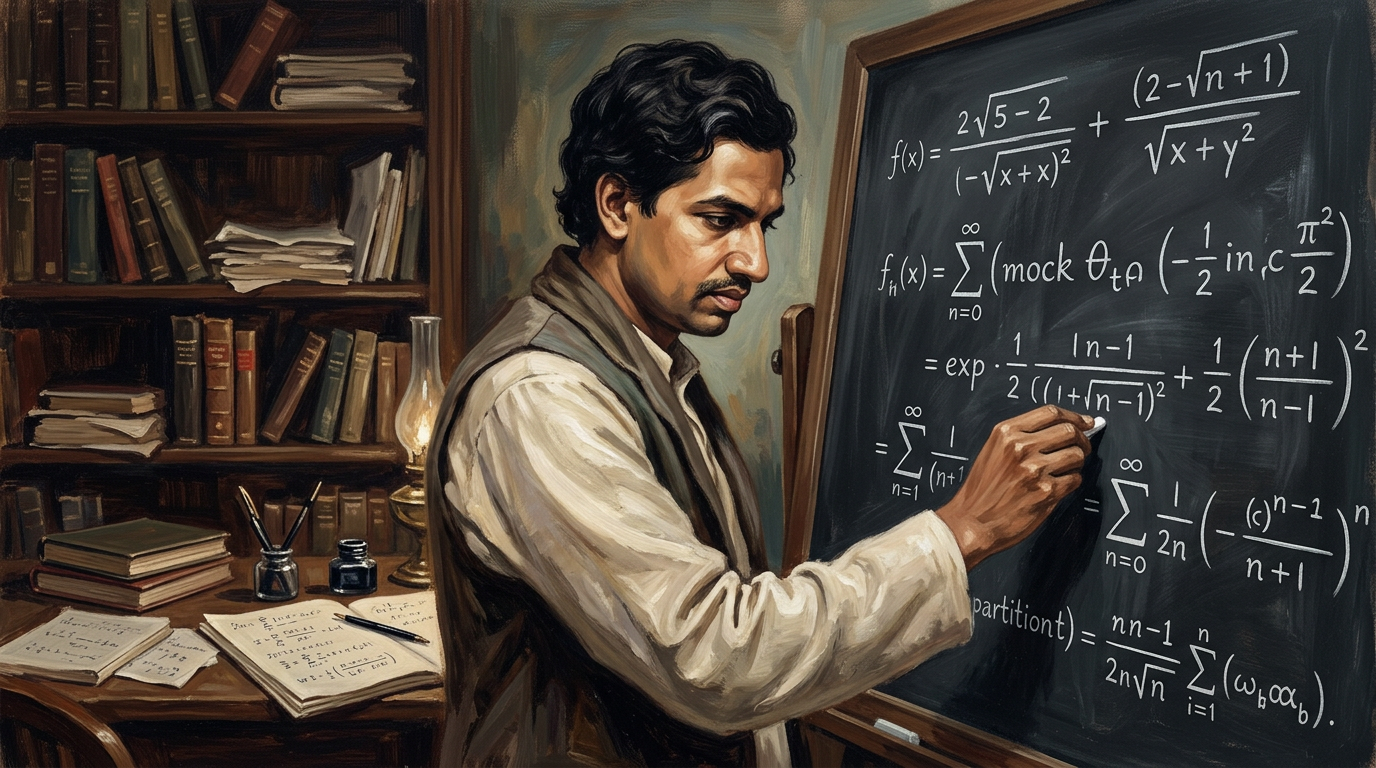
Srinivasa Ramanujan
1887–1920 · Mathematician
Srinivasa Ramanujan was a self-taught Indian mathematical genius whose intuitive insights into numbers produced thousands of results, many of which are still being understood today.
“An equation for me has no meaning unless it expresses a thought of God.”
When G. H. Hardy visited Ramanujan in hospital and mentioned he had arrived in taxi number 1729, Ramanujan instantly replied that it was the smallest number expressible as the sum of two cubes in two different ways.
Why is this scientist famous?
Making extraordinary contributions to number theory, infinite series, and continued fractions, largely self-taught.
Ramanujan was a self-taught Indian mathematician who produced thousands of extraordinary formulas, many written as if in a dream. His insights into number theory now appear in unexpected places — from the mathematics of string theory in physics to the algorithms that keep your online banking secure. He showed that genius can come from anywhere, and that deep intuition is as valuable as formal training.
Srinivasa's story
Early Life
Born in Erode in southern India, Ramanujan showed an early genius for mathematics but struggled in every other subject. He failed college exams because he would not study anything except mathematics. Living in poverty, he worked as a clerk in the Madras Port Trust, filling notebooks with mathematical results in his spare time that he could not always prove but believed were true by intuition.
Reaching Cambridge
In 1913, Ramanujan wrote a letter to the Cambridge mathematician G. H. Hardy, containing a list of remarkable theorems and identities. Hardy initially thought it might be a hoax, but soon recognised its genius — he later called it the most singular event of his life. Hardy arranged for Ramanujan to come to Cambridge, and in April 1914 the self-taught clerk from Madras arrived at Trinity College.
The Hardy–Ramanujan Collaboration
Over five years at Cambridge, Ramanujan and Hardy produced groundbreaking work on partition functions, mock theta functions, and the distribution of primes. Ramanujan's approach was very different from Hardy's rigorous European style — he relied on deep intuition and claimed his results were revealed to him in dreams by the goddess Namagiri. Hardy respected this and worked to provide formal proofs for many of Ramanujan's insights.
Legacy
Ramanujan fell ill in England and returned to India in 1919, dying the following year at the age of 32. His notebooks — containing nearly 3,900 results — have been studied for over a century, and new applications of his work continue to appear in fields from string theory to cancer research. He became a Fellow of the Royal Society in 1918, one of the youngest ever elected, and his birthday is celebrated as National Mathematics Day in India.
What did they discover?
Partition Function Formula
With Hardy, discovered an exact asymptotic formula for p(n), the number of ways to write an integer as a sum of positive integers — one of the most celebrated results in number theory.
Mock Theta Functions
In his last letter to Hardy, Ramanujan described 17 functions he called 'mock theta functions,' whose true significance was only understood in the 21st century and which have applications in string theory.
Highly Composite Numbers
Studied numbers that have more divisors than any smaller positive integer, a concept he introduced that has applications in design theory and cryptography.
Ramanujan Primes
Defined a new generalisation of Bertrand's postulate, identifying a third prime between certain bounds — now known as Ramanujan primes.
Amazing facts
He was largely self-taught, learning from a single library book on advanced mathematics.
He claimed many of his formulas were revealed to him in dreams by the goddess Namagiri.
The number 1729 is called the Hardy–Ramanujan number — it is the smallest number expressible as the sum of two cubes in two different ways.
His notebooks contain nearly 3,900 results, many still being studied and proved today.
He became a Fellow of the Royal Society in 1918, one of the youngest ever elected.
His birthday, 22 December, is celebrated as National Mathematics Day in India.
Timeline
Born in Erode, Madras Presidency, India
Obtained a book on advanced mathematics and began filling notebooks with results
Began working as a clerk at the Madras Port Trust
Wrote his famous letter to G. H. Hardy at Cambridge
Arrived at Trinity College, Cambridge
Elected a Fellow of the Royal Society at the age of 30
Returned to India in failing health
Died in Kumbakonam, India, age 32
Awards & honours
Related Super Scientists
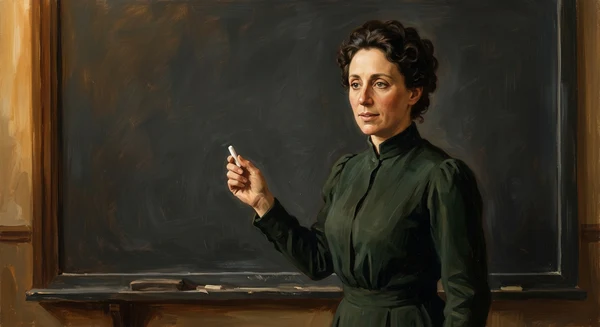
Emmy Noether
1882–1935 · Mathematician
Proved Noether's theorem, linking symmetry and conservation laws — a foundation of modern physics.
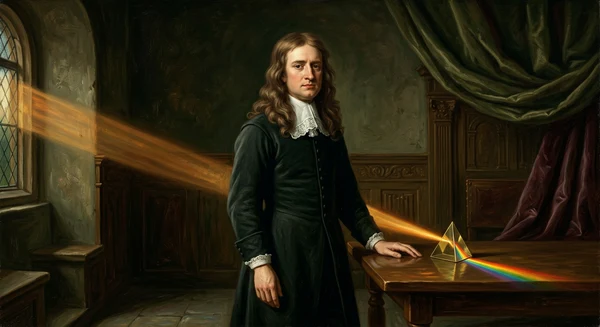
Isaac Newton
1643–1727 · Physicist & Mathematician
Formulating the laws of motion and universal gravitation.

Alan Turing
1912–1954 · Mathematician & Computer Scientist
Breaking Nazi codes and founding the science of artificial intelligence.
Sources & references
Books and educational kits about Srinivasa Ramanujan coming soon