_(2).jpg)
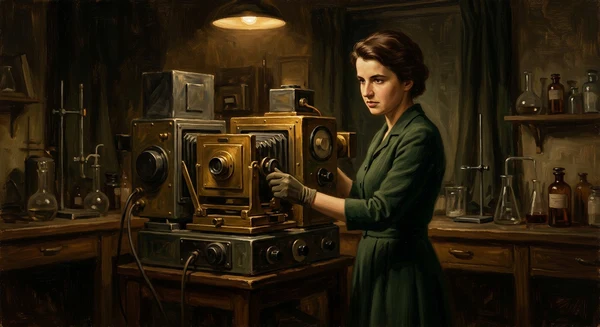
Rosalind Franklin
1920–1958 · Chemist & X-ray Crystallographer
A pioneering chemist whose X-ray images of DNA were essential to one of the greatest discoveries in biology, though her role went unrecognised for decades.
“Science and everyday life cannot and should not be separated.”
Rosalind Franklin's famous "Photograph 51" revealed the double-helix shape of DNA — but she didn't know her work was secretly shared with Watson and Crick, who used it to win the Nobel Prize.
Why is this scientist famous?
Taking the photograph that revealed the double-helix structure of DNA.
Franklin took the crucial X-ray photograph that revealed DNA's double-helix shape. Her image, called "Photo 51," was shown to Watson and Crick without her knowledge, and it was the key to their model. Today, scientists use the same X-ray crystallography technique to study the structure of proteins, helping them design new drugs. Her story also sparked an important conversation about giving credit where it is due.
Rosalind's story
Early Life
Born in London into a prominent Jewish family. From childhood, Rosalind was determined, direct, and passionate about science. She studied chemistry at Newnham College, Cambridge, and earned her PhD researching the structure of coal.
DNA at King's College
In 1951, Franklin joined King's College London to study DNA using X-ray crystallography — a technique that bounces X-rays off crystals to reveal the arrangement of atoms. She refined the equipment, controlled humidity, and produced exceptionally clear images. Her most famous image, "Photograph 51," showed unmistakably that DNA had a helical structure.
The Discovery
Without Franklin's knowledge, her colleague Maurice Wilkins showed Photograph 51 to James Watson and Francis Crick at Cambridge. Their 1953 paper proposing the double-helix structure of DNA was built directly on Franklin's data. They — and Wilkins — received the 1962 Nobel Prize. Franklin, who had died of cancer in 1958 at just 37, was never mentioned.
Legacy
Franklin moved to Birkbeck College and did important work on the structure of viruses before her death. Only in later decades did her crucial role in the DNA discovery become widely known. Today she is recognised as a central figure in one of the most important scientific breakthroughs of the 20th century.
What did they discover?
Photograph 51
An X-ray diffraction image of DNA that provided the key evidence for its double-helix structure.
DNA Structure Data
Her precise measurements of DNA's dimensions and helical nature were essential to Watson and Crick's model.
Virus Structure
Pioneered structural studies of the tobacco mosaic virus and polio, work continued by her team after her death.
Amazing facts
Her photograph of DNA — "Photograph 51" — was shown to Watson and Crick without her knowledge or consent.
She died at 37, four years before the Nobel Prize was awarded for the DNA discovery she had enabled.
Nobel Prizes are not awarded posthumously, so she could never have shared it.
She was an expert mountaineer and loved hiking in the Alps.
Her family helped Jewish refugees escape Nazi Germany.
A Mars rover, an asteroid, and a university college are all named after her.
Timeline
Born in London, England
Graduated from Cambridge with a degree in chemistry
Joined King's College London to study DNA
Produced Photograph 51
Watson and Crick published the DNA double-helix model
Diagnosed with ovarian cancer
Died at age 37
Awards & honours
Related Super Scientists
Marie Curie
1867–1934 · Physicist & Chemist
Discovering radioactivity and two new elements: radium and polonium.
Charles Darwin
1809–1882 · Naturalist & Biologist
Proposing the theory of evolution by natural selection.
James Watson
1928–present · Molecular Biologist & Geneticist
Co-discovered the double-helix structure of DNA.
Articles about this scientist
The Double Helix
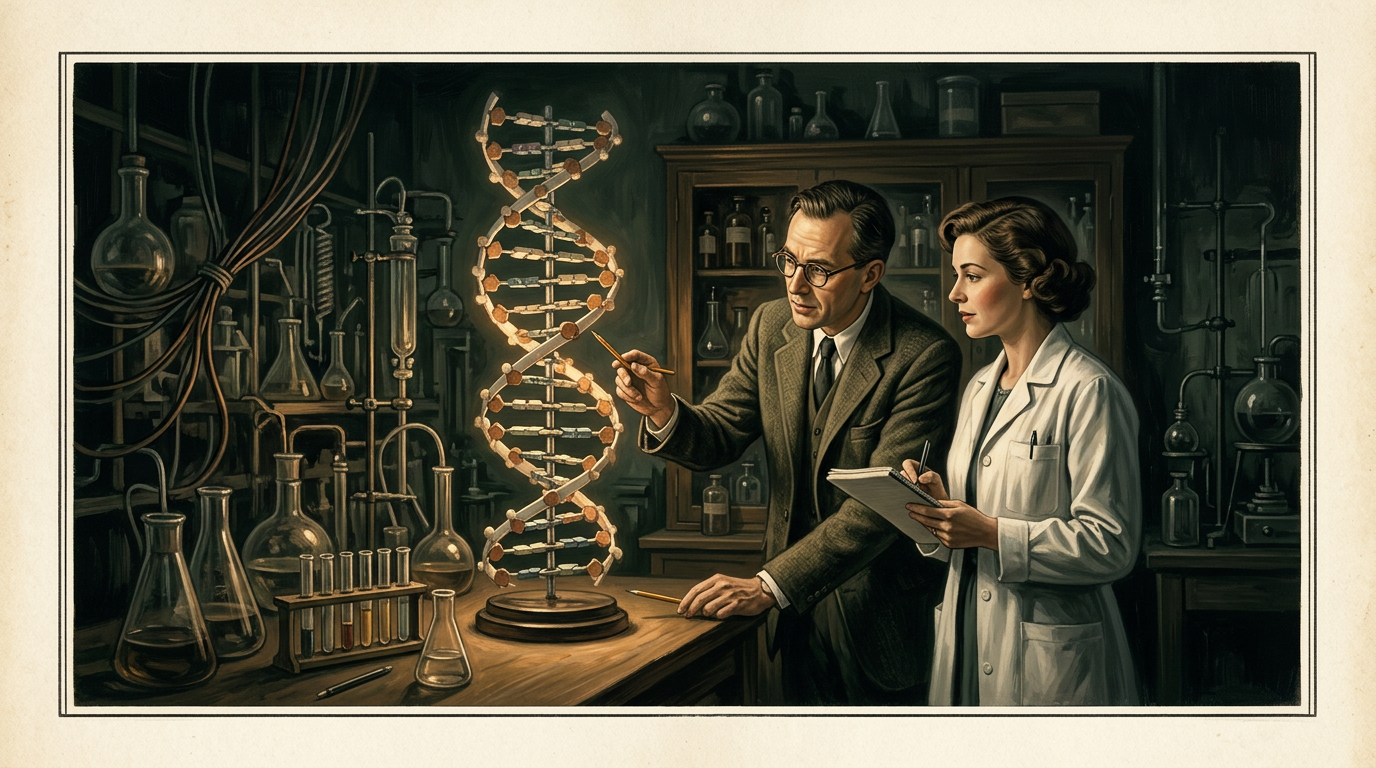
The discovery of DNA's structure in 1953 is one of the most important breakthroughs of the 20th century. But behind the Nobel Prize lies a story of competition and a woman left uncredited.
Women Who Changed Science
Throughout history, women in science have faced exclusion, dismissal, and erasure. Yet their discoveries have been transformative. This article celebrates the women whose brilliance could not be held back by the barriers of their time.
Sources & references
Books and educational kits about Rosalind Franklin coming soon