_(2).jpg)
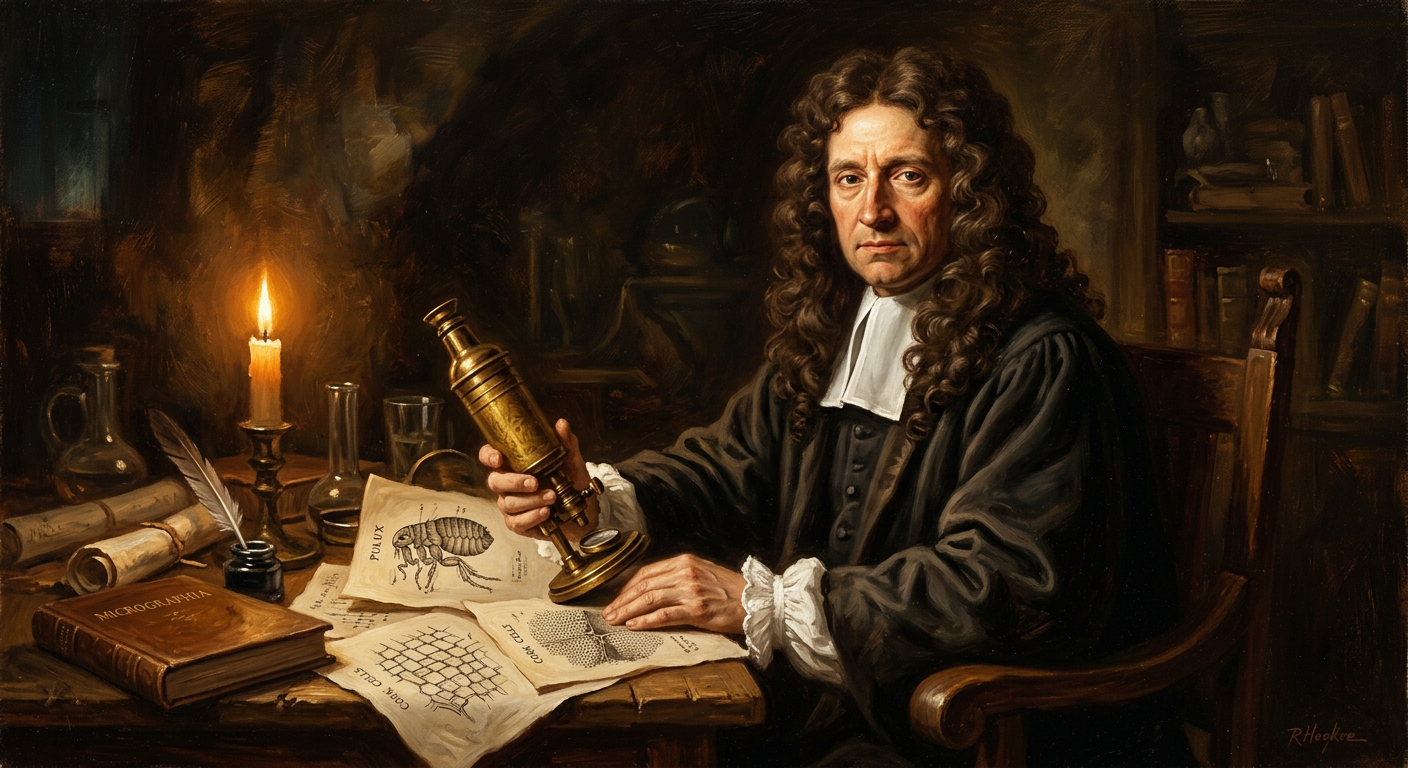
Robert Hooke
1635–1703 · Biologist and Physicist
The English scientist who peered through a microscope at cork and gave the world the word "cell", while also working out how springs stretch.
“The science of Nature has been already too long made only a work of the brain and the fancy: It is now high time that it should return to the plainness and soundness of observations on material and obvious things.”
Hooke’s drawing of a flea under a microscope so terrified people that some refused to look through microscopes, fearing what they might see.
Why is this scientist famous?
Coined the word "cell" after examining cork under a microscope and formulated Hooke’s Law on springs.
Robert's story
A Curious Mind on the Isle of Wight
Robert Hooke was born in 1635 on the Isle of Wight, the son of a church curate. As a boy he was so frail that his father decided he was not strong enough for farm work or an apprenticeship, and instead let him pursue his education. Young Robert spent his time drawing, taking apart clocks and mechanical toys to see how they worked, and reading anything he could find. When his father died in 1648, Hooke was left a modest inheritance of forty pounds — enough to be sent to London, where he enrolled at Westminster School. There his extraordinary talent for mathematics and mechanical invention quickly became obvious. He mastered Latin, Greek, and Euclid’s geometry in a remarkably short time, and caught the attention of the school’s headmaster, Richard Busby, one of the most influential teachers of the age.
The Great Microscope
In 1660 Hooke became one of the first fellows of the newly founded Royal Society, and a few years later he was appointed its Curator of Experiments — a role that required him to demonstrate three or four new experiments at every weekly meeting. In 1665 he published a magnificent book called Micrographia, filled with astonishingly detailed drawings of things he had examined under his microscope. The pages showed the compound eyes of a fly, the intricate stinger of a bee, and the bristly, spiny legs of a flea magnified to the size of a small dog. King Charles II was so entertained by it that he kept a copy on his bedside table. But the most important observation was of a thin slice of cork, in which Hooke saw a honeycomb pattern of tiny empty boxes. He called them “cells” because they reminded him of the small rooms monks lived in. The word stuck, and when later scientists discovered that all living things are made of these same little boxes, Hooke’s name for them became universal.
Springs, Buildings and Rivalries
Hooke’s interests ranged far beyond microscopy. He discovered the law of elasticity now known as Hooke’s Law — that the stretch of a spring is proportional to the force pulling it — a principle still used in engineering today. He argued that light travels in waves, that gravity follows an inverse-square law, and that the Earth is not a perfect sphere. After the Great Fire of London in 1666, Hooke was appointed as one of the chief surveyors tasked with rebuilding the city. He personally designed several buildings and worked alongside Christopher Wren on the Monument to the Great Fire and the Royal Greenwich Observatory. But Hooke had a difficult temperament — he was combative and quick to claim that others had stolen his ideas. His most bitter feud was with Isaac Newton, who reportedly became so irritated by Hooke’s accusations that he waited until after Hooke’s death to publish his own work on optics.
A Forgotten Genius
Hooke died in 1703, aged 67, and was buried in London. For nearly three centuries his reputation faded into the shadow of Newton and Wren. No portrait of him survives — the only known likeness reportedly hung in the Royal Society until it was moved or lost in the early eighteenth century. It was only in the late twentieth century that historians began to recognise just how wide-ranging his genius had been. He made original contributions to microscopy, mechanics, architecture, astronomy, geology, and the theory of combustion. Today he is remembered as one of the most versatile minds of the Scientific Revolution — a man who could peer through a microscope at a flea, survey the ruins of a burned city, and argue about the laws of the cosmos, all in the same week.
What did they discover?
Coined the Word “Cell”
While examining a slice of cork under a microscope, Hooke observed tiny hollow compartments he called “cells”, after the small rooms of monks. The name became the universal term for the basic building blocks of all living things.
Hooke’s Law of Elasticity
He discovered that the extension of a spring is directly proportional to the force applied to it, a relationship now known as Hooke’s Law. It remains a foundational principle in physics and engineering.
Micrographia
His 1665 book of microscopic observations, with its vast and beautiful drawings of insects and plants, was the first major work of microscopy published in English and made the invisible world visible to a wide audience.
Wave Theory of Light
Hooke proposed that light consists of waves rather than particles, an idea that predated and influenced later work by Christiaan Huygens and Thomas Young.
Amazing facts
Hooke was left forty pounds by his father — roughly a year’s wages for a labourer at the time — and used it to fund his education in London.
He was the first person to use the word “cell” in a biological context, but he never saw living cells — his cork cells were the empty walls of dead plant tissue.
As a boy, he took apart a brass clock and built a working wooden copy entirely from memory.
King Charles II kept a copy of Micrographia by his bedside because he found the pictures so entertaining.
Hooke was one of the first people to suggest that gravity follows an inverse-square law — an idea Newton later used in his law of universal gravitation.
No authenticated portrait of Hooke survives. The only known painting hung in the Royal Society but disappeared in the early 1700s.
Timeline
Born in Freshwater, Isle of Wight
Father dies; Hooke inherits forty pounds and is sent to London for schooling
Enters Christ Church, Oxford, as a chorister and assistant to Robert Boyle
Becomes one of the first fellows of the newly founded Royal Society
Appointed Curator of Experiments for the Royal Society
Publishes Micrographia, with groundbreaking drawings of microscopic life
Helps survey and rebuild London after the Great Fire as chief surveyor alongside Wren
Publishes his law of elasticity, now known as Hooke’s Law
Dies in London, aged 67
Awards & honours
Related Super Scientists
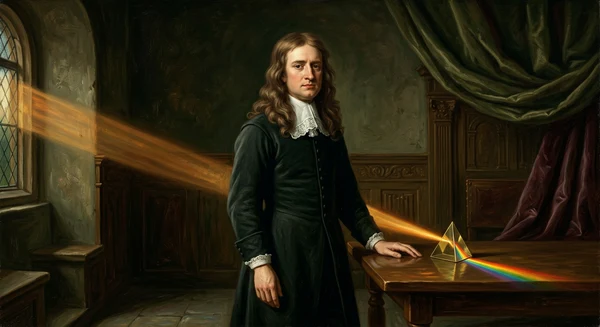
Isaac Newton
1643–1727 · Physicist & Mathematician
Formulating the laws of motion and universal gravitation.
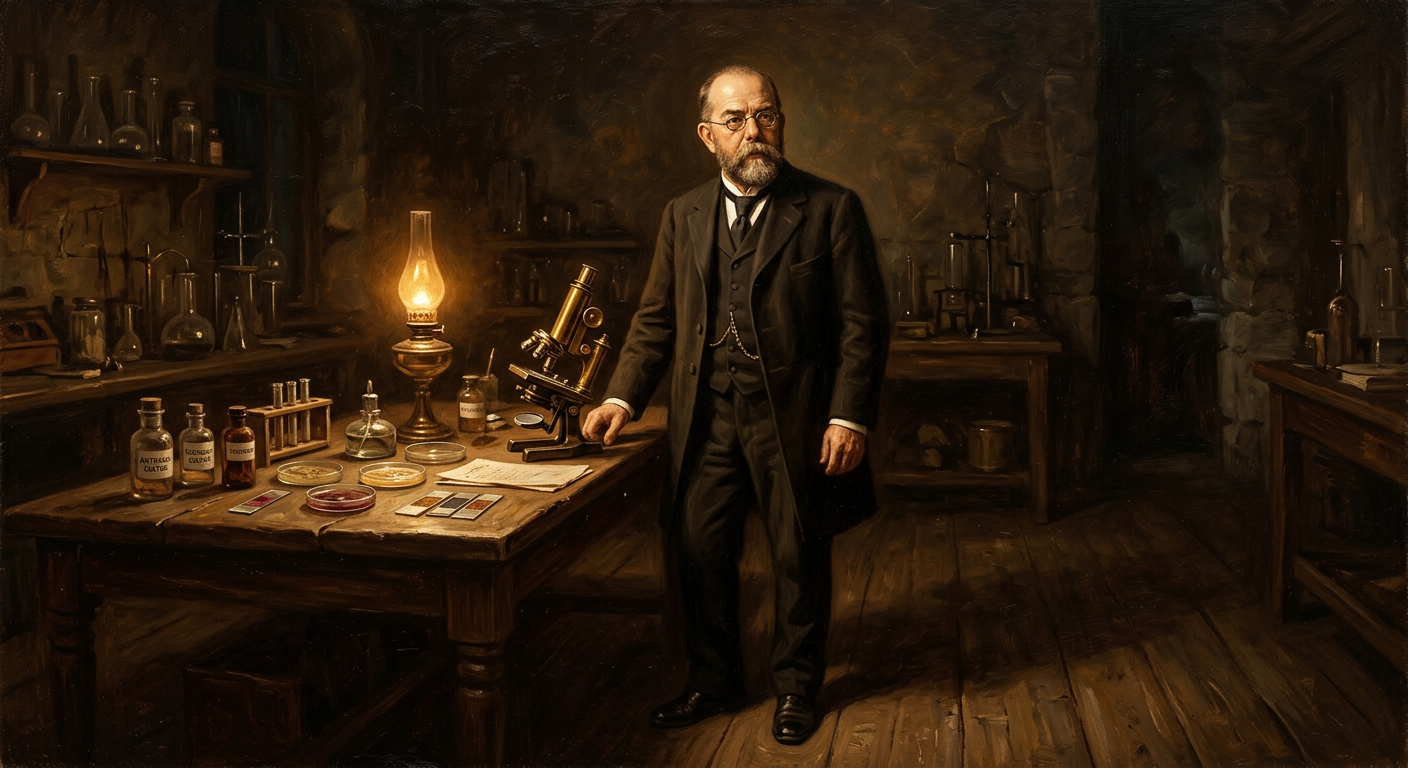
Robert Koch
1843–1910 · Physician and Microbiologist
Discovered the bacteria that cause anthrax, tuberculosis, and cholera, and laid the foundations of modern medical microbiology.
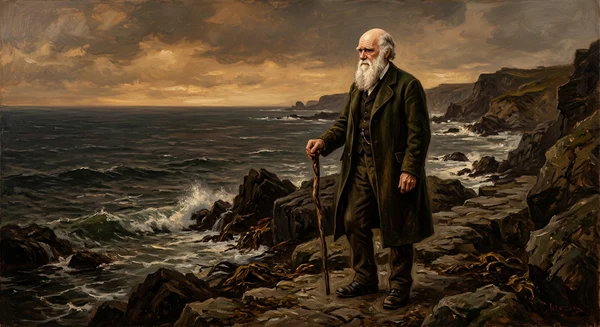
Charles Darwin
1809–1882 · Naturalist & Biologist
Proposing the theory of evolution by natural selection.
Sources & references
Books and educational kits about Robert Hooke coming soon