_(2).jpg)
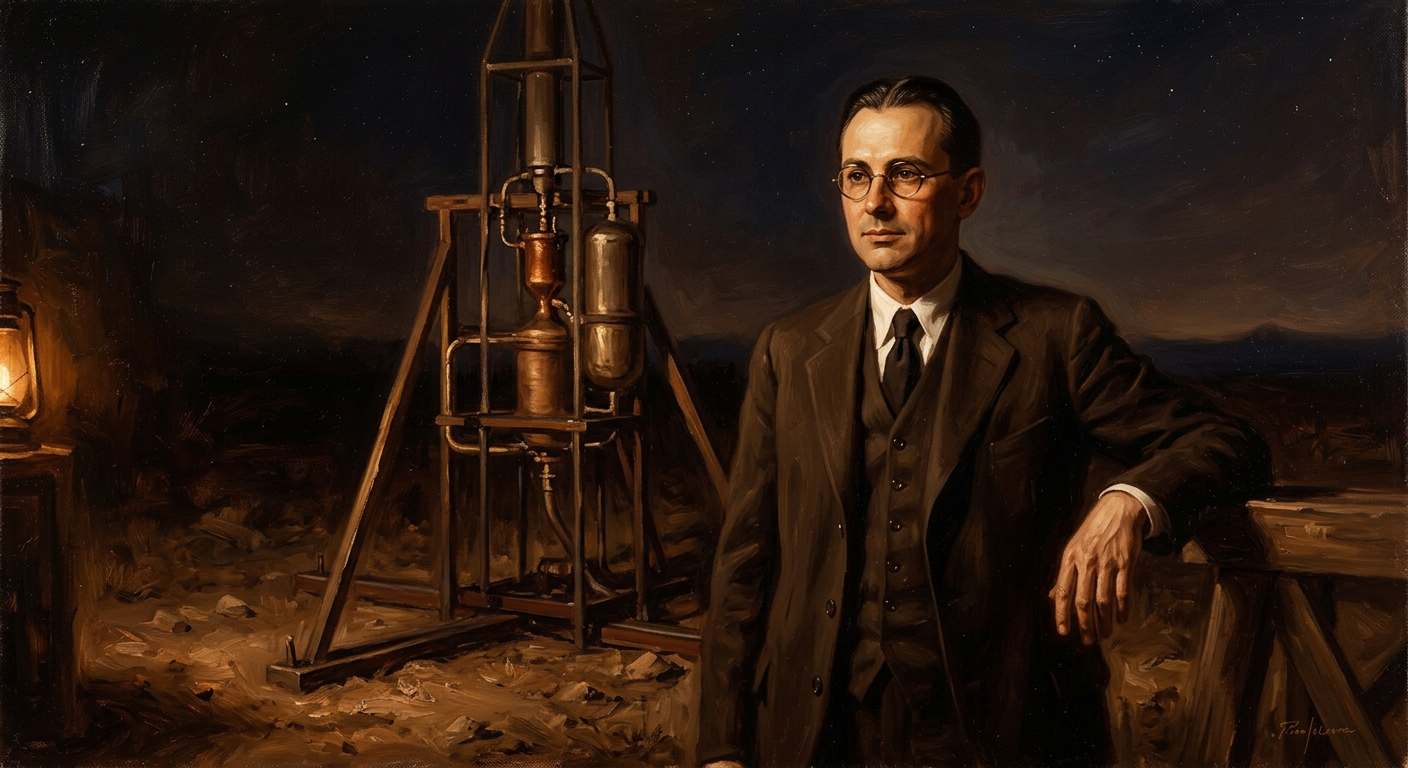
Robert Goddard
1882–1945 · Engineer and Physicist
An American engineer who pioneered the liquid-fuelled rocket and was mocked for believing rockets could work in space — then was proved spectacularly right.
“It is difficult to say what is impossible, for the dream of yesterday is the hope of today and the reality of tomorrow.”
The New York Times, which had mocked Goddard’s claim that rockets could fly in space, printed a formal apology in 1969 — the day after Apollo 11 launched.
Why is this scientist famous?
Built and launched the world’s first liquid-fuelled rocket, laying the groundwork for spaceflight.
Robert's story
A Boy’s Dream of Space
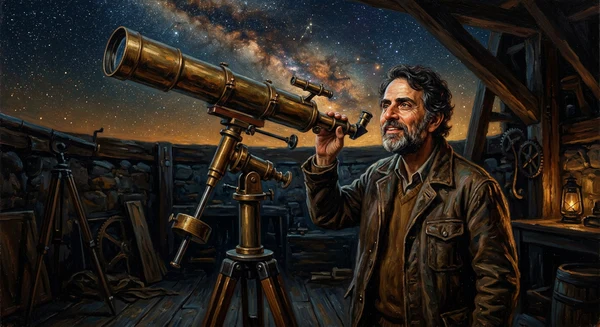
Robert Hutchings Goddard was born in 1882 in Worcester, Massachusetts, the only child of a bookkeeper and a sewing machine operator. As a boy he was fascinated by machinery — he built a telescope, experimented with a hydrogen-filled balloon, and read science fiction voraciously. The turning point came when he was seventeen. He had been ill and was resting in a cherry tree in the garden of his family home, daydreaming about what it would take to send a vehicle to Mars. He later wrote that when he climbed down from that tree, he felt as though his life’s purpose had been decided: he would devote himself to the problem of spaceflight. The vision was so vivid that for the rest of his life he remembered the exact date — 19 October 1899 — and celebrated it privately as his personal anniversary. Few teenagers have ever set themselves so ambitious or so lonely a goal.
Theory and Mockery
Goddard studied physics at Worcester Polytechnic Institute and then at Clark University, where he earned his doctorate in 1911 and later became a professor. He began by working through the mathematics of rocket propulsion, proving that a rocket could work in the vacuum of space — it did not need air to push against, as many people believed. In 1919 he published a short paper called A Method of Reaching Extreme Altitudes, outlining how a solid-fuel rocket could reach the Moon and describing the idea of multistage rockets. The press seized on the lunar idea and mocked him mercilessly. The New York Times ran an editorial saying that Goddard lacked “the knowledge ladled out daily in high schools” because he seemed not to understand that a rocket needed something to push against. The criticism stung Goddard deeply. He became intensely private about his work, sharing fewer and fewer details, and retreated to his laboratory to build rather than to argue.
The First Liquid-Fuelled Rocket
Solid-fuel rockets, like fireworks, burned all their fuel at once and could not be controlled. Goddard realised that a liquid fuel — gasoline mixed with liquid oxygen — could be fed into a combustion chamber in a controlled stream, allowing thrust to be regulated. The engineering challenges were enormous: the fuels had to be stored separately, mixed in the right proportions, ignited safely, and pumped through a nozzle that could withstand enormous heat. On 16 March 1926, at his aunt Effie’s farm in Auburn, Massachusetts, Goddard launched the world’s first liquid-fuelled rocket. It was a clumsy-looking thing — about four feet tall, mounted on a frame that one writer compared to a mobile windmill tower. It flew for two and a half seconds, reached an altitude of about forty feet, and landed in a cabbage field 184 feet away. It was not impressive to look at, but it was the first time a liquid-fuelled rocket had ever left the ground. Every spaceflight since — from the Apollo missions to the Space Shuttle to SpaceX — traces its ancestry back to that cabbage field.
Vindication Came Late
Goddard received some funding from the Smithsonian Institution and later from the Guggenheim family, and he continued to improve his designs. He developed gyroscopic stabilisation, parachutes for payload recovery, and the concept of a turbo-pump to feed fuel into the engine. He was granted 214 patents, many of which became fundamental to later rocket engineering. But in his lifetime he was largely ignored in the United States. In Germany, by contrast, his work was studied closely by the team that built the V-2 missile during the Second World War. Goddard died of throat cancer in 1945, aged 62, before seeing the age of spaceflight he had made possible. In 1969, the day after the Apollo 11 launch, the New York Times finally printed a correction to its 1920 editorial, acknowledging that rockets could indeed work in a vacuum. NASA named its Goddard Space Flight Center in his honour, and today he is recognised as the father of modern rocketry — the boy who climbed down from a cherry tree and spent his life trying to reach the sky.
What did they discover?
First Liquid-Fuelled Rocket
On 16 March 1926, Goddard launched the world’s first liquid-fuelled rocket from a farm in Auburn, Massachusetts. Every modern spaceflight traces its ancestry to this flight.
Multistage Rocket Concept
Goddard described and patented the concept of staging — using multiple rocket sections that are discarded as their fuel is used up — which is fundamental to all space launches today.
Gyroscopic Stabilisation
He developed gyroscopic control systems to keep rockets flying straight, a technique still used in modern spacecraft guidance.
Turbo-Pump Fuel System
Goddard designed a turbo-pump to feed liquid fuel into the combustion chamber at high pressure, enabling the powerful engines needed for spaceflight.
Amazing facts
Goddard remembered the exact date — 19 October 1899 — when he first dreamed of spaceflight while sitting in a cherry tree, and celebrated it every year as his personal anniversary.
The New York Times mocked him in 1920 for suggesting rockets could work in space, then published a formal retraction on 17 July 1969 — the day after Apollo 11 launched.
His first rocket flew only 184 feet, lower than the distance of a cricket pitch, but it proved that liquid-fuel propulsion was possible.
He was granted 214 patents, covering everything from fuel pumps to parachute recovery systems.
His work was largely ignored in the United States during his lifetime but was studied closely by German rocket engineers who built the V-2 missile.
NASA’s Goddard Space Flight Center in Maryland was named in his honour in 1959.
Timeline
Born in Worcester, Massachusetts
While sitting in a cherry tree, conceives the idea of building a vehicle that could reach space
Graduates from Worcester Polytechnic Institute with a degree in physics
Earns a PhD in physics from Clark University and joins the faculty there
Publishes A Method of Reaching Extreme Altitudes, outlining the theory of spaceflight
Launches the world’s first liquid-fuelled rocket in Auburn, Massachusetts
Moves to Roswell, New Mexico, with Guggenheim funding to continue rocket research
Successfully tests gyroscopically stabilised rockets
Dies of throat cancer in Baltimore, aged 62
Awards & honours
Related Super Scientists
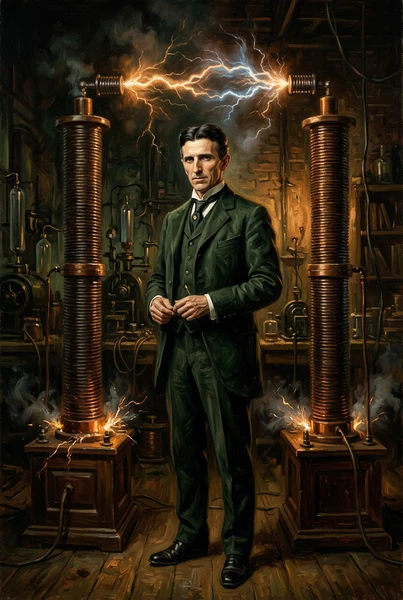
Nikola Tesla
1856–1943 · Inventor & Engineer
Pioneering alternating current (AC) electricity and numerous electrical inventions.
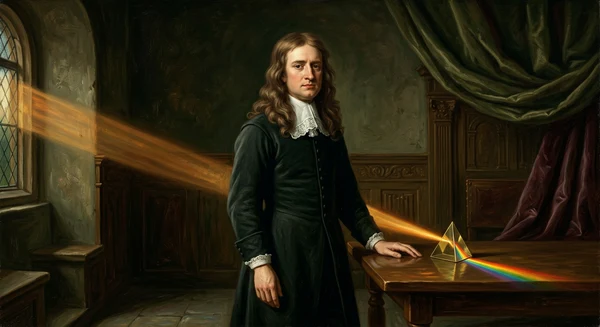
Isaac Newton
1643–1727 · Physicist & Mathematician
Formulating the laws of motion and universal gravitation.
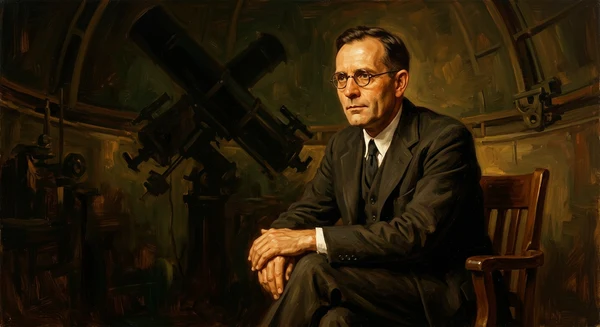
Edwin Hubble
1889–1953 · Astronomer
Proved that the universe is expanding and that other galaxies exist beyond our own.
Sources & references
Books and educational kits about Robert Goddard coming soon