_(2).jpg)
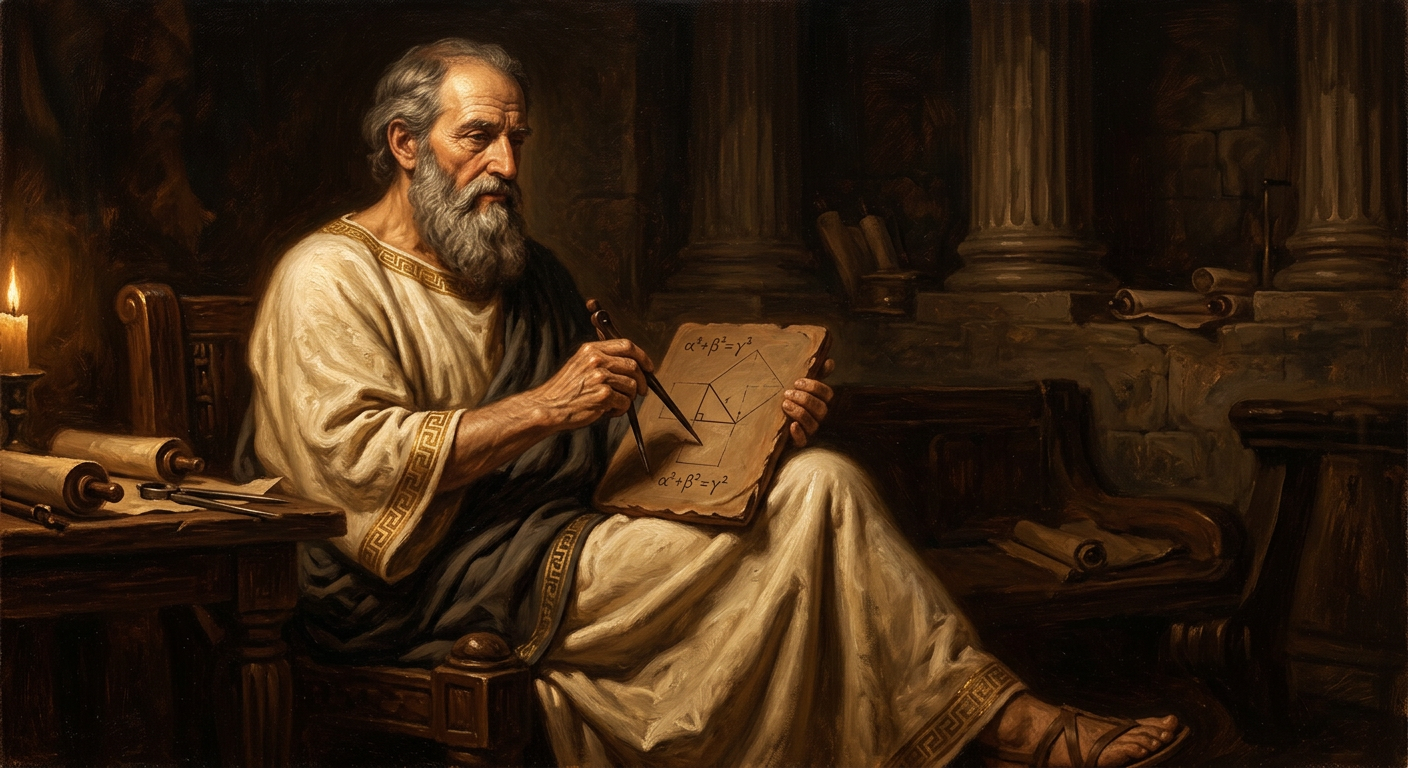
Pythagoras
-570–-495 · Mathematician and Philosopher
A mysterious figure from ancient Greece who believed the universe was built on numbers, founded a secretive philosophical brotherhood, and may or may not have proved the theorem that bears his name.
“Numbers rule the universe.”
Pythagoras founded a religious community whose followers believed numbers had mystical properties, souls could transmigrate after death, and it was forbidden to eat beans — because beans resembled human embryos.
Why is this scientist famous?
The ancient Greek philosopher and mathematician whose theorem about right-angled triangles is taught in every school — and who founded a mystical brotherhood of numbers.
Pythagoras gave us the theorem about right-angled triangles that every student learns: a² + b² = c². That relationship is used constantly — by architects making sure corners are square, by surveyors measuring land, and by computer graphics programs drawing 3D worlds. He believed maths could describe the universe, an idea that still drives physicists and mathematicians today.
Pythagoras's story
The Mysterious Sage
Pythagoras was born around 570 BC on the island of Samos, in the Aegean Sea off the coast of what is now Turkey. Almost nothing certain is known about his life — he wrote nothing down, and his followers kept his teachings secret. What we know comes from accounts written hundreds of years after his death, a mixture of fact and legend that is impossible to untangle. His father, Mnesarchus, was a merchant from Tyre who had been granted Samian citizenship after bringing grain to the island during a famine. As a young man, Pythagoras travelled widely — to Egypt, where he studied with priests for over two decades, to Babylon, where he learned mathematics and astronomy, and possibly to India. These journeys shaped everything he would later teach.
The Brotherhood
Around 530 BC, Pythagoras settled in Croton, a Greek colony in southern Italy. There he founded a remarkable community — part school, part religious order, part political club. Its members, known as Pythagoreans, lived by strict rules. They shared their possessions, ate a vegetarian diet, studied mathematics and music, and believed that the soul was immortal and could be reborn in other bodies. The inner circle, called the mathematicikoi (learners), studied advanced mathematics and philosophy. The outer circle, the akousmatikoi (listeners), lived ordinary lives and followed the master''s moral teachings. Women were admitted as equals — extraordinary for ancient Greece. Pythagoras himself was regarded as a semi-divine figure, said to have a golden thigh and the ability to be in two places at once.
All is Number
Pythagoras''s central teaching was radical and beautiful: the universe is built on numbers. He and his followers discovered that musical notes are related by simple numerical ratios. If you pluck a string and then shorten it to exactly half its length, you get the same note one octave higher. Shorten it to three-quarters, and you get a perfect fourth. This discovery — that music and mathematics are connected — stunned the Pythagoreans. They concluded that if music follows mathematical laws, then so must everything else. This idea, that nature has a mathematical structure, is the foundation of all physics. It is no exaggeration to say that every equation in modern science traces its ancestry back to Pythagoras.
The Theorem
The famous theorem attributed to Pythagoras states that in any right-angled triangle, the square of the length of the hypotenuse (the side opposite the right angle) equals the sum of the squares of the other two sides: a² + b² = c². The Babylonians and Indians had known this relationship for over 1,000 years before Pythagoras, and had tables of triples (like 3, 4, 5) that satisfy it. What Pythagoras may have contributed — though even this is disputed — was the first formal proof that the relationship holds for all right-angled triangles, not just specific examples. Whether he proved it or not, his name became permanently attached to the most famous theorem in mathematics, taught to schoolchildren everywhere.
The Discovery That Broke the Brotherhood
The Pythagoreans believed that every number could be expressed as a ratio of whole numbers — that all of reality was built on integers and their fractions. Then one of their own, a man named Hippasus, made a devastating discovery. Consider a square with sides of length 1. The diagonal of that square has a length of √2 — and √2 cannot be expressed as any ratio of whole numbers. It is irrational. This was a catastrophe for the Pythagorean worldview. Legend says that Hippasus was drowned at sea, either by the gods or by his fellow Pythagoreans, for revealing this secret. The discovery of irrational numbers cracked the foundations of the brotherhood''s philosophy and marked one of the great turning points in the history of mathematics.
Legacy and Death
Pythagoras died around 490 BC, though the circumstances are uncertain. Some accounts say the brotherhood was attacked and its school burned by a political rival named Cylon, whom Pythagoras had rejected for membership. Pythagoras fled to nearby Metapontum and died there, possibly from starvation. The brotherhood survived in various forms for another 200 years, influencing Plato and through him all of Western philosophy. Pythagoras''s idea that mathematics reveals the hidden structure of reality became the guiding principle of scientists from Kepler to Newton to Einstein. The 17th-century astronomer Johannes Kepler wrote: ''Geometry has existed from eternity in the mind of God, and Pythagoras was the first to share it with mankind.''
What did they discover?
Pythagoras''s Theorem
The principle that in any right-angled triangle, the square of the hypotenuse equals the sum of the squares of the other two sides (a² + b² = c²) — the most famous theorem in mathematics, known to the Babylonians but possibly first proved by Pythagoras.
The Mathematics of Music
He discovered that musical harmonies correspond to simple numerical ratios of string lengths — the octave (2:1), the perfect fifth (3:2), and the perfect fourth (4:3) — establishing that mathematics underlies the physical world.
The Irrational Numbers
A member of his school discovered that the square root of 2 cannot be expressed as any ratio of whole numbers, revealing the existence of irrational numbers and challenging the Pythagorean belief that all things are ratios of integers.
The Pythagorean Brotherhood
He founded a philosophical and religious community in Croton that studied mathematics as a path to spiritual purification, admitting women as equals and influencing Plato and the entire Western philosophical tradition.
The Spherical Earth
Pythagoras was among the first to argue that the Earth is a sphere, reasoning from the shape of its shadow on the Moon during lunar eclipses — an idea that preceded Aristotle''s more famous proof by 150 years.
Number Theory Foundations
He and his followers classified numbers as odd, even, prime, perfect, triangular, and square, laying the groundwork for number theory as a mathematical discipline.
Amazing facts
Pythagoras wrote nothing down himself — everything we know about him comes from accounts written hundreds of years after his death.
He founded a religious brotherhood that admitted women as equals, which was extraordinary in ancient Greece.
His followers believed it was forbidden to eat beans, because beans resembled human embryos and contained souls.
The Babylonians knew the relationship a² + b² = c² for over 1,000 years before Pythagoras — he may have been the first to prove it in general, not just for specific numbers.
A member of his brotherhood named Hippasus discovered that the square root of 2 is irrational — legend says he was drowned at sea for revealing this secret.
He was among the first to argue that the Earth is a sphere, based on the round shadow it casts on the Moon during eclipses.
His followers believed he had a golden thigh and could be in two places at the same time.
He believed in transmigration of souls — that after death, a person''s soul could be reborn in another body, including an animal.
His discovery that musical notes follow simple numerical ratios led him to conclude that the entire universe is built on mathematics — an idea that underpins all modern physics.
The word ''mathematics'' comes from the Greek word mathema, meaning ''that which is learned'' — a term the Pythagoreans used for their studies.
Plato was so influenced by Pythagoras that he travelled to Italy to study with Pythagorean philosophers before founding his Academy in Athens.
Timeline
Born on the island of Samos in the Aegean Sea, off the coast of modern Turkey
Travelled to Egypt to study with priests, staying for over 20 years and learning mathematics and astronomy
Taken to Babylon as a captive during the Persian invasion of Egypt, where he studied Babylonian mathematics
Settled in Croton, a Greek colony in southern Italy, and founded the Pythagorean brotherhood
Discovered that musical harmonies correspond to simple numerical ratios of string lengths
A follower named Hippasus discovered irrational numbers, challenging the brotherhood''s belief that all things are ratios of integers
The brotherhood was attacked by political rivals; Pythagoras fled to Metapontum
Possibly proved the theorem now known as Pythagoras''s theorem — that a² + b² = c² for all right-angled triangles
Died in Metapontum, southern Italy, around the age of 75
Awards & honours
Related Super Scientists
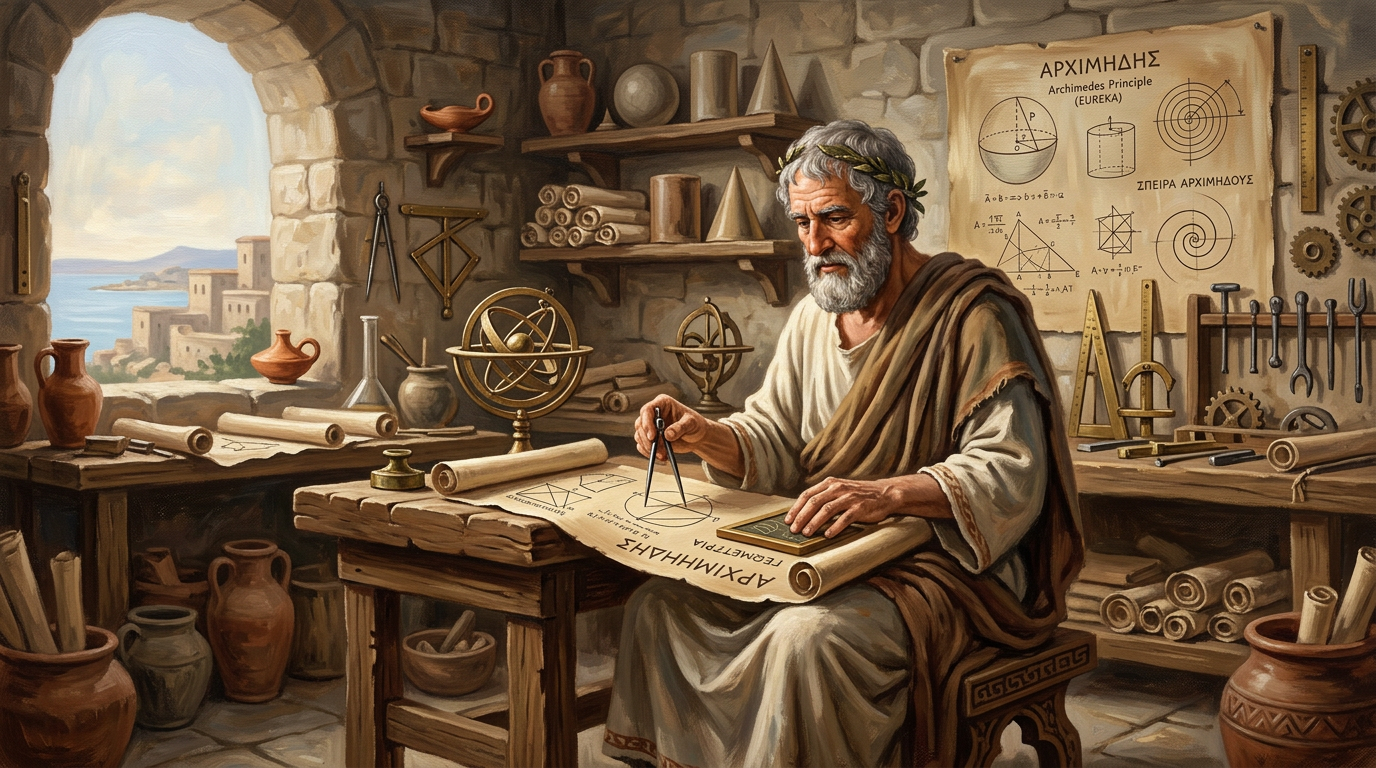
Archimedes
-287–-212 · Mathematician and inventor
Discovering the principles of buoyancy, the lever, and pioneering mathematical methods that anticipated calculus.
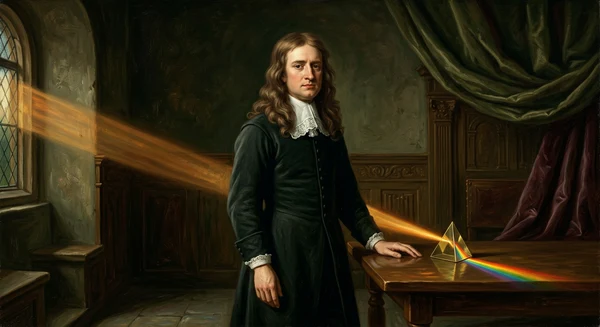
Isaac Newton
1643–1727 · Physicist & Mathematician
Formulating the laws of motion and universal gravitation.
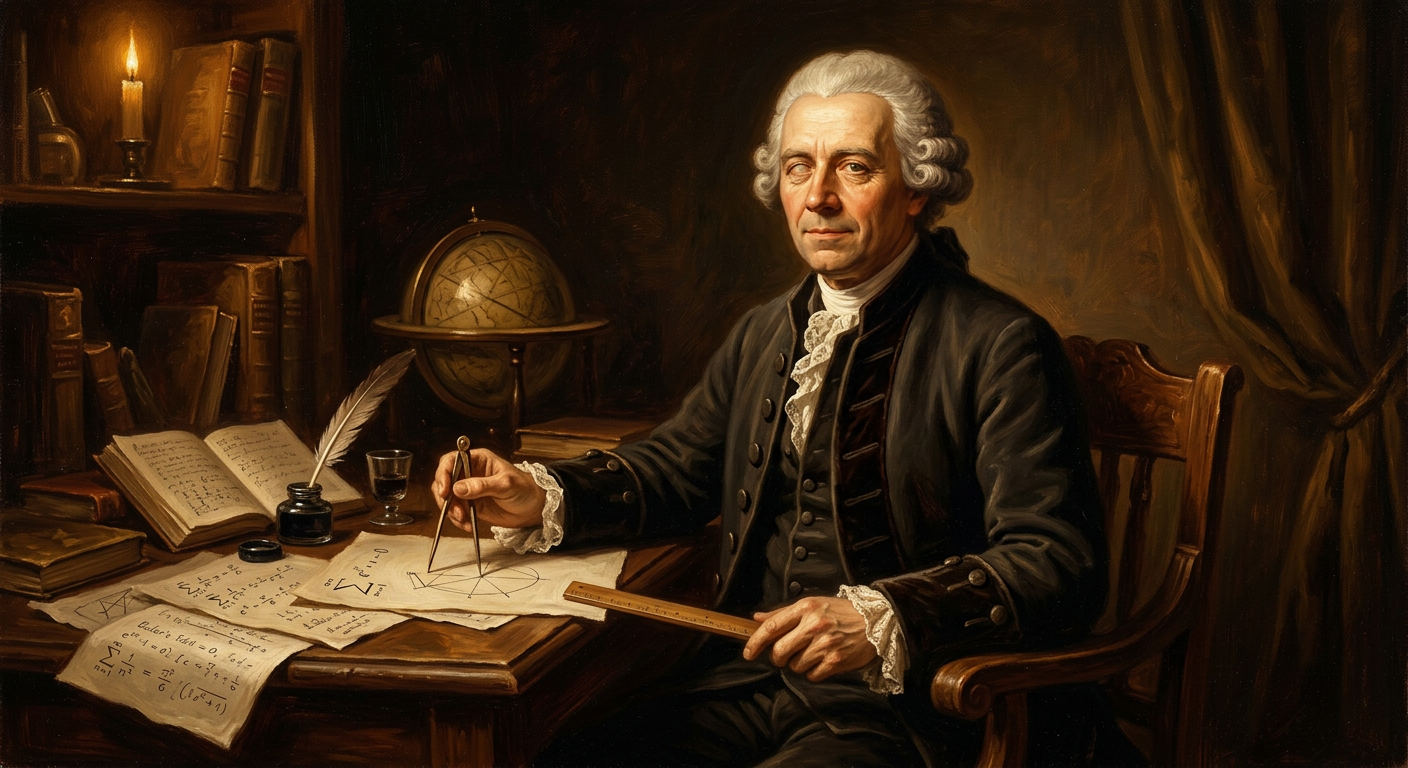
Leonhard Euler
1707–1783 · Mathematician and Physicist
The most prolific mathematician in history, who produced groundbreaking work in calculus, number theory, and topology — much of it after going entirely blind.
Sources & references
Books and educational kits about Pythagoras coming soon