_(2).jpg)
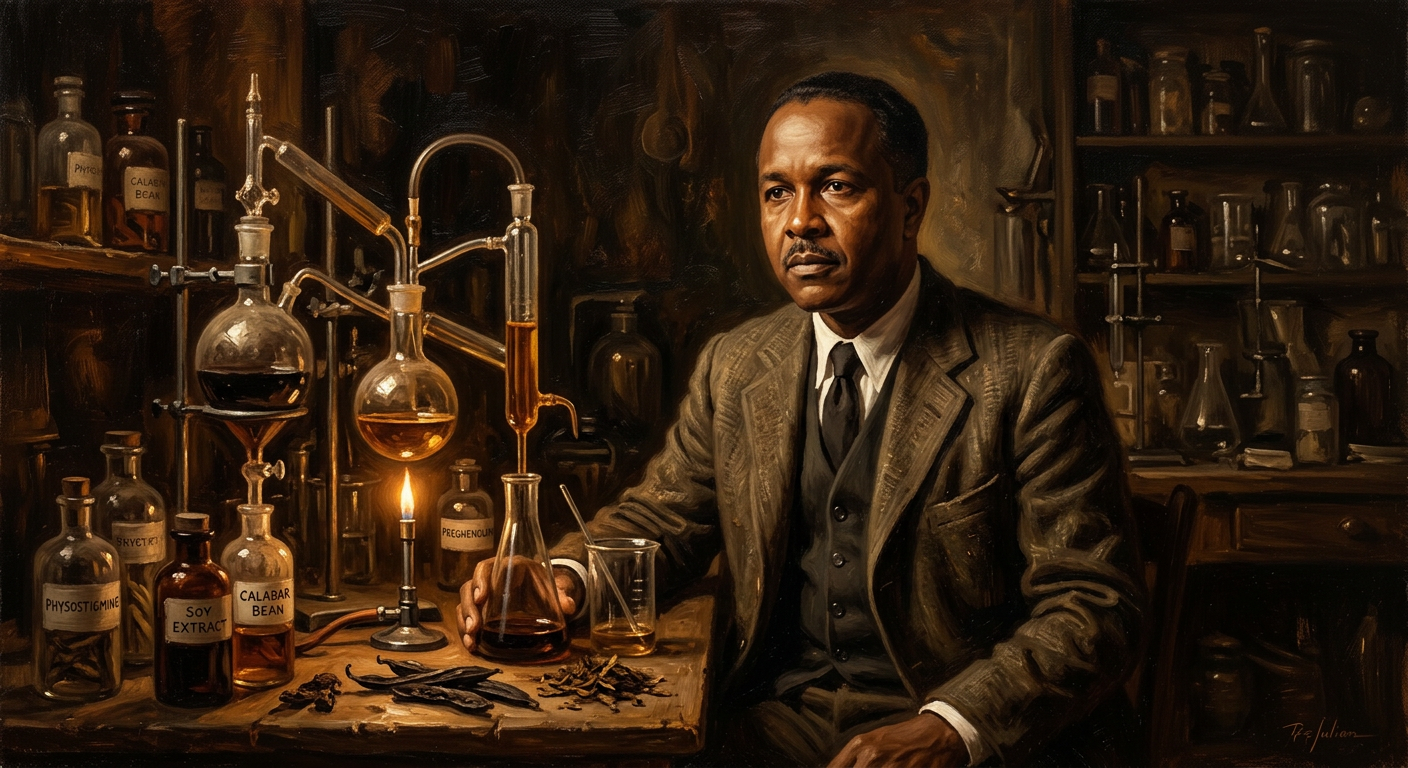
Percy Julian
1899–1975 · Chemist
Percy Julian was a brilliant chemist who overcame racial discrimination to become one of the most important pharmaceutical chemists of the 20th century. His work synthesizing drugs from plants made life-saving medicines affordable for millions of people.
“I have had one goal in my life, that of playing some role in making life a little easier for the persons who come after me.”
Because Montgomery, Alabama had no public high school for Black students, he had to take high-school-level classes at DePauw University while already enrolled there as a college student, graduating top of his class.
Why is this scientist famous?
Synthesizing important medicines from plant compounds, including physostigmine for glaucoma and affordable cortisone for arthritis.
Percy's story
Early Life in the Jim Crow South
Percy Lavon Julian was born on April 11, 1899, in Montgomery, Alabama, the grandson of enslaved people. His father, a railway mail clerk, had once been denied admission to college because of his race, but he was determined that his children would have the education he was denied. Growing up in the segregated South, Percy attended a school for Black children that ended at eighth grade. Montgomery had no public high school for Black students, so when he enrolled at DePauw University in Greencastle, Indiana, he was accepted as a college student but was secretly taking high-school-level classes at the same time to catch up. He walked to campus because he could not afford the bus fare, and he worked as a waiter and dug ditches to pay for his tuition. Despite all of this, he graduated at the top of his class in 1920.
The Road to Chemistry
After DePauw, Julian taught chemistry at Fisk University, a historically Black college in Nashville, for two years before winning a scholarship to Harvard University for a master’s degree. At Harvard, he was not allowed to live in the dormitories because he was Black, and despite his academic brilliance, the university refused to allow him to pursue a doctorate. He went to Austria instead, earning his PhD at the University of Vienna in 1931, studying the chemistry of natural products from plants. He returned to America with expertise in a field that would transform medicine: how to extract and synthesize complex chemical compounds from soybeans and other plants.
Synthesizing Medicines
Julian’s great achievement was figuring out how to synthesize drugs that had previously been available only from rare natural sources, making them affordable and mass-producible. His first major breakthrough was physostigmine, a compound from the Calabar bean used to treat glaucoma, a disease that causes blindness. Previous attempts to synthesize it had failed for decades. Julian succeeded in 1935, producing the drug synthetically and confirming its effectiveness. He then turned to cortisone, a powerful anti-inflammatory used to treat rheumatoid arthritis. At the time, cortisone could only be extracted in tiny, expensive amounts from animal organs. Julian developed a way to produce it from soybean sterols, dramatically reducing its cost and making it available to millions of patients who could never have afforded it before. He also developed a fire-fighting foam from soy protein that was used during World War II and saved countless lives.
Building an Empire and Facing Hate
In 1953, Julian and his family moved to the wealthy Chicago suburb of Oak Park, becoming the first Black family in the neighborhood. They were met with threats, arson, and a dynamite bomb thrown at their house. Julian refused to be driven out. He posted guards and stayed, eventually becoming a respected community member. He also founded his own company, Julian Laboratories, because he could not get a senior research position at major chemical firms due to his race. The company was enormously successful, and in 1961 he sold it for 2.3 million dollars, becoming one of the first Black millionaires in America. In 1973, he became the first African American chemist elected to the National Academy of Sciences. He died on April 19, 1975, in Waukegan, Illinois, having spent his life making medicines affordable for people who could never have afforded them.
What did they discover?
Synthesis of Physostigmine
Julian synthesized physostigmine, a compound from the Calabar bean used to treat glaucoma, after decades of failed attempts by other chemists. His 1935 synthesis made the drug widely available and affordable.
Affordable Cortisone from Soybeans
Julian developed a method to produce cortisone from soybean sterols, replacing a process that relied on extracting tiny amounts from animal organs. His work dramatically reduced the cost of the drug, making it accessible to millions of arthritis patients.
Soy-Based Fire-Fighting Foam
During World War II, Julian developed a protein-based fire-fighting foam from soybeans that was used by the military to extinguish oil and gasoline fires, saving countless lives.
Amazing facts
He graduated top of his class at DePauw University while secretly taking high-school-level classes because Montgomery had no high school for Black students.
Harvard accepted him for a master’s degree but refused to let him pursue a doctorate because of his race.
He earned his PhD at the University of Vienna because no American university would allow a Black chemist to do doctoral work in his field.
He became the first African American chemist elected to the National Academy of Sciences in 1973.
He founded his own chemical company because no major firm would give him a senior research position, and later sold it for 2.3 million dollars.
When his family moved to Oak Park, Illinois, a dynamite bomb was thrown at their house and arsonists set fire to their property. He refused to leave.
He developed a soy-based fire-fighting foam used by the military during World War II.
His synthesis of cortisone from soybeans made a previously expensive drug affordable for millions of arthritis patients.
Timeline
Born in Montgomery, Alabama, the grandson of enslaved people
Graduated top of his class at DePauw University while taking high-school-level classes alongside college work
Earned a master’s degree at Harvard University, where he was barred from the dormitories because of his race
Earned his PhD at the University of Vienna in Austria, studying plant chemistry
Synthesized physostigmine, a drug for glaucoma, after decades of failed attempts by others
Developed a method to produce affordable cortisone from soybean sterols
Moved to Oak Park, Illinois, becoming the first Black family in the neighborhood and facing bombings and arson
Founded Julian Laboratories to manufacture his synthetic hormones and medicines
Sold Julian Laboratories for 2.3 million dollars, becoming one of the first Black millionaires in America
Became the first African American chemist elected to the National Academy of Sciences
Died in Waukegan, Illinois, on April 19, age 76
Awards & honours
Related Super Scientists
Marie Curie
1867–1934 · Physicist & Chemist
Discovering radioactivity and two new elements: radium and polonium.
Rosalind Franklin
1920–1958 · Chemist & X-ray Crystallographer
Taking the photograph that revealed the double-helix structure of DNA.
Louis Pasteur
1822–1895 · Chemist and microbiologist
Proving that germs cause disease, developing pasteurisation, and creating the first rabies vaccine.
Sources & references
Books and educational kits about Percy Julian coming soon