_(2).jpg)
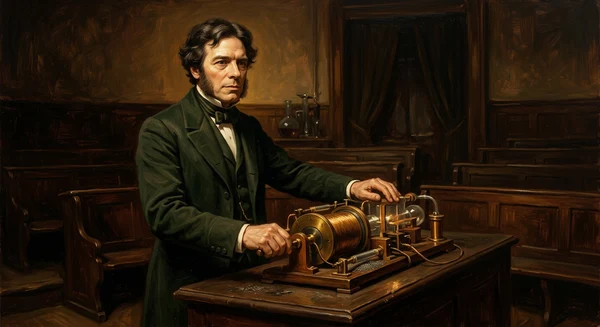
Michael Faraday
1791–1867 · Physicist & Chemist
Michael Faraday was a self-taught scientist who rose from poverty to become one of the greatest experimental physicists in history. His discoveries in electricity and magnetism made the modern electrical age possible.
“Nothing is too wonderful to be true, if it be consistent with the laws of nature.”
Faraday had almost no formal education and left school at 13 — yet he discovered the principles that make every electric motor, generator, and transformer on Earth work.
Why is this scientist famous?
Discovered electromagnetic induction and built the first electric motor and generator.
Faraday discovered electromagnetic induction — the principle that generates electricity by moving magnets near wires. Every power plant, every electric motor, and every charger you use works on his principle. He had no formal education and started as a bookbinder's apprentice, proving that curiosity and hands-on experimenting can change the world. The electric car you might ride in one day is a direct descendant of his discoveries.
Michael's story
Humble Beginnings
Born in 1791 in a London slum, Faraday was the son of a blacksmith who could barely afford to feed his family. He left school at 13 and was apprenticed to a bookbinder. There, he read every science book that came through the shop and taught himself chemistry and physics.
A Lucky Break
A customer gave Faraday tickets to attend Humphry Davy's lectures at the Royal Institution. Faraday took meticulous notes, bound them into a book, and sent it to Davy. Impressed, Davy hired him as a laboratory assistant. Faraday eventually succeeded Davy and became the greatest experimentalist of his era.
Electromagnetic Induction
In 1831, Faraday discovered that moving a magnet through a coil of wire creates an electric current. This principle — electromagnetic induction — is the basis of every electric generator, motor, and transformer. Without it, there would be no electricity in homes, no cars, no phones.
Fields and Light
Faraday conceived of electromagnetic "fields" — invisible lines of force spreading through space. This idea, rejected by many at the time, was later mathematized by James Clerk Maxwell and became the foundation of modern physics. Faraday also discovered that light is affected by magnetism, linking two seemingly separate phenomena.
What did they discover?
Electromagnetic Induction
Discovered that a changing magnetic field produces an electric current, making electric generators and transformers possible.
The Electric Motor
Built the first device that converted electrical energy into continuous mechanical motion.
Benzene
Discovered benzene, one of the most important compounds in organic chemistry, which later became fundamental to the chemical industry.
Electromagnetic Fields
Proposed that electricity and magnetism propagate through space as fields, an idea later confirmed by Maxwell and central to modern physics.
Amazing facts
He had almost no formal education and couldn't do advanced math — yet he made discoveries that changed physics forever.
He was apprenticed to a bookbinder at 13 and learned science by reading the books he was supposed to bind.
He turned down a knighthood and twice refused the presidency of the Royal Society, preferring to remain "plain Mr. Faraday."
He suffered from memory loss and breakdowns later in life, possibly from chemical exposure in his lab.
The farad, the unit of electrical capacitance, is named after him.
He invented the first electric motor in 1821 — a wire spinning around a magnet in a pool of mercury.
Timeline
Born in Newington, Surrey (now South London) on September 22
Apprenticed to a bookbinder at age 14
Attended Humphry Davy's lectures and sent him his notes, landing a job as lab assistant
Built the first electric motor, demonstrating that electricity can create continuous motion
Discovered benzene and became director of the Royal Institution laboratory
Discovered electromagnetic induction — the principle behind all electric generators
Invented the Faraday cage, which blocks electromagnetic fields
Discovered that magnetism affects light (the Faraday effect)
Died at Hampton Court on August 25, age 75
Awards & honours
Related Super Scientists
Articles about this scientist
Sources & references
Books and educational kits about Michael Faraday coming soon