_(2).jpg)
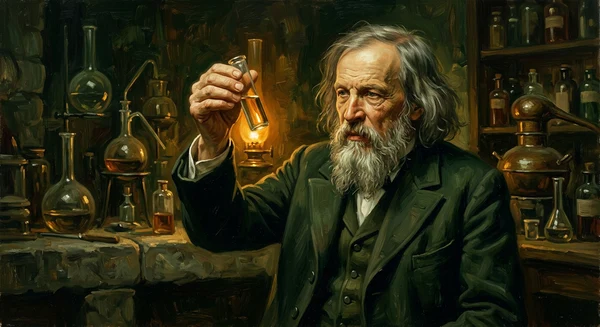
Dmitri Mendeleev
1834–1907 · Chemist & Inventor
Dmitri Mendeleev was a Russian chemist who created the Periodic Table — one of the most important tools in all of science. His brilliant insight was to leave gaps for elements that hadn't been discovered yet, and predict their properties.
“The elements which are the most widely diffused have small atomic weights.”
Mendeleev reportedly saw the periodic table in a dream — he woke up and wrote it down, and it became one of the greatest scientific achievements of all time.
Why is this scientist famous?
Created the Periodic Table of Elements and predicted the existence of undiscovered elements.
Mendeleev created the periodic table — the chart hanging in every science classroom that organises every element by its properties. He left gaps for elements that had not been discovered yet, and predicted what they would be like. When those elements were found, he was right. The periodic table is still the map chemists use to understand everything from medicine to materials.
Dmitri's story
Early Life
Born in 1834 in Tobolsk, Siberia, Mendeleev was the youngest of 14 children. His father went blind and died when Dmitri was young, leaving his mother to support the family by running a glass factory. She walked the young Dmitri across Russia to get him into university in Moscow and St. Petersburg.
The Periodic Table
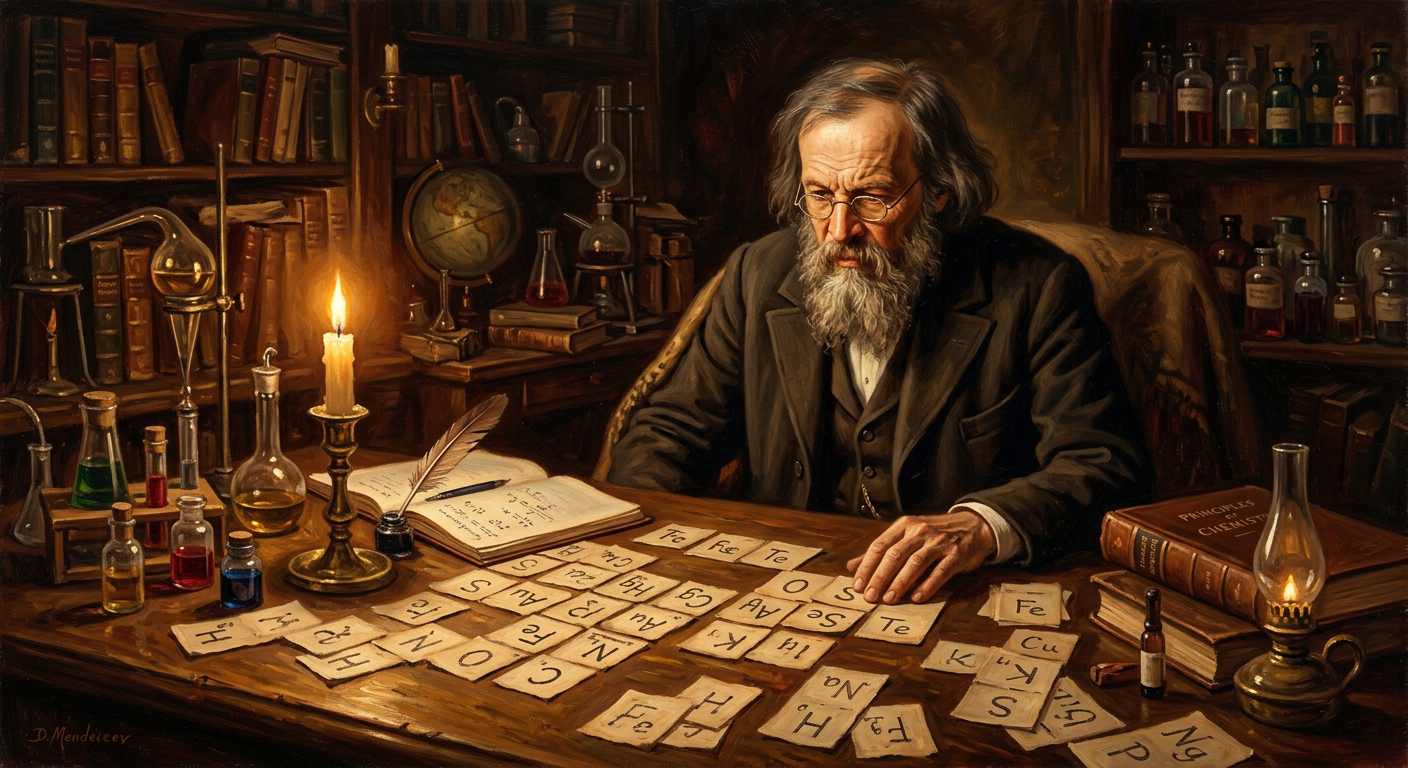
By 1869, scientists knew about 60 elements but had no way to organise them. Mendeleev wrote each element's name and properties on cards and arranged them like a game of patience (solitaire). He noticed that when elements were ordered by atomic weight, their properties repeated in a pattern — a period. The breakthrough was leaving gaps for missing elements and predicting what they would be like.
Predictions Confirmed
Mendeleev predicted the properties of gallium, germanium, and scandium — elements no one had discovered yet. When they were found in the 1870s and 1880s, their properties matched his predictions almost exactly. This convinced the scientific world that his table was correct.
Beyond Chemistry
Mendeleev was a polymath. He worked on the oil industry, helped develop Russia's first oil pipeline, studied meteorology, invented a new type of gunpowder, and even helped introduce the metric system to Russia. He also studied solutions and discovered that adding salt to water lowers its freezing point — useful for roads today.
What did they discover?
The Periodic Table of Elements
Created the first periodic table, organising all known elements by atomic weight and revealing repeating patterns in their properties.
Predicting Undiscovered Elements
Left gaps in his table and predicted the existence and properties of gallium, germanium, and scandium — all confirmed within 20 years.
The Concept of Periodicity
Established that chemical properties repeat periodically when elements are ordered by atomic weight, a principle that still organises chemistry today.
Amazing facts
He reportedly saw the complete periodic table in a dream, woke up, and wrote it down immediately.
He was the youngest of 14 or 17 children — sources disagree on the exact number.
His mother walked him hundreds of miles across Siberia to get him into university.
Element 101, Mendelevium (Md), is named after him.
He helped introduce the metric system to Russia and worked on the Russian oil industry.
He once said that he valued a solution by its usefulness, not by its academic elegance.
Timeline
Born in Tobolsk, Siberia, Russian Empire on February 8
Entered the Main Pedagogical Institute in St. Petersburg to study chemistry
Studied in Heidelberg, Germany under prominent chemists
Earned his PhD and became a professor at the University of St. Petersburg
Presented his Periodic Table of Elements to the Russian Chemical Society
Published an improved periodic table with predictions for undiscovered elements
Gallium discovered, matching his predictions — his table gained credibility
Germanium discovered, further confirming his predictions
Died in St. Petersburg on February 2, age 72
Awards & honours
Related Super Scientists
Marie Curie
1867–1934 · Physicist & Chemist
Discovering radioactivity and two new elements: radium and polonium.
Niels Bohr
1885–1962 · Physicist
Developed the Bohr model of the atom and made foundational contributions to quantum mechanics.
Rosalind Franklin
1920–1958 · Chemist & X-ray Crystallographer
Taking the photograph that revealed the double-helix structure of DNA.
Articles about this scientist
Sources & references
Books and educational kits about Dmitri Mendeleev coming soon