_(2).jpg)
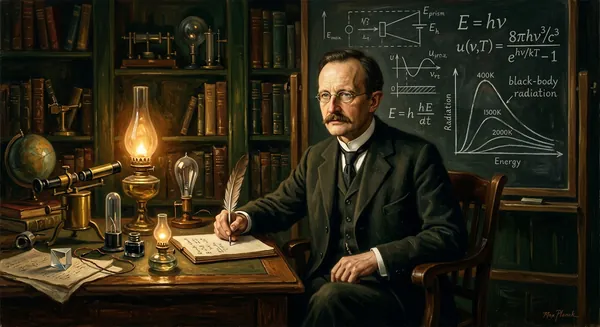
Max Planck
1858–1947 · Theoretical Physicist
Max Planck’s discovery that energy flows in tiny indivisible packets — quanta — shattered classical physics and became the foundation of quantum mechanics, the most successful scientific theory ever devised.
“Science cannot solve the ultimate mystery of nature. And that is because, in the last analysis, we ourselves are a part of the mystery that we are trying to solve.”
Planck’s quantum theory was so radical that even he did not fully believe it at first — he spent years trying to fit it back into classical physics before accepting it was real.
Why is this scientist famous?
Discovering that energy is emitted in discrete packets called quanta, launching the field of quantum physics.
Planck launched quantum physics by proposing that energy comes in discrete packets, or "quanta." That idea is the foundation of every electronic device you use — the chips in your phone, the lasers in barcode scanners, and the LEDs in your screen all rely on quantum mechanics. He opened a door to a strange, tiny world that powers most of modern technology.
Max's story
Early Life
Born in Kiel, Germany, in 1858 to a family of scholars — his father was a professor of constitutional law. Planck showed talent in music and physics, and a schoolteacher told him that physics was essentially complete, with only minor gaps left to fill. He chose it anyway, later remarking that his adviser had warned him not to expect any major discoveries.
The Ultraviolet Catastrophe
By the 1890s, physics had a serious problem. The existing theory of radiation predicted that hot objects should emit infinite energy at high frequencies — the so-called ‘ultraviolet catastrophe.’ Every attempt to fix it using classical physics failed. Planck, working on black-body radiation in Berlin, was simply trying to find a mathematical formula that matched the experimental data, not to start a revolution.
The Quantum Leap
In December 1900, Planck found that the data could only be explained if energy was not continuous but came in tiny indivisible packets — quanta. The size of each packet was proportional to the frequency of the radiation, linked by a constant he called h, now known as Planck’s constant. He initially viewed it as a mathematical trick, a ‘lucky guess’ to make the equations work, and spent years trying to reconcile it with classical physics. But the quantum was real, and it changed everything.
Einstein and the Quantum
It was Albert Einstein, in 1905, who first took Planck’s quanta seriously as a physical reality rather than a mathematical convenience. Einstein used the idea to explain the photoelectric effect — light itself was quantised into particles called photons. Planck was one of Einstein’s earliest supporters, and the two became close friends despite living through some of the darkest years of German history together.
Personal Tragedy
Planck’s later life was marked by devastating loss. His first wife died in 1909. His eldest son was killed at the Battle of Verdun in 1916. Both of his twin daughters died in childbirth. His other son was implicated in the July 1944 plot to assassinate Hitler and was executed by the Gestapo in 1945. Through all of this, Planck, a deeply patriotic German, stayed in his homeland and tried to preserve German science from within.
Legacy
Planck lived to see quantum mechanics fully developed by a new generation — Heisenberg, Bohr, Schrödinger, Dirac — all building on the seed he had planted. He died in 1947 at the age of 89, having outlived most of his family and the Germany he had known. The Max Planck Society, successor to the Kaiser Wilhelm Institutes he once led, is now one of the world’s leading research organisations, with over 80 institutes and more Nobel Prizes than any single university. The constant h remains the fundamental number of quantum physics, defining the scale at which the classical world gives way to the quantum one.
What did they discover?
Planck’s Constant
The fundamental constant h that relates a quantum of energy to its frequency — the number that sets the scale of the entire quantum world and appears in every equation of quantum mechanics.
Quantum Theory
The discovery that energy is not continuous but emitted in discrete packets called quanta, overturning two centuries of classical physics that assumed energy flowed smoothly.
Black-Body Radiation Law
The formula that correctly described how hot objects emit radiation at every frequency, solving the ultraviolet catastrophe that had defeated every other physicist.
Planck Units
A system of natural units based on fundamental physical constants, used by physicists to this day as the simplest way to express equations in quantum gravity and cosmology.
The Max Planck Society
The research organisation that succeeded the Kaiser Wilhelm Institutes he led, now operating 86 institutes and producing more Nobel laureates than any other single institution in the world.
Amazing facts
His quantum theory was so radical that he initially called it a ‘lucky guess’ and spent years trying to fit it back into classical physics before accepting it was real.
His school physics teacher told him the field was essentially complete and advised against a career in it.
He was an exceptionally gifted pianist and considered becoming a professional musician before choosing physics.
His son Erwin was executed by the Gestapo in 1945 for involvement in the plot to assassinate Hitler.
He once turned down an invitation to teach in the United States, saying he could not abandon Germany in its darkest hour.
His second wife’s twin sister married his first wife’s brother — making the two families doubly intertwined.
Planck was 42 when he published his quantum theory in 1900, proving that major discoveries do not always come from the young.
The Planck space telescope, launched by ESA in 2009, measured the cosmic microwave background with unprecedented precision using principles rooted in his work.
His house in Berlin was destroyed in an Allied bombing raid in 1944, along with most of his papers and possessions.
Max Born said of him: ‘He was a man of absolute honesty, unaffected modesty, and a deeply religious spirit.’
Timeline
Born in Kiel, Germany
Began studying physics at the University of Munich
Earned his doctorate with a thesis on thermodynamics
Appointed professor of theoretical physics at the University of Kiel
Joined the University of Berlin as professor
Published the quantum theory of energy
Awarded the Nobel Prize in Physics
Became president of the Kaiser Wilhelm Society
His son Erwin executed by the Gestapo for the plot to kill Hitler
His home and most of his papers destroyed in an Allied bombing raid
Became honorary president of the newly renamed Max Planck Society
Died in Göttingen, Germany, age 89
Awards & honours
Related Super Scientists
Sources & references
Books and educational kits about Max Planck coming soon