_(2).jpg)
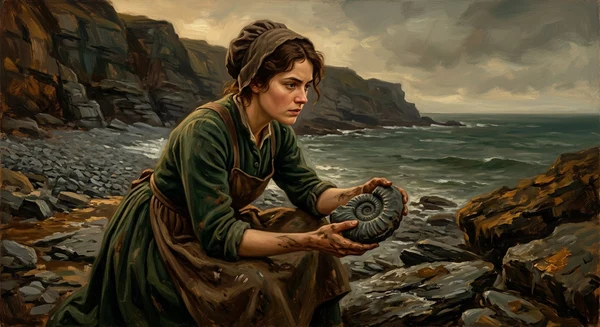
Mary Anning
1799–1847 · Paleontologist
Mary Anning was a self-taught fossil hunter from Lyme Regis who found some of the most important dinosaur-era fossils ever discovered. She was a working-class woman in a world of wealthy male scientists — yet her discoveries transformed our understanding of prehistoric life.
“The world has used me so unkindly, I fear it has made me suspicious of everyone.”
Anning was struck by lightning as a baby and survived — as an adult, she found fossils no one else could, walking the dangerous cliffs of Lyme Regis after every storm.
Why is this scientist famous?
Discovered the first complete Ichthyosaurus skeleton and became the greatest fossil hunter in history.
Anning was a self-taught fossil hunter who found some of the first complete dinosaur-era skeletons, including the first plesiosaur. Her discoveries helped scientists realize that species could go extinct — a radical idea at the time. Every museum dinosaur display and every fossil you see in a classroom owes a debt to the woman who scoured the cliffs of Lyme Regis and changed how we see life's history.
Mary's story
Early Life
Born in 1799 in Lyme Regis, Dorset, Mary Anning was the daughter of a cabinetmaker who collected fossils to supplement his income. The family was poor, and after her father died, Mary and her brother Joseph collected fossils to sell to tourists. She had almost no formal education but taught herself anatomy, geology, and paleontology from the specimens she found.
The Ichthyosaurus
In 1811, at age 12, Mary and her brother found the complete skeleton of an Ichthyosaurus — a marine reptile from 200 million years ago. It was the first complete one ever found. This discovery challenged the belief that the Earth was only a few thousand years old and that no species had ever gone extinct.
The Plesiosaurus and Pterosaur
In 1823, Anning discovered the first complete Plesiosaurus skeleton — a long-necked marine reptile so bizarre that some scientists thought it was a fake. In 1828, she found the first British pterosaur (flying reptile) skeleton. These discoveries showed that prehistoric oceans and skies were filled with creatures unlike anything alive today.
Unrecognized Genius
Despite her extraordinary discoveries, Anning was excluded from the Geological Society of London — women were not admitted. Wealthy male geologists published papers about her fossils without crediting her. She struggled financially her entire life. When she died of breast cancer in 1847 at age 47, the Geological Society finally published a tribute to her. The tongue-twister "she sells seashells by the seashore" was inspired by her.
What did they discover?
First Complete Ichthyosaurus
Discovered the first complete skeleton of an Ichthyosaurus, a 200-million-year-old marine reptile, at age 12.
First Complete Plesiosaurus
Found the first complete Plesiosaurus skeleton in 1823, a creature so strange that scientists initially thought it was a fraud.
First British Pterosaur
Discovered the first pterosaur (flying reptile) skeleton found in Britain in 1828.
Amazing facts
She was struck by lightning as a baby and survived — the same event killed three women standing nearby.
She was only 12 when she found her first major fossil, the Ichthyosaurus.
The tongue-twister "she sells seashells by the seashore" was inspired by her.
She was not allowed to join the Geological Society of London because she was a woman.
She discovered fossils of creatures that proved extinction was real — a controversial idea at the time.
She was so skilled at finding fossils that geologists came from across Europe to buy from her.
Timeline
Born in Lyme Regis, Dorset on May 21
Survived being struck by lightning as a 15-month-old baby
Discovered the first complete Ichthyosaurus skeleton at age 12
Discovered the first complete Plesiosaurus skeleton
Opened her own fossil shop in Lyme Regis
Discovered the first British pterosaur skeleton
Discovered the Squaloraja, a transitional fossil between sharks and rays
Died of breast cancer in Lyme Regis on March 9, age 47
The Geological Society of London published a tribute to her — the first for a woman
Awards & honours
Related Super Scientists
Charles Darwin
1809–1882 · Naturalist & Biologist
Proposing the theory of evolution by natural selection.

Gregor Mendel
1822–1884 · Biologist & Augustinian Friar
Discovered the fundamental laws of genetic inheritance by studying pea plants.
Rachel Carson
1907–1964 · Marine Biologist & Conservationist
Wrote Silent Spring, launching the global environmental movement.
Articles about this scientist
Sources & references
Books and educational kits about Mary Anning coming soon