_(2).jpg)
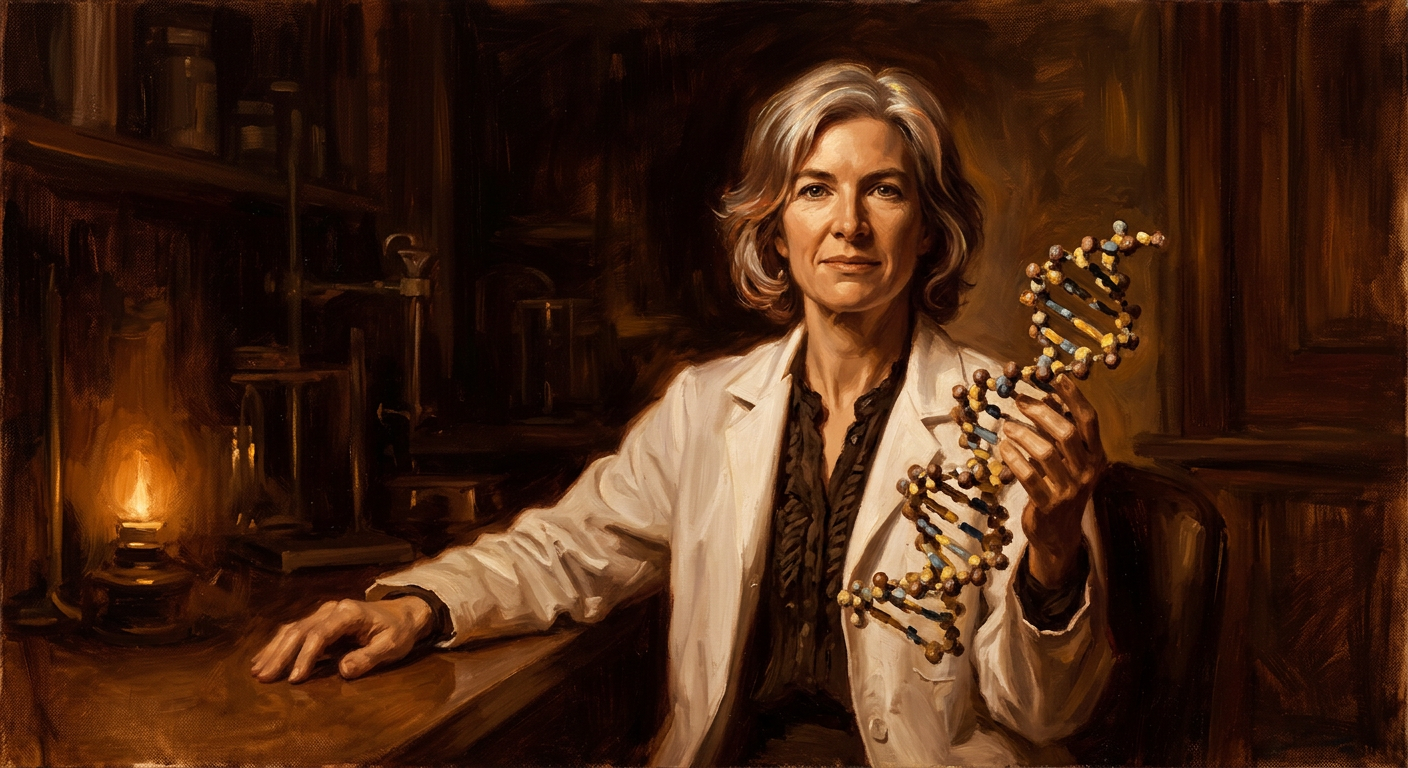
Jennifer Doudna
1964–present · Biochemist
An American biochemist at UC Berkeley whose discovery of how to programme CRISPR as a gene-editing tool launched a revolution in biology and medicine.
“The power to control our species' genetic future is awesome and terrifying. Deciding how to handle it may be the biggest challenge we have ever faced.”
Her father gave her a copy of James Watson’s book ‘The Double Helix’ when she was in sixth grade, growing up in Hilo, Hawaii. She read it in two days and decided she wanted to be a scientist.
Why is this scientist famous?
Co-developed CRISPR-Cas9, the gene-editing technology that allows scientists to rewrite DNA with extraordinary precision, and won the 2020 Nobel Prize in Chemistry for the work.
Jennifer's story
Growing Up in Hilo
Jennifer Anne Doudna was born on 19 February 1964 in Washington, D.C., but she grew up in the small town of Hilo on the Big Island of Hawaii. Her father was an English literature professor who developed a passion for science, and her mother was a historian. The family lived on campus at the University of Hawaii at Hilo, surrounded by tropical greenery and the vast Pacific. Young Jennifer was a curious, bookish child who loved exploring the volcanic landscape. When she was in sixth grade, her father came home with a copy of James Watson’s ‘The Double Helix’, the autobiographical account of discovering the structure of DNA. She read it in two days and announced to her parents that she wanted to be a scientist — not just any scientist, but one who studied the fundamental chemistry of life.
From Curiosity to Chemistry
Doudna earned her bachelor’s degree in biochemistry from Pomona College in California in 1985, where she was mentored by Fred Grieco, a professor who encouraged her to pursue research. She then moved to Harvard University for her doctoral studies, joining the laboratory of Jack Szostak, who would himself win a Nobel Prize in 2009. In Szostak’s lab, she worked on RNA — the molecule that carries genetic information and, in some cases, catalyses chemical reactions. She earned her PhD in 1989 and completed postdoctoral work at the University of Colorado with Thomas Cech, another future Nobel laureate. She was building a reputation as one of the world’s foremost experts on the structure of RNA.
The RNA Years
In 1994, Doudna joined the faculty at Yale University, where she began using X-ray crystallography to determine the three-dimensional structure of RNA molecules. Her work revealed how RNA folds into intricate shapes that allow it to function as a catalyst — a discovery that helped establish the field of ribozyme biology. In 2002, she moved to the University of California, Berkeley, where she continued her structural biology work and became an investigator with the Howard Hughes Medical Institute. She was studying how bacteria defend themselves against viruses when a chance encounter changed the direction of her career.
The CRISPR Discovery
In 2011, at a scientific conference in Puerto Rico, Doudna met Emmanuelle Charpentier, a French microbiologist studying how bacteria use a system called CRISPR to fight off viral infections. The two scientists bonded over a walk through the old city of San Juan and decided to collaborate. Within months, their teams had shown that a protein called Cas9 could be programmed with a piece of RNA to cut DNA at any desired location. The paper, published in the journal Science on 28 June 2012, described a tool that could edit genes with a precision and ease that had never been possible before. It was, in the words of one colleague, ‘the equivalent of giving biologists a word processor for DNA’.
A Tool That Changed the World
The CRISPR-Cas9 paper became one of the most cited scientific publications in history. Within years, laboratories around the world were using the technique to study genes, model diseases, and develop potential cures. Doudna co-founded several companies — Editas Medicine, Intellia Therapeutics, and Caribou Biosciences — to translate the discovery into treatments. But she also became deeply concerned about the ethical implications. In 2015, she helped organise an international summit on human gene editing and spoke publicly about the dangers of using CRISPR to modify human embryos. She has urged scientists and governments to think carefully about where this powerful technology should and should not be used.
The Nobel Prize and Beyond
On 7 October 2020, Doudna was awoken at 2 a.m. by a phone call from Stockholm. She and Charpentier had been awarded the Nobel Prize in Chemistry — the first time two women alone had shared a Nobel science prize. The ceremony, held virtually on 10 December 2020 because of the pandemic, recognised ‘the development of a method for genome editing’. By then, CRISPR-based treatments for sickle cell disease were already in clinical trials, and the first such treatment would be approved by the U.S. Food and Drug Administration in 2023. Doudna continues to lead research at Berkeley, pushing the boundaries of what CRISPR can do while advocating for its responsible use.
What did they discover?
CRISPR-Cas9 Gene Editing (2012)
With Emmanuelle Charpentier, Doudna showed that the Cas9 protein could be guided by RNA to cut DNA at any chosen location, creating a programmable tool for editing genes. This paper launched the CRISPR revolution.
RNA Crystallography
Her earlier work determined the three-dimensional structure of RNA molecules, revealing how RNA folds into shapes that allow it to catalyse chemical reactions — a foundational contribution to ribozyme biology.
CRISPR Diagnostics
Her lab helped develop CRISPR-based diagnostic tools that can detect viral infections, including COVID-19, with the accuracy of PCR tests but far greater speed and simplicity.
Amazing facts
She grew up in Hilo, Hawaii, where her father gave her a copy of James Watson’s ‘The Double Helix’ when she was in sixth grade — sparking her lifelong fascination with the chemistry of life.
She won the 2020 Nobel Prize in Chemistry jointly with Emmanuelle Charpentier — the first time two women alone shared a Nobel science prize.
The CRISPR-Cas9 paper, published in Science in June 2012, is one of the most cited biological papers in history.
Her collaboration with Charpentier began at a conference in Puerto Rico in 2011, where they decided to work together over a walk through Old San Juan.
She was an investigator with the Howard Hughes Medical Institute for over 20 years.
She co-founded three companies — Editas Medicine, Intellia Therapeutics, and Caribou Biosciences — to develop CRISPR-based treatments.
She helped organise the 2015 International Summit on Human Gene Editing to address ethical concerns about modifying human embryos.
She earned her PhD from Harvard working with Jack Szostak, who himself won a Nobel Prize in 2009.
The first CRISPR-based treatment for sickle cell disease was approved by the FDA in 2023, built on foundations she helped lay.
She was elected to the National Academy of Sciences in 2003 and as a foreign member of the Royal Society in 2016.
Timeline
Born in Washington, D.C.
Earned BA in biochemistry from Pomona College
Earned PhD from Harvard University under Jack Szostak
Joined the faculty at Yale University
Moved to UC Berkeley as Professor of Biochemistry
Met Emmanuelle Charpentier at a conference in Puerto Rico; began CRISPR collaboration
Published the landmark CRISPR-Cas9 paper in the journal Science
Co-organised the International Summit on Human Gene Editing
Awarded the Nobel Prize in Chemistry with Emmanuelle Charpentier
First CRISPR-based treatment for sickle cell disease approved by the FDA
Awards & honours
Related Super Scientists
Rosalind Franklin
1920–1958 · Chemist & X-ray Crystallographer
Taking the photograph that revealed the double-helix structure of DNA.
Barbara McClintock
1902–1992 · Geneticist
Discovering transposable elements — jumping genes — that can move within the genome.
James Watson
1928–present · Molecular Biologist & Geneticist
Co-discovered the double-helix structure of DNA.
Sources & references
Books and educational kits about Jennifer Doudna coming soon