_(2).jpg)
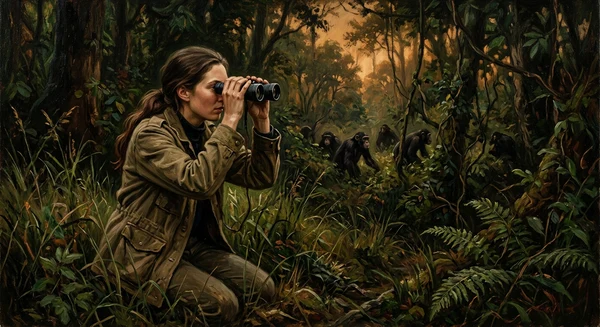
Jane Goodall
1934–present · Primatologist & Anthropologist
Beginning with no formal training, Jane Goodall transformed our understanding of chimpanzees — and ourselves — through patience, courage, and groundbreaking observation.
“Only if we understand, can we care. Only if we care, will we help. Only if we help, shall all life be saved.”
Jane Goodall named the chimpanzees she studied instead of giving them numbers — something no scientist had done before, and it changed how we think about animals forever.
Why is this scientist famous?
Spending 60 years studying wild chimpanzees and redefining what it means to be human.
Jane Goodall lived with wild chimpanzees and showed that they make tools, feel emotions, and form close family bonds — things people once thought only humans could do. Her work changed how we see animals and ourselves. Today she travels the world inspiring young people to protect nature, proving that one person's passion for wildlife can grow into a global movement.
Jane's story
Early Life
Born Valerie Jane Morris-Goodall in London, she was fascinated by animals from childhood. Her mother gave her a toy chimp named Jubilee instead of a teddy bear — friends were horrified, but Jane loved it. At 26, with no university degree, she travelled to Kenya, met the palaeontologist Louis Leakey, and was soon sent to observe chimpanzees in the wild at Gombe Stream in Tanzania.
Gombe
In 1960, Goodall began her study of the chimpanzees of Gombe. For months, the chimps fled at her approach. Eventually they accepted her. Her patience paid off with discoveries that stunned the world: she saw chimpanzees making and using tools — stripping leaves from twigs to fish for termites. Until then, tool-making was thought to be uniquely human.
Changing Science
Leakey arranged for Goodall to earn a PhD at Cambridge — only the eighth person to do a doctorate without a bachelor's degree. She challenged scientific conventions by giving chimpanzees names instead of numbers and describing their distinct personalities, emotions, and family bonds — ideas that were controversial then but are now accepted.
Global Advocate
In 1977, she founded the Jane Goodall Institute. In 1991, she began Roots & Shoots, a global youth programme active in over 60 countries. Traveling 300 days a year, she has become one of the world's most influential voices for conservation, animal welfare, and environmental action.
What did they discover?
Chimpanzee Tool Use
Was the first to document wild chimpanzees making and using tools, forcing a redefinition of what makes humans unique.
Chimpanzee Culture and Emotion
Showed that chimpanzees have distinct personalities, form deep family bonds, and experience emotions like grief and joy.
Roots & Shoots
Founded a global youth environmental programme operating in over 60 countries, inspiring millions of young conservationists.
Amazing facts
Her mother gave her a toy chimpanzee instead of a teddy bear; friends were horrified, but Jane loved it.
She began her research with no university degree — Louis Leakey chose her specifically because she had "no mind cluttered with theory."
She gave chimpanzees names like David Greybeard and Flo, breaking scientific convention that demanded numbering.
She earned a PhD from Cambridge without ever earning a bachelor's degree.
She has travelled about 300 days a year for decades advocating for conservation.
She was made a Dame of the British Empire in 2004 and a UN Messenger of Peace in 2002.
Timeline
Born in London, England
Began studying chimpanzees at Gombe Stream, Tanzania
Earned a PhD from Cambridge without a bachelor's degree
Founded the Jane Goodall Institute
Launched Roots & Shoots youth programme
Named a UN Messenger of Peace
Made a Dame of the British Empire
Awards & honours
Related Super Scientists
Sources & references
Books and educational kits about Jane Goodall coming soon