_(2).jpg)
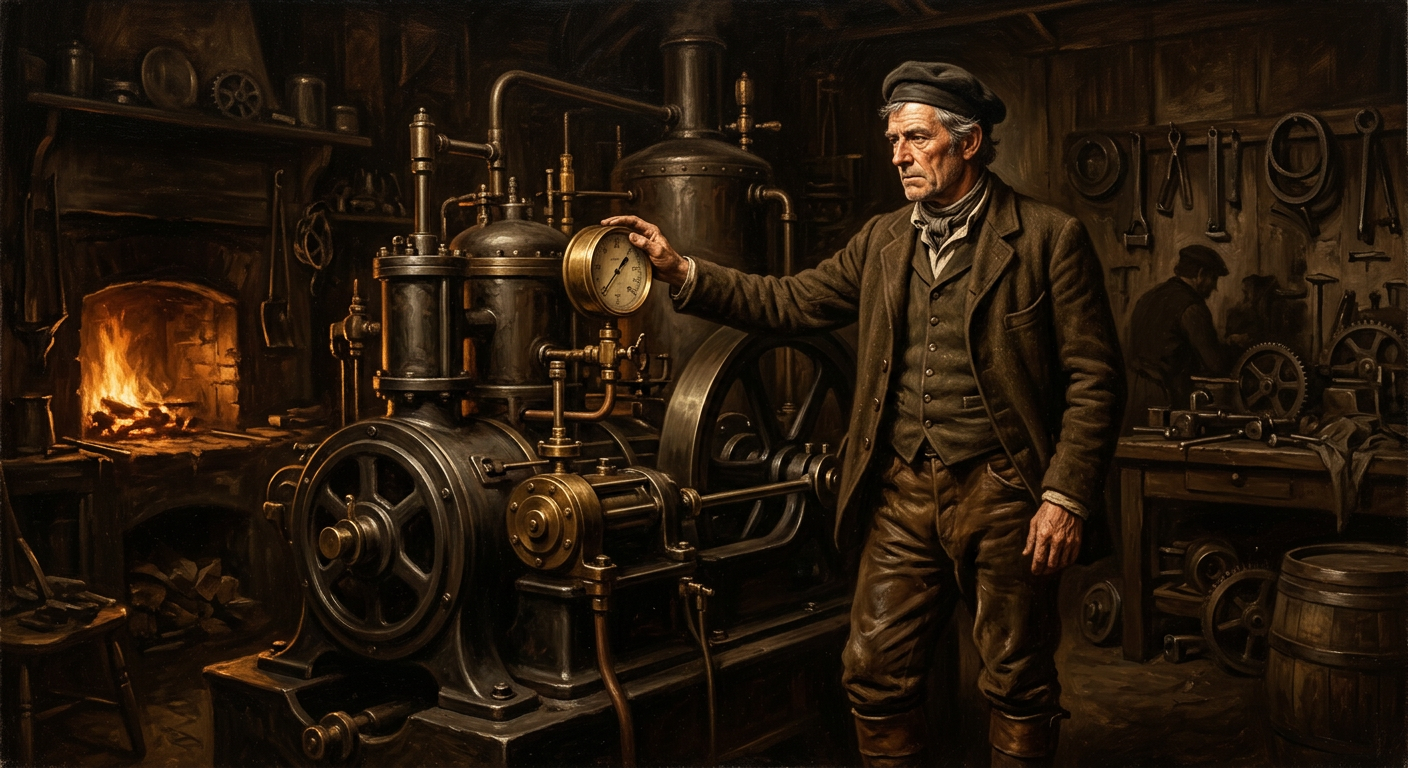
James Watt
1736–1819 · Engineer & Inventor
James Watt was a Scottish engineer whose improvements to the steam engine made it the engine of the Industrial Revolution. His name lives on in the watt, the unit of power used worldwide.
“I can think of nothing but the engine. I would rather have it than a fortune.”
The term ‘horsepower’ was invented by Watt to help customers understand how much work his engines could do — he calculated it by observing ponies lifting coal at a mine.
Why is this scientist famous?
Improving the steam engine so dramatically that his work powered the Industrial Revolution.
Watt improved the steam engine so dramatically that it powered the Industrial Revolution. His engine ran factories, ships, and trains, replacing muscle and water with reliable machine power. The unit we use to measure power — the watt, on every light bulb and appliance label — is named after him because his work literally redefined what "power" meant.
James's story
A Maker from Greenock
James Watt was born in 1736 in the port town of Greenock, Scotland, the son of a shipwright and merchant. His grandfather had been a teacher of mathematics and navigation, and his father ran a small workshop repairing ships’ instruments. Young James was a sickly child, largely educated at home by his mother, who taught him reading, writing, and arithmetic. He showed a remarkable talent for mathematics and for working with his hands — he disassembled and reassembled his toys, built models, and spent hours in his father’s workshop learning to use tools. At 17, he went to Glasgow to learn instrument-making, then to London to complete his training.
The Glasgow Workshop
In 1757, Watt returned to Glasgow and set up a small instrument-making workshop on the university grounds. The University of Glasgow became his intellectual home — he repaired astronomical instruments, telescopes, and scientific apparatus for the professors, and befriended the chemist Joseph Black and the economist Adam Smith, who were both on the faculty. The university gave him space, tools, and a community of brilliant thinkers who would later prove crucial to his greatest breakthrough.
The Steam Engine Breakthrough
In 1763, Watt was asked to repair a model of a Newcomen steam engine, the standard pumping engine used in mines. He noticed it was terribly inefficient — most of the steam’s energy was wasted reheating the cylinder after each stroke. For months he brooded on the problem, walking the streets of Glasgow at night muttering to himself. The solution came to him on a Sunday walk on Glasgow Green in 1765: a separate condenser. If the steam condensed in a separate chamber kept cool, the main cylinder could stay hot, saving enormous amounts of energy. This single insight made the steam engine roughly three times more efficient, transforming it from a crude mine pump into the power source that would drive factories, ships, and railways.
Partnership with Boulton
Watt needed money and manufacturing expertise to build his improved engine. After years of financial struggle and a difficult partnership with the ironmaster John Roebuck, he joined forces with Matthew Boulton, a brilliant manufacturer in Birmingham. Together they formed Boulton & Watt in 1775, based at the Soho Manufactory. Boulton provided capital, skilled workers, and a network of customers; Watt provided the engineering genius. Their engines were soon pumping water from mines across Cornwall, powering textile mills in Lancashire, and driving machinery in factories across Britain. Watt invented the centrifugal governor to automatically regulate engine speed, and the sun-and-planet gear to convert the engine’s up-and-down motion into rotary motion — allowing steam engines to turn wheels, not just pump water.
Legacy
Watt retired in 1800 a wealthy man, his patents expired, and the partnership with Boulton dissolved amicably. He continued inventing in retirement — designing a machine for copying sculptures, improving letter-copying presses, and even experimenting with chemical processes. He died in 1819 at his home in Heathfield, Birmingham, aged 83. The unit of power — the watt — was named in his honour in 1882, and is used to measure everything from light bulbs to power stations. His separate condenser is regarded as one of the most consequential inventions in history: without it, the Industrial Revolution would have been immeasurably slower, and the modern world of mechanised production might never have arrived.
What did they discover?
The Separate Condenser
Watt’s key insight: condensing steam in a separate chamber kept the main cylinder hot, reducing fuel consumption by about 75% and making the steam engine practical for far wider use.
The Sun-and-Planet Gear
A mechanism that converted the steam engine’s reciprocating motion into rotary motion, allowing engines to turn machinery — essential for powering factories and mills.
The Centrifugal Governor
An automatic speed-control device using spinning weights that moved outward as the engine sped up, closing the steam valve — one of the earliest examples of feedback control in engineering.
The Concept of Horsepower
Watt coined ‘horsepower’ to compare his engines to the work of draft horses, giving customers an intuitive measure of power. The unit is still used today for engines and motors.
Amazing facts
He coined the term ‘horsepower’ by measuring how much coal ponies could lift from a mine in a minute — one horsepower equals about 746 watts.
He was largely home-schooled by his mother because of his delicate health, and never attended university as a student.
His partnership with Matthew Boulton created Boulton & Watt, one of the most innovative engineering firms in history, based at the Soho Manufactory in Birmingham.
He walked the streets of Glasgow at night muttering about steam, and his eureka moment came on a Sunday stroll across Glasgow Green in 1765.
He invented a machine for copying letters and documents — an early form of the copying press — that was used in offices for over a century.
He was a member of the Lunar Society of Birmingham, a club of scientists and industrialists that met on nights of the full moon so they could see their way home.
Timeline
Born in Greenock, Scotland
Moved to London to train as an instrument maker
Set up a workshop at the University of Glasgow
Asked to repair a model Newcomen steam engine
Invented the separate condenser during a walk on Glasgow Green
Formed Boulton & Watt with Matthew Boulton in Birmingham
Invented the sun-and-planet gear for rotary motion
Designed the centrifugal governor for automatic speed control
Retired from Boulton & Watt
Died at Heathfield, Birmingham, age 83
Awards & honours
Related Super Scientists
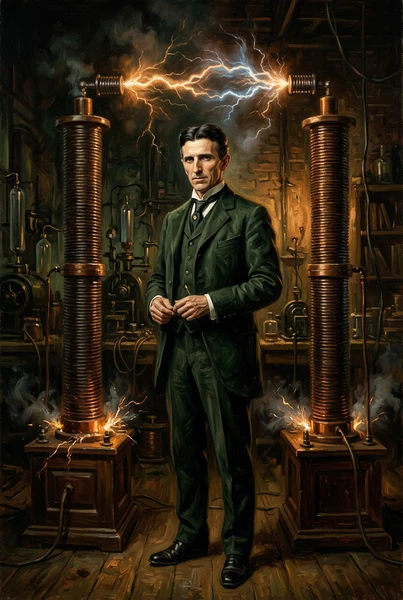
Nikola Tesla
1856–1943 · Inventor & Engineer
Pioneering alternating current (AC) electricity and numerous electrical inventions.
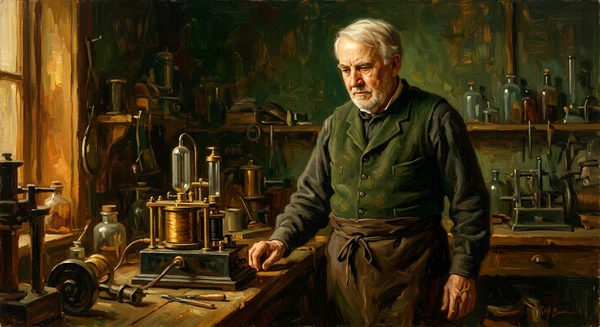
Thomas Edison
1847–1931 · Inventor & Businessman
Invented the practical incandescent light bulb, phonograph, and motion picture camera.
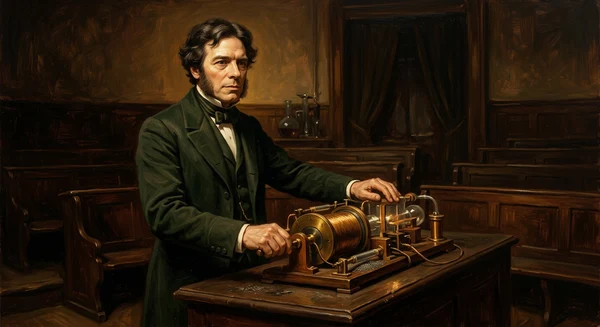
Michael Faraday
1791–1867 · Physicist & Chemist
Discovered electromagnetic induction and built the first electric motor and generator.
Articles about this scientist
Sources & references
Books and educational kits about James Watt coming soon