_(2).jpg)
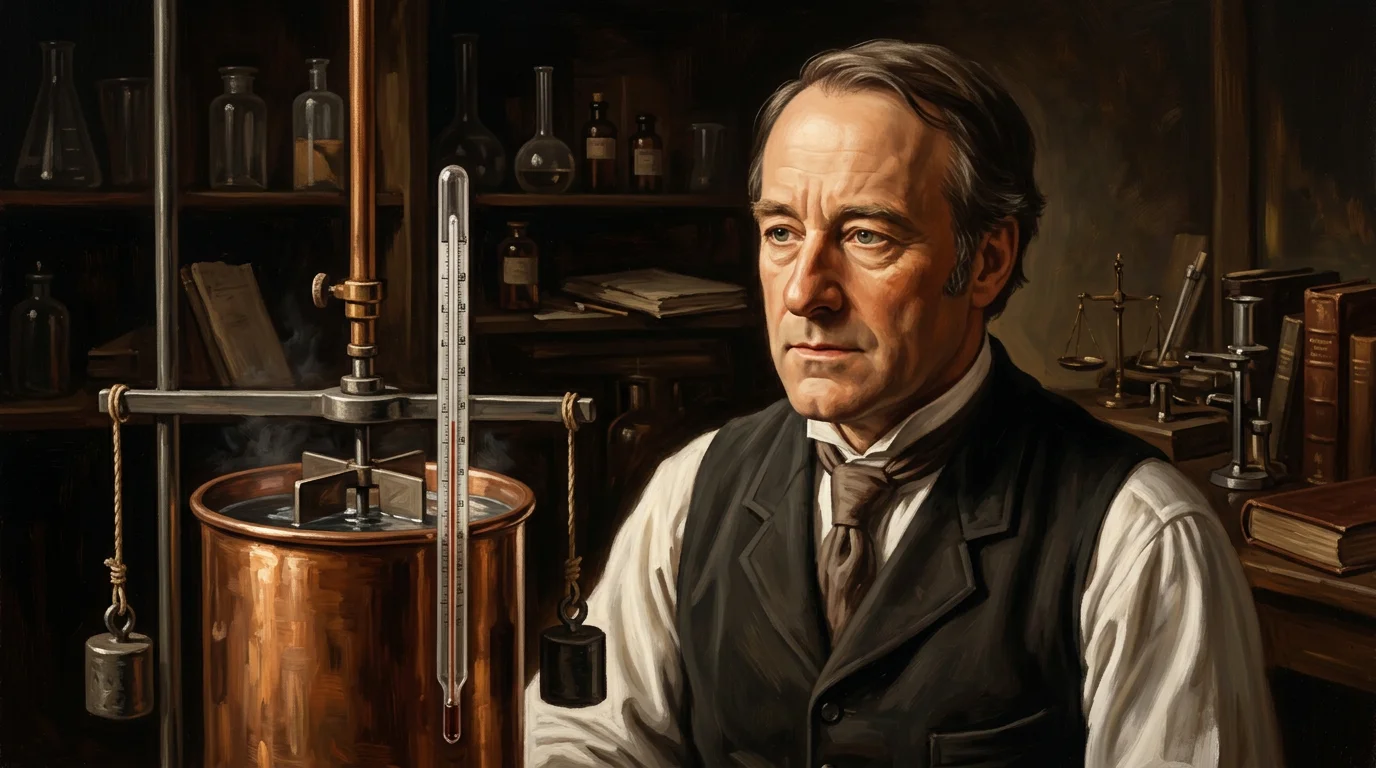
James Prescott Joule
1818–1889 · Physicist
A brewer-turned-physicist from Manchester whose painstaking experiments proved that heat and mechanical work are interchangeable — a discovery that founded the law of conservation of energy.
“Wherever mechanical force is expended, an exact equivalent of heat is always obtained.”
Joule was a beer brewer by trade, and his precision measurements were so refined he could detect temperature changes of less than a thirtieth of a degree — using a thermometer in his brewery.
Why is this scientist famous?
Showed that heat is a form of energy and established the mechanical equivalent of heat. The SI unit of energy, the joule (J), is named after him.
James's story
The Brewer of Manchester
James Prescott Joule was born in Salford, near Manchester, the son of a wealthy brewer. The Joule family brewery was a prosperous business, and James was expected to take it over. But from an early age he was fascinated by science and mathematics. He was tutored privately by the renowned chemist John Dalton, who recognised the boy's exceptional aptitude for precise measurement. Joule grew up surrounded by the vats, pumps, and thermometers of the brewery, and it was this environment that shaped his scientific character: a brewer's obsession with temperature, pressure, and the efficient use of energy.
The Electric Motor Quest
In the late 1830s Joule became interested in the recently invented electric motor, seeing it as a potential replacement for the steam engines used in his family's brewery. He built his own motors and studied their efficiency meticulously, measuring the heat produced by electric currents flowing through wires. In 1841 he discovered that the heat generated by an electric current is proportional to the square of the current multiplied by the resistance — a relationship now known as Joule's Law. His goal was practical: to determine whether electric motors could economically replace steam power. But the pursuit led him to something far more fundamental.
The Mechanical Equivalent of Heat
Joule's most important work began in 1843, when he set out to determine the precise relationship between mechanical work and heat. He designed a series of increasingly elegant experiments. In his most famous, falling weights turned a paddle wheel inside an insulated container of water, and he measured the tiny temperature rise caused by the churning. The experiment was extraordinarily delicate: the water warmed by only a fraction of a degree, yet Joule's thermometer could detect changes smaller than a thirtieth of a degree. He found that the same amount of mechanical work always produced the same amount of heat, no matter how the work was done — by paddle wheel, by friction, by gas compression, or by electric current. This fixed ratio was the mechanical equivalent of heat.
Indifference and Recognition
When Joule presented his results at a meeting of the British Association for the Advancement of Science in Cork in 1843, he was met with silence. The Royal Society rejected one of his papers for publication. The scientific establishment was committed to the caloric theory, which treated heat as a weightless fluid, and was not ready to accept that heat was simply another form of energy. But Joule persevered, publishing his work privately and refining his measurements. His breakthrough in recognition came through an encounter with William Thomson (later Lord Kelvin) in 1847. Thomson was initially sceptical but recognised the quality of Joule's work and became his ally. Within a few years, the scientific community accepted that energy is conserved — that it can change form but is never created or destroyed.
Collaboration with Kelvin
Joule and Thomson formed one of the most productive partnerships in nineteenth-century physics. Together they studied the cooling of gases when they expand without doing work — the Joule-Thomson effect — which became important for refrigeration and gas liquefaction. Joule's precision in measurement complemented Thomson's theoretical brilliance perfectly. Their collaboration lasted years and produced results that neither could have achieved alone. Joule also corresponded with other leading scientists of the day, but it was the Manchester environment — the world of practical men, engines, and industry — that shaped his approach to science. He was proof that great physics could come from a brewery as well as a university.
Legacy
Joule died in 1889 at the age of 70, having lived to see his work fully accepted and celebrated. The SI unit of energy was named the joule in his honour in 1889, the year of his death. His discovery of the mechanical equivalent of heat was the foundation of the first law of thermodynamics — the principle that energy is conserved — which is one of the most important laws in all of physics. Every time we calculate the energy in food, fuel, or a battery, we are using the framework Joule built. The brewer from Manchester had proved that the universe keeps a strict energy account, and that nothing is ever lost.
What did they discover?
The Mechanical Equivalent of Heat
Through his paddle-wheel experiment and others, Joule proved that a fixed amount of mechanical work always produces the same amount of heat. This was the foundation of the law of conservation of energy and the first law of thermodynamics.
Joule's Law of Heating
Discovered in 1841 that the heat produced by an electric current is proportional to the square of the current multiplied by the resistance (P = I²R). This relationship is fundamental to electrical engineering and is used in everything from fuse design to heating appliances.
The Joule-Thomson Effect
Working with William Thomson (Lord Kelvin), Joule discovered that most gases cool when they expand without doing external work. This effect is essential to modern refrigeration and the liquefaction of gases.
The SI Unit of Energy
The joule (J), the SI unit of energy, was named in his honour in 1889. One joule is the energy expended when a force of one newton acts over a distance of one metre — a direct echo of his paddle-wheel experiments.
Amazing facts
Joule was a beer brewer by trade, and he conducted many of his most important experiments in the brewery's laboratory between brews.
His precision was so great he could measure temperature changes of less than a thirtieth of a degree — using a specially constructed thermometer.
When he presented his mechanical equivalent of heat to the British Association in 1843, he was met with complete silence — the audience did not believe him.
The Royal Society rejected one of his key papers for publication, but he published it himself and was proved right within a few years.
He was tutored as a boy by the famous chemist John Dalton, who instilled in him a lifelong obsession with precise measurement.
Joule met his wife Amelia on a walking holiday in the Lake District, and they honeymooned in the Alps, where he attempted to measure the temperature difference between the top and bottom of a waterfall.
Timeline
Born in Salford, near Manchester, England
Began building electric motors and studying their efficiency at the family brewery
Discovered Joule's Law: the heat from an electric current is proportional to the square of the current times the resistance
Presented the mechanical equivalent of heat at the British Association meeting in Cork, met with silence
Performed his famous paddle-wheel experiment, measuring heat from mechanical work in water
Met William Thomson (Lord Kelvin), who became his key ally and collaborator
Discovered the Joule-Thomson effect: gases cool when expanding without doing work
Elected president of the Manchester Literary and Philosophical Society
Died in Sale, Cheshire, aged 70 — the same year the joule was named as the SI unit of energy
Awards & honours
Related Super Scientists
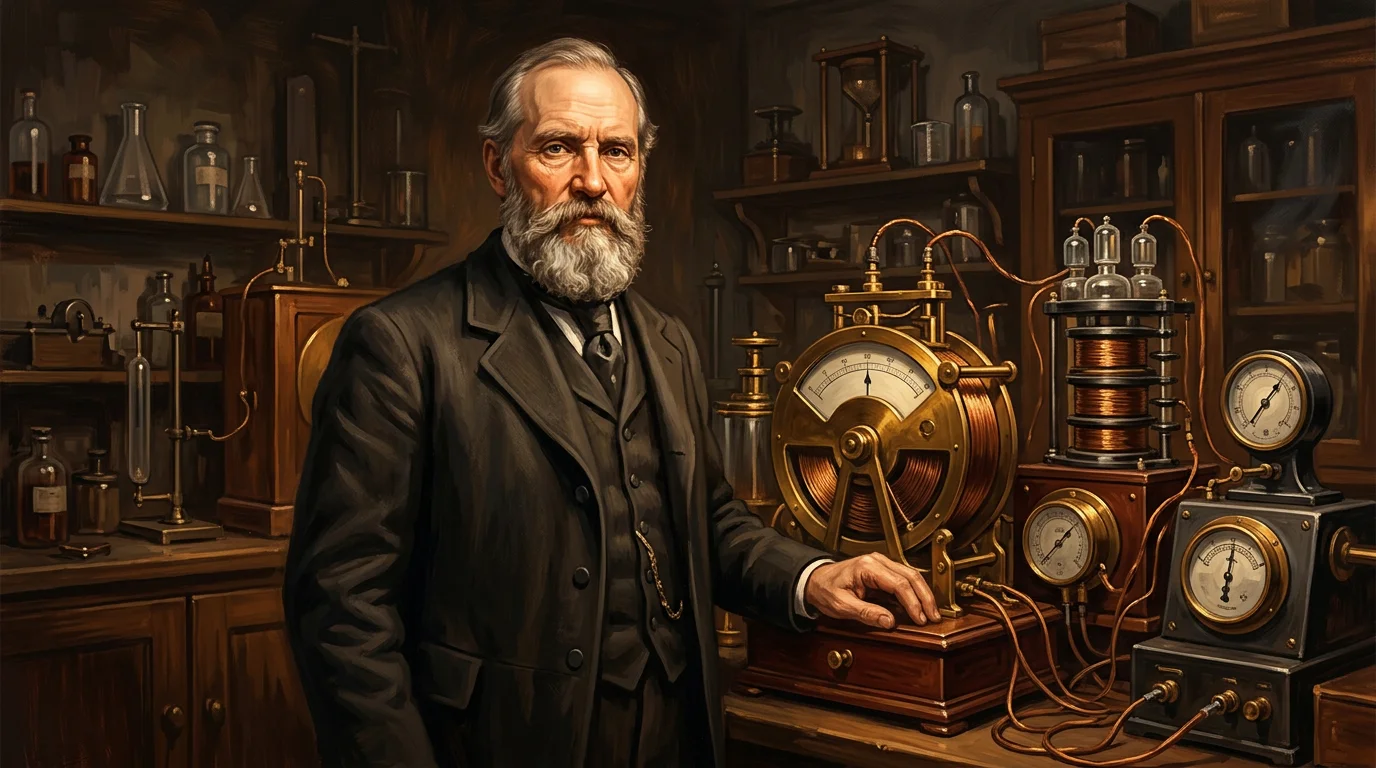
William Thomson, Lord Kelvin
1824–1907 · Physicist and Engineer
Developed the absolute temperature scale measured in kelvins (K), made major contributions to thermodynamics, and played a key role in the laying of the transatlantic telegraph cable.
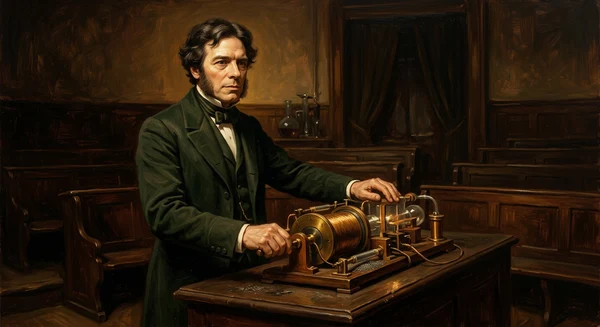
Michael Faraday
1791–1867 · Physicist & Chemist
Discovered electromagnetic induction and built the first electric motor and generator.
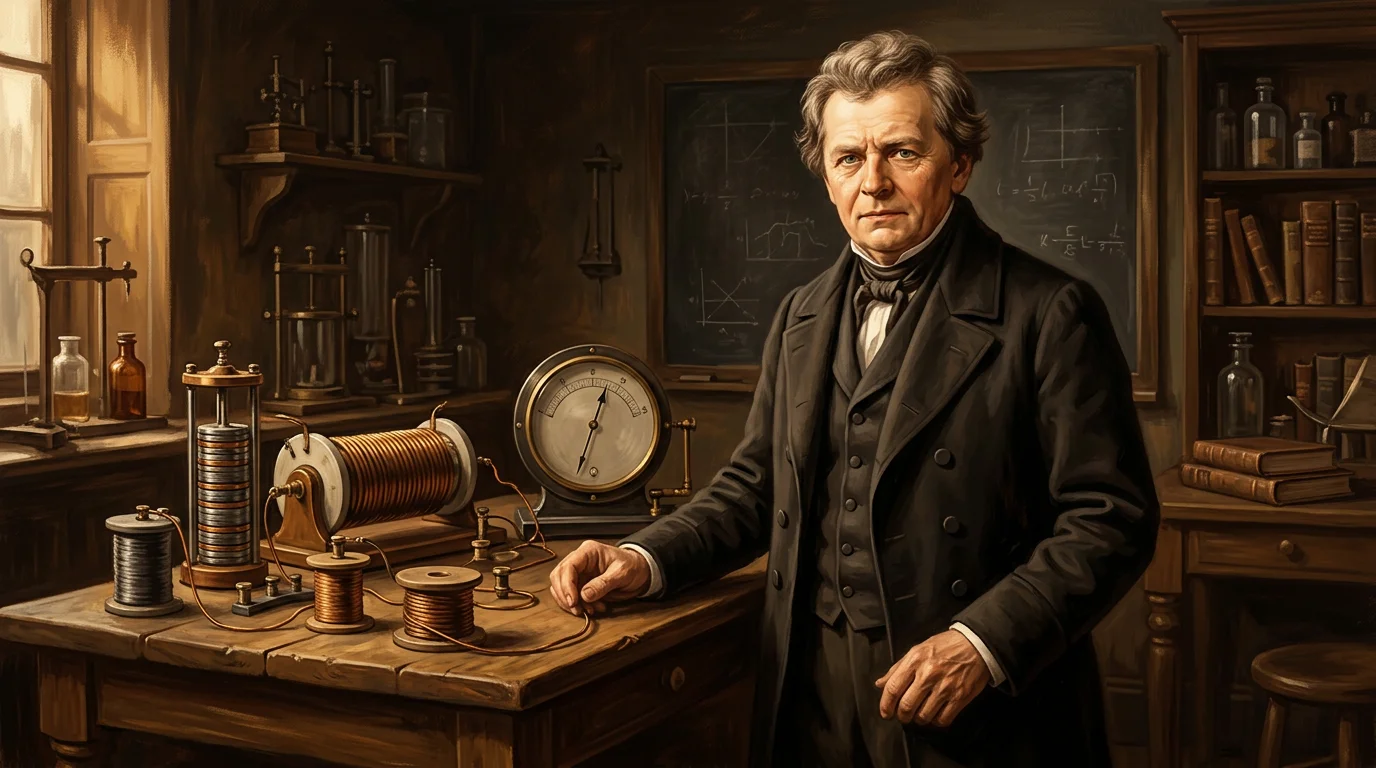
Georg Simon Ohm
1789–1854 · Physicist and Mathematician
Discovered Ohm's Law, the fundamental relationship between voltage, current, and resistance. The unit of electrical resistance, the ohm, is named after him.
Sources & references
Books and educational kits about James Prescott Joule coming soon