_(2).jpg)
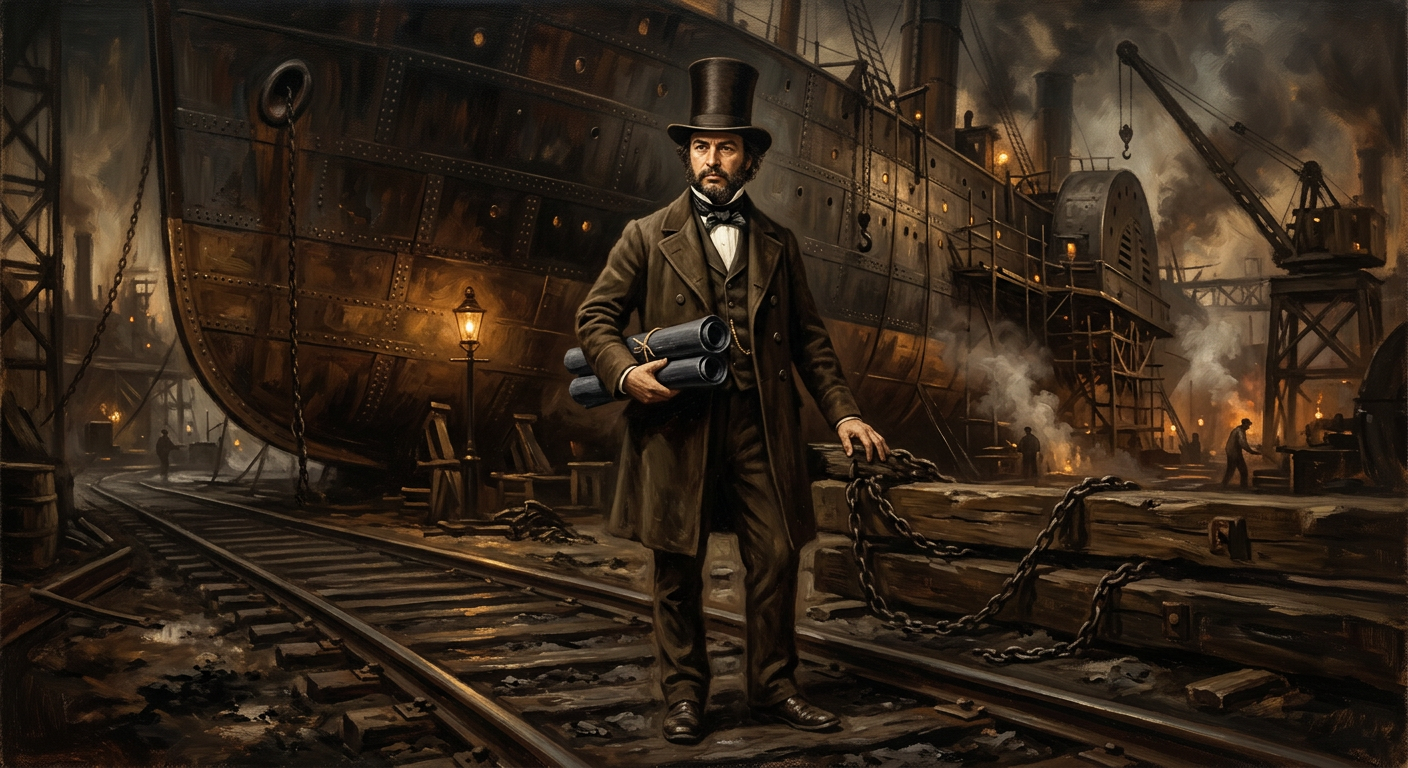
Isambard Kingdom Brunel
1806–1859 · Civil and Marine Engineer
A daring English engineer whose bridges, railways, and record-breaking ships transformed the Industrial Revolution and changed how people travelled forever.
“I am opposed to the laying down of rules or conditions to be observed in the construction of bridges lest the progress of improvements tomorrow might be embarrassed or shackled by recording or registering as law the prejudices or errors of today.”
Brunel was so small at birth that he was feared dead — his aunt sent for a doctor, who offered no hope. But his mother kept him warm and he survived, growing into a man who would build the biggest ships in the world.
Why is this scientist famous?
The visionary engineer who built the Great Western Railway and the world's largest steamships, reshaping Victorian Britain's transport network.
Brunel designed ships, bridges, and railways that pushed engineering to its limits. His Clifton Suspension Bridge still carries traffic today. He showed that bold engineering could connect communities and transform economies. Modern infrastructure projects — from cross-channel tunnels to skyscrapers — follow his example of thinking big and building to last.
Isambard's story
Born to Build
Isambard Kingdom Brunel was born on 9 April 1806 in Portsea, near Portsmouth, England. His father, Marc Brunel, was a French-born engineer who had fled the French Revolution and become one of Britain''s most innovative engineers. Marc recognised his son''s extraordinary talent early and gave him drawing lessons, took him on site visits, and sent him to school in France — the best engineering education available at the time. Young Isambard returned to England at 16 and went to work for his father. He was precise, demanding, and relentless, with a draftsman''s eye for detail and a showman''s flair for the dramatic.
The Thames Tunnel
Brunel''s first great project was also his most dangerous. His father had begun digging a tunnel under the River Thames — the first tunnel ever built under a navigable river. In 1828, when Isambard was just 22, the tunnel flooded catastrophically. Six men drowned. Isambard was swept to the top of the shaft and clung to a chain, badly injured. He spent months recovering, but the experience only hardened his resolve. The tunnel was eventually completed in 1843 and is still used today as part of London''s Overground rail network. It was a feat that made the Brunels famous — and made Isambard hungry for bigger challenges.
The Great Western Railway
In 1833, at just 27, Brunel was appointed chief engineer of the Great Western Railway, charged with connecting London to Bristol. He threw himself into the project with breathtaking ambition. He designed a broad gauge track (seven feet wide instead of the standard four feet eight and a half inches) for smoother, faster rides. He built viaducts, cuttings, and tunnels — including the famous Box Tunnel, then the longest railway tunnel in the world at nearly two miles. He designed Paddington Station, still one of London''s most magnificent railway buildings. The line opened in 1841 and was an immediate triumph, cutting the London-to-Bristol journey from a grueling day''s travel to a comfortable few hours.
The Three Great Ships
Brunel was not content with railways. He dreamed of connecting London to New York by a single iron chain: train to Bristol, then steamship across the Atlantic. To do this, he built three ships, each the largest in the world when launched. The SS Great Western (1837) was a wooden paddle steamer that crossed the Atlantic in 15 days. The SS Great Britain (1843) was the first iron-hulled, screw-propellered ocean liner — a design so revolutionary that every modern ship descends from it. The SS Great Eastern (1858) was so vast (692 feet long) that it would not be surpassed in size for 40 years. It was a triumph of engineering but a financial disaster, and Brunel died shortly after its first troubled voyage.
A Relentless Visionary
Brunel worked at a pace that would destroy most people. He slept four hours a night, smoked cigars constantly, and kept a desk piled with drawings and letters. He inspected every detail of his projects personally, from the curvature of rails to the rivets on ship hulls. He was vain, charismatic, and impossible to work with — and impossible to work without. His bridges, tunnels, and stations are still standing and still in use, 160 years after his death. He died on 15 September 1859, aged just 53, likely from a stroke brought on by overwork and kidney disease. Ten thousand people lined the route of his funeral procession in London.
What did they discover?
The Great Western Railway
His London-to-Bristol railway, with its broad gauge track, Box Tunnel, and Paddington Station, set new standards for speed, comfort, and engineering ambition in rail travel.
SS Great Britain
Launched in 1843, it was the first iron-hulled, screw-propellered ocean liner — a design so revolutionary that every large ship built since traces its ancestry to this vessel. It is now restored and on display in Bristol.
SS Great Eastern
At 692 feet long, it was the largest ship ever built when launched in 1858 and would not be surpassed for 40 years. It was the first ship to be built with a double iron hull and cellular construction.
Clifton Suspension Bridge
His design for a spectacular suspension bridge over the Avon Gorge in Bristol was completed after his death in 1864 and remains one of Britain''s most iconic engineering landmarks.
Amazing facts
Brunel was so small at birth that he was feared dead, but his mother kept him warm and he survived — and grew up to build the biggest ships in the world.
He was sent to school in France at age 14 because Britain had no engineering schools at the time.
He survived the catastrophic 1828 Thames Tunnel flood that killed six men — he was swept to the top of the shaft and clung to a chain, badly injured.
He slept only four hours a night and smoked up to 40 cigars a day while managing multiple enormous projects simultaneously.
His broad gauge railway track (7 feet wide) was smoother and faster than standard gauge, but was eventually forced to conform to the national standard — a defeat that still frustrates railway enthusiasts.
The SS Great Britain, his iron-hulled screw-propeller ship, is now fully restored and sits in the dry dock in Bristol where she was originally built, visited by millions of tourists.
Timeline
Born in Portsea, near Portsmouth, England
Sent to France for his education, studying mathematics and engineering at the Lycée Henri-Quatre in Paris
Returned to England and began working with his father Marc on the Thames Tunnel project
Severely injured in the Thames Tunnel flood that killed six workers — spent months recovering
Appointed chief engineer of the Great Western Railway at age 27
SS Great Western launched — the largest steamship in the world, crossing the Atlantic in 15 days
Great Western Railway London-to-Bristol line completed, including the 1.83-mile Box Tunnel
SS Great Britain launched — the first iron-hulled, screw-propellered ocean liner
The Great Western Railway''s broad gauge line fully operational, offering faster smoother rides than any rival
Construction began on SS Great Eastern, designed to carry 4,000 passengers to Australia without refuelling
SS Great Eastern launched after enormous difficulty — at 692 feet it was the largest ship ever built
Died in London at age 53, ten days after suffering a stroke aboard the Great Eastern
Awards & honours
Related Super Scientists
Nikola Tesla
1856–1943 · Inventor & Engineer
Pioneering alternating current (AC) electricity and numerous electrical inventions.
James Watt
1736–1819 · Engineer & Inventor
Improving the steam engine so dramatically that his work powered the Industrial Revolution.
Michael Faraday
1791–1867 · Physicist & Chemist
Discovered electromagnetic induction and built the first electric motor and generator.
Sources & references
Books and educational kits about Isambard Kingdom Brunel coming soon