_(2).jpg)
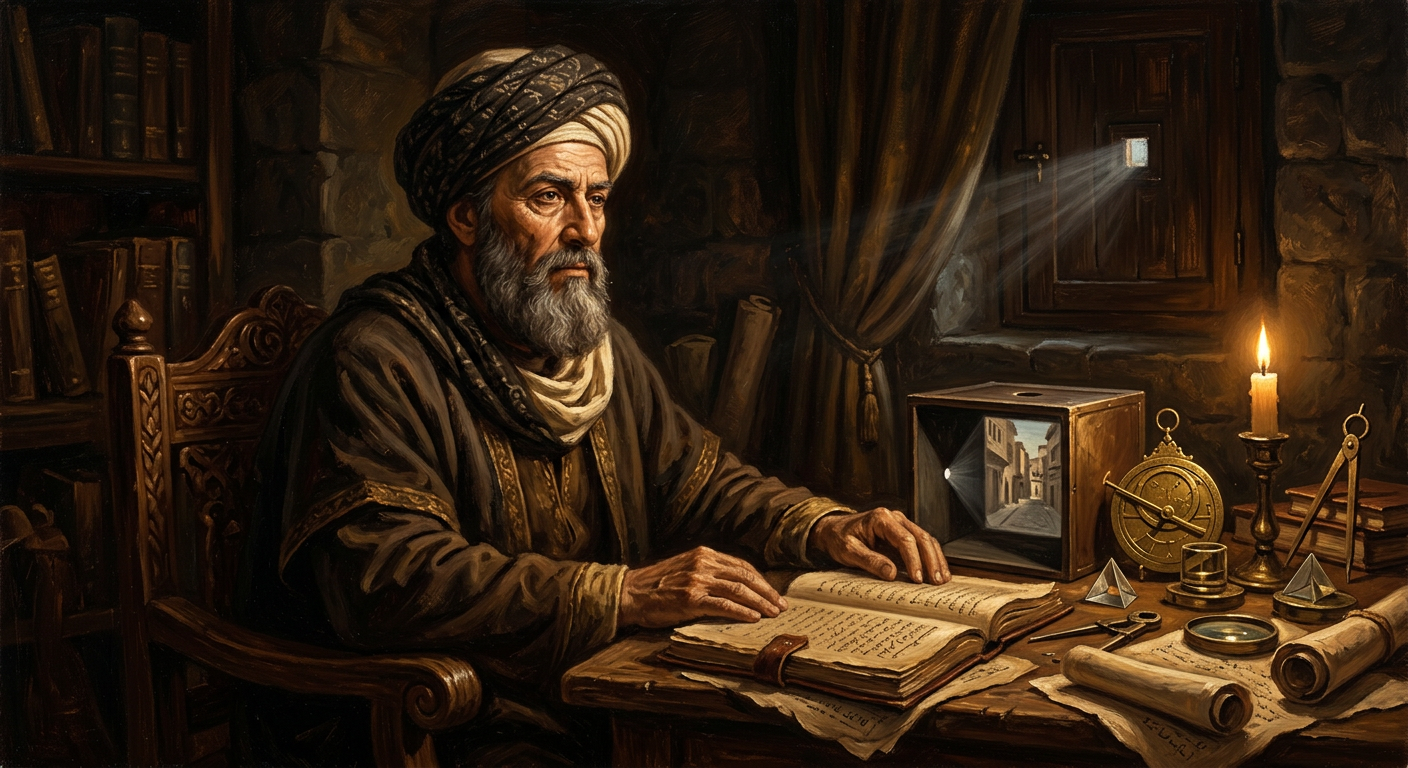
Ibn al-Haytham
965–1040 · Mathematician and Astronomer
Ibn al-Haytham was an Arab scholar who lived 1,000 years ago and pioneered the science of optics and the experimental method. His Book of Optics overturned ancient ideas about vision and laid the foundation for how science is done today.
“The seeker after truth is not the one who follows his natural disposition to trust the writings of the ancients. The seeker after truth is the one who suspects them, questions them, and submits only to argument and experiment.”
He spent years under house arrest in Cairo after failing to build a dam on the Nile, and used that time of confinement to write his greatest work, the Book of Optics.
Why is this scientist famous?
Pioneering the science of optics and the experimental scientific method through his Book of Optics, written over 1,000 years ago.
Ibn's story
Early Life in Basra
Ibn al-Haytham, known in Europe as Alhazen, was born around the year 965 in the city of Basra, in what is now Iraq. Little is known about his early life, but he grew up in a thriving centre of Islamic learning during the Islamic Golden Age, a time when scholars across the Arab world were translating Greek and Persian texts, building observatories, and pushing the boundaries of mathematics, astronomy, and medicine. As a young man, Ibn al-Haytham studied theology, mathematics, and the works of Aristotle and Euclid. He was appointed to a government post in Basra but found the work tedious and distracting. His mind was fixed on bigger questions: how does light work? How do we see? Can the movements of the stars be predicted with mathematics?
The Nile Dam and House Arrest
The story of how Ibn al-Haytham came to Cairo is one of the most remarkable episodes in the history of science. The Fatimid caliph al-Hakim, ruler of Egypt, heard of Ibn al-Haytham’s reputation as an engineer and invited him to Cairo to solve a problem that had plagued Egypt for centuries: the annual flooding of the Nile. Ibn al-Haytham proposed building a massive dam south of Aswan to regulate the river’s flow. He traveled to Egypt and surveyed the site, but when he saw the sheer scale of the Nile and the engineering challenges involved, he realised the dam could not be built with the technology of the time. Fearful of the caliph’s legendary wrath, Ibn al-Haytham pretended to be mad to escape punishment. He was placed under house arrest in Cairo for years, his property confiscated, his freedom gone. But instead of despairing, he turned his confinement into one of the most productive periods of intellectual work in history. In that small house in Cairo, surrounded by books and simple instruments, he wrote his masterpiece.
The Book of Optics
Ibn al-Haytham’s great work, the Kitab al-Manazir, or Book of Optics, written in seven volumes over many years, fundamentally changed how humanity understood vision and light. Before him, the accepted theory, going back to the ancient Greeks, was that the eyes emitted rays that touched objects, like a kind of invisible feeler. Euclid and Ptolemy had taught this, and for over a thousand years nobody seriously questioned it. Ibn al-Haytham demolished this idea with a simple but devastating argument: if the eye emitted rays, we should be able to see in the dark. He proposed instead that vision happens because light enters the eye from the outside, bouncing off objects and travelling in straight lines. He proved this with experiments: he studied how light bends when passing through water and glass, how shadows form, how colours appear in the atmosphere. He built a camera obscura — a darkened room with a pinhole that projects an inverted image — to demonstrate how light travels in straight lines. He was the first person to understand that the eye is a passive receiver, not an active projector.
The Scientific Method
What makes Ibn al-Haytham revolutionary is not just what he discovered but how he discovered it. In his writings, he laid out a philosophy of knowledge that was astonishingly modern. He insisted that every claim about the physical world must be tested by experiment, and that experiments must be repeatable so others could verify the results. He wrote detailed instructions for every experiment in his book, telling readers not to take his word for anything but to build the equipment and run the tests themselves. He criticised blind trust in ancient authority, arguing that the seeker after truth must question the writings of the ancients and submit only to argument and experiment. This was a radical break from the intellectual tradition of his time, when scholars were expected to quote Aristotle and defend old ideas rather than test new ones. In effect, he described the scientific method 600 years before it reached Europe.
Mathematics and Astronomy
Beyond optics, Ibn al-Haytham made important contributions to mathematics and astronomy. He wrote on geometry, developing early ideas about what we now call algebraic geometry, and he found a formula for calculating the volume of a curved solid using a method that foreshadowed integral calculus by six centuries. In astronomy, he wrote Doubts Concerning Ptolemy, a bold critique of the great Greek astronomer’s models of planetary motion. He argued that Ptolemy’s mathematical models did not correspond to any real physical mechanism, a position that pushed the field toward more physically realistic descriptions of the cosmos. He also studied the atmosphere, estimating its height by observing how twilight lingers after sunset, and he correctly explained that the moon appears larger near the horizon because of atmospheric distortion, not because the moon itself changes size.
Legacy
Ibn al-Haytham died around 1040 in Cairo, but his influence spread far beyond the Arab world. His Book of Optics was translated into Latin in the late 12th century and became a standard text in European universities for centuries. Roger Bacon, the English friar often credited as an early advocate of the scientific method, relied heavily on Ibn al-Haytham’s work. Johannes Kepler used his findings on optics to explain how the eye focuses images. His approach to experiment and evidence helped shape the scientific revolution in Europe, even though few Europeans knew his name — they knew him only as Alhazen. Today, historians of science recognise him as one of the most important figures in the entire history of human knowledge, a man who lived a thousand years ago and helped invent the way we seek truth.
What did they discover?
The Book of Optics (Kitab al-Manazir)
A seven-volume work that overturned the ancient Greek theory of vision by proving that light enters the eye from outside, travelling in straight lines. It became the standard text on optics in European universities for centuries.
The Camera Obscura
Ibn al-Haytham built and described the camera obscura, a darkened room with a pinhole that projects an inverted image of the outside world. He used it to prove that light travels in straight lines, and it later became the basis for photography.
Founding the Experimental Method
He insisted that every claim about the physical world be verified by repeatable experiments, and that scholars must question ancient authority rather than blindly trust it. This principle, written 600 years before the European Renaissance, is the foundation of modern science.
Doubts Concerning Ptolemy
A bold critique of the ancient astronomer Ptolemy’s models of planetary motion, arguing that mathematical models must correspond to real physical mechanisms. It pushed astronomy toward more realistic descriptions of the cosmos.
Atmospheric Studies
He estimated the height of the atmosphere by measuring how long twilight persists after sunset, and correctly explained the moon illusion — the apparent enlargement of the moon near the horizon — as an effect of atmospheric distortion.
Early Calculus-like Methods
He developed a method for calculating the volume of a curved solid by breaking it into infinitely thin slices, a technique that foreshadowed integral calculus by six centuries.
Amazing facts
He pretended to be mad to escape execution after failing to build a dam on the Nile, then spent years under house arrest writing his greatest work.
His Latinised name, Alhazen, is how he was known to European scholars for centuries — most never knew his real name.
He proved that we see because light enters the eye, overturning a theory held for over 1,000 years that the eye emits rays to touch objects.
He wrote that scholars must question the ancient Greeks and test ideas with experiments, 600 years before the European scientific revolution.
His Book of Optics was translated into Latin and remained a standard university text in Europe for centuries.
He built a camera obscura to demonstrate how light travels in straight lines, the same principle behind every camera today.
He correctly explained the moon illusion — that the moon looks bigger near the horizon — as an atmospheric effect, not a change in the moon itself.
He developed a method for finding the volume of curved solids that foreshadowed integral calculus by 600 years.
He criticised Ptolemy’s planetary models for not matching physical reality, a position that helped push astronomy forward.
He estimated the height of the Earth’s atmosphere by measuring how long twilight lasts after sunset.
Timeline
Born in Basra, in what is now Iraq
Appointed to a government post in Basra but devoted himself to studying mathematics and science
Invited to Cairo by the caliph al-Hakim to solve the Nile flooding problem
Realised the Nile dam could not be built and pretended to be mad to escape the caliph’s wrath
Placed under house arrest in Cairo, where he began his major scientific writings
Continued writing after al-Hakim’s death and regained his freedom
Completed the Book of Optics, his seven-volume masterpiece on light and vision
Wrote Doubts Concerning Ptolemy, critiquing the ancient astronomer’s planetary models
Studied atmospheric phenomena and estimated the height of the atmosphere
Died in Cairo, around age 75
Awards & honours
Related Super Scientists
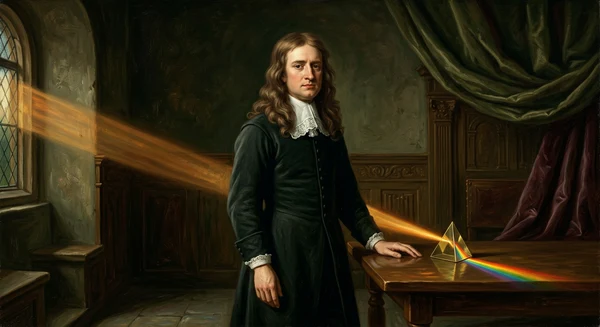
Isaac Newton
1643–1727 · Physicist & Mathematician
Formulating the laws of motion and universal gravitation.
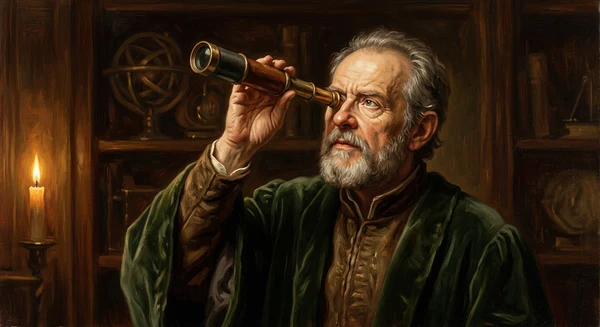
Galileo Galilei
1564–1642 · Astronomer & Physicist
Proving that the Earth orbits the Sun and founding modern observational astronomy.
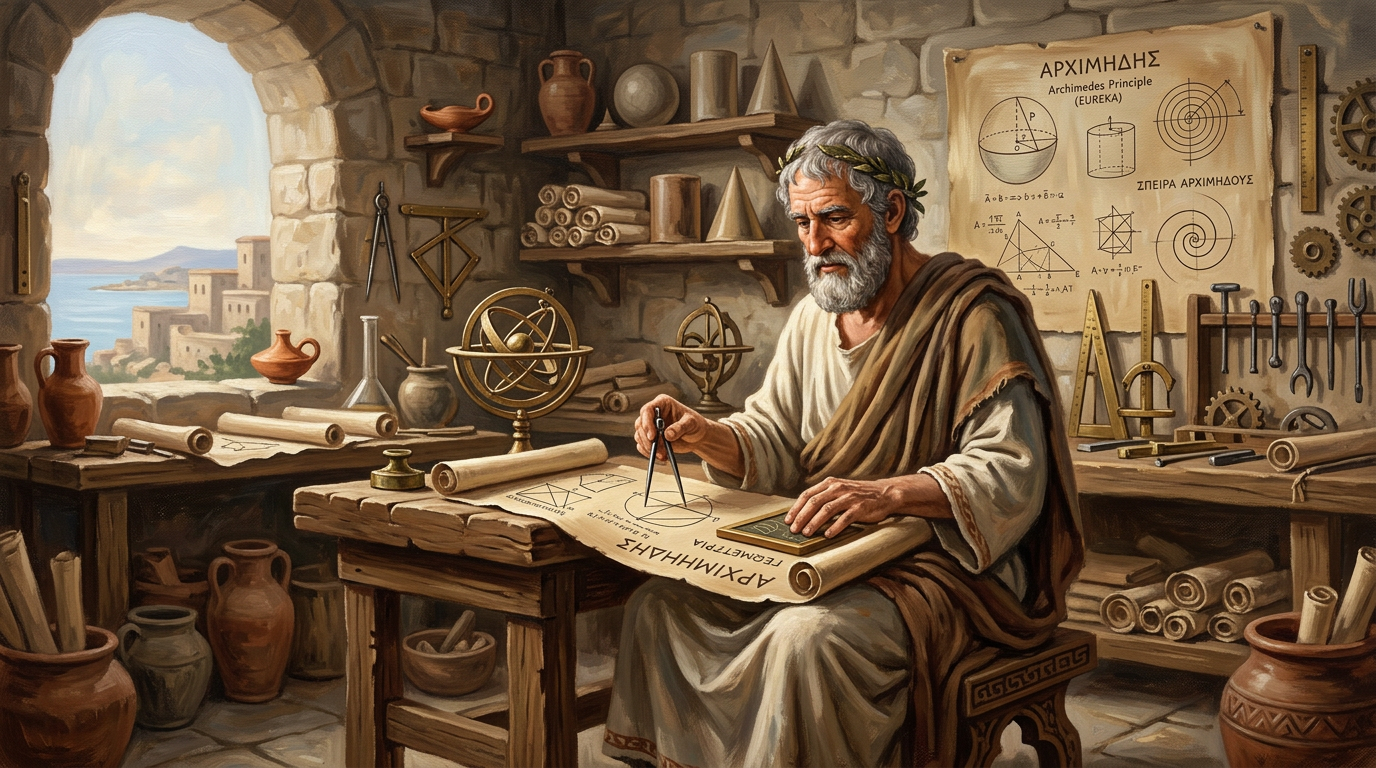
Archimedes
-287–-212 · Mathematician and inventor
Discovering the principles of buoyancy, the lever, and pioneering mathematical methods that anticipated calculus.
Sources & references
Books and educational kits about Ibn al-Haytham coming soon