_(2).jpg)
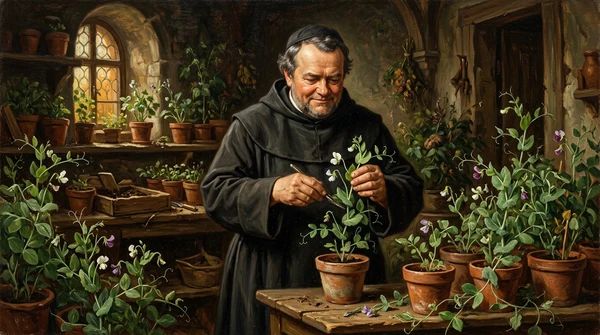
Gregor Mendel
1822–1884 · Biologist & Augustinian Friar
Gregor Mendel was an Augustinian friar who discovered the basic principles of heredity by breeding thousands of pea plants in his monastery garden. His work, ignored for 35 years, became the foundation of modern genetics.
“My scientific labors have brought me a great deal of satisfaction, and I am convinced that it will not be long before the whole world acknowledges the results of these labors.”
Mendel grew and studied nearly 30,000 pea plants over 8 years, carefully counting every trait — and discovered the hidden mathematical rules of inheritance that no one had noticed before.
Why is this scientist famous?
Discovered the fundamental laws of genetic inheritance by studying pea plants.
Mendel counted pea plants in a garden and discovered the hidden rules of inheritance — how traits pass from parents to children. His work is the foundation of genetics, the science that helps doctors predict inherited diseases and farmers breed better crops. Every time you hear about DNA or a genetic test, it traces back to his patient counting.
Gregor's story
Early Life
Born Johann Mendel in 1822 in the Austrian Empire (now Czech Republic), he grew up on a farm and showed early talent in science. His family was poor, so he joined the Augustinian monastery in Brno to continue his education, taking the name Gregor.
The Pea Plant Experiments
From 1856 to 1863, Mendel bred and studied nearly 30,000 pea plants in the monastery garden. He tracked seven traits — seed shape, flower colour, stem height, and others — across generations. By carefully counting the offspring, he discovered consistent mathematical ratios: about 3:1 for dominant to recessive traits in the second generation.
The Laws of Inheritance
Mendel established two key principles: the Law of Segregation (traits are controlled by pairs of "factors" — what we now call genes — that separate during reproduction) and the Law of Independent Assortment (different traits are inherited independently). These are the foundational laws of genetics.
Rediscovery
Mendel published his findings in 1866, but the scientific world ignored them. He died in 1884, unknown as a scientist. In 1900, three botanists independently rediscovered his work and realized its significance. Mendel is now recognised as the father of modern genetics.
What did they discover?
Law of Segregation
Established that inherited traits are controlled by paired factors (genes) that separate during the formation of reproductive cells.
Law of Independent Assortment
Showed that different traits are inherited independently of each other, a principle that underpins genetic prediction.
Dominant and Recessive Inheritance
Demonstrated that some traits are dominant and others recessive, explaining why characteristics can skip generations.
Amazing facts
He studied nearly 30,000 pea plants over 8 years, counting every single trait by hand.
His groundbreaking paper was ignored for 35 years before being rediscovered in 1900.
He was a monk who became the father of genetics — his monastery garden was his laboratory.
He also kept bees and attempted to breed them for specific traits, though this work was less successful.
He failed his teaching exam twice — once because he was so nervous he was sick during the test.
The word "gene" and the unit "Mendel" were named in his honour.
Timeline
Born in Heinzendorf, Austrian Empire (now Hyncice, Czech Republic) on July 20
Entered the Augustinian monastery in Brno and took the name Gregor
Studied physics and chemistry at the University of Vienna
Began his pea plant experiments in the monastery garden
Completed the pea plant experiments, having studied nearly 30,000 plants
Published "Experiments on Plant Hybridization" — ignored by the scientific community
Became abbot of the monastery, leaving less time for science
Died in Brno on January 6, age 61, unrecognised as a scientist
His work was independently rediscovered by three botanists, founding modern genetics
Awards & honours
Related Super Scientists
Charles Darwin
1809–1882 · Naturalist & Biologist
Proposing the theory of evolution by natural selection.
Rosalind Franklin
1920–1958 · Chemist & X-ray Crystallographer
Taking the photograph that revealed the double-helix structure of DNA.
Mary Anning
1799–1847 · Paleontologist
Discovered the first complete Ichthyosaurus skeleton and became the greatest fossil hunter in history.
Articles about this scientist
Sources & references
Books and educational kits about Gregor Mendel coming soon