_(2).jpg)
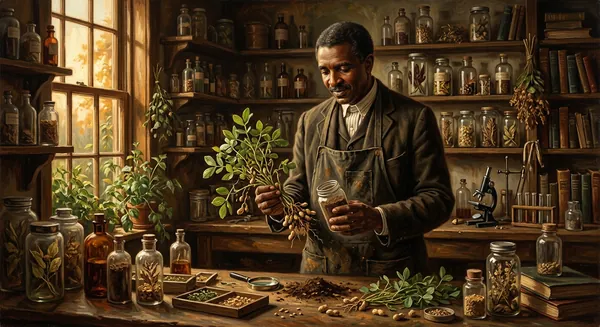
George Washington Carver
1864–1943 · Agricultural Scientist and Botanist
Born into slavery, George Washington Carver became one of America’s most beloved scientists, developing hundreds of uses for peanuts and sweet potatoes that revolutionised Southern agriculture and helped feed a nation.
“When you can do the common things of life in an uncommon way, you will command the attention of the world.”
George Washington Carver was born into slavery and never knew his exact birthday — he estimated it based on the seasons and the events of the Civil War.
Why is this scientist famous?
Transforming Southern agriculture by developing hundreds of products from peanuts and sweet potatoes, freeing farmers from dependence on cotton.
Carver developed hundreds of products from crops like peanuts and sweet potatoes, helping Southern farmers avoid depleting their soil by rotating cotton with other plants. His work on sustainable farming — keeping soil healthy by growing different crops — is exactly what modern regenerative agriculture tries to do. He showed that science could lift up communities and protect the land at the same time.
George's story
From Slavery to Science
Born into slavery on a Missouri farm around 1864, Carver and his mother were kidnapped by Confederate raiders when he was an infant. His owner, Moses Carver, traded a horse to get the baby back, but his mother was never seen again. He never knew the month or day of his birth — he estimated it from the blooming of spring flowers and the progress of the Civil War. Raised by the Carver family, he was too frail for field work and spent his childhood wandering the woods, studying plants and drawing them with extraordinary skill.
An Education Hard Won
Carver was denied entry to schools because of his race. At around age 13 he left home to attend a school for Black children in a neighbouring town, supporting himself by doing laundry and cooking. He later applied to Highland University in Kansas and was accepted — but when he arrived and they saw he was Black, they turned him away. He homesteaded a claim, farmed, and continued studying nature on his own until he was finally admitted to Iowa State Agricultural College in 1891, where he became the first Black student and later the first Black faculty member.
Tuskegee and the Peanut
In 1896, Booker T. Washington invited Carver to lead the agriculture department at the Tuskegee Institute in Alabama. The South was in crisis — decades of growing nothing but cotton had drained the soil of nutrients and left farmers destitute. Carver taught farmers to rotate crops, planting peanuts and sweet potatoes to restore nitrogen to the soil. But then he faced a new problem: nobody wanted to buy the peanuts. So he went to his laboratory and invented over 300 products from the peanut — including milk, flour, ink, soap, cosmetics, and plastics — and over 100 from the sweet potato, creating demand for the crops he had encouraged farmers to grow.
A Man Who Refused Wealth
Carver became famous. He testified before the United States Congress on the peanut’s potential, impressing them so thoroughly that a tariff on imported peanuts was enacted. Thomas Edison offered him a salary of more than $100,000 a year — a fortune at the time — to come work for him, but Carver refused, saying he could not abandon the people of the South who needed him. He lived in a simple room on the Tuskegee campus and gave his savings away to support agricultural research and student scholarships.
What did they discover?
Crop Rotation in the South
Taught Southern farmers to rotate cotton with peanuts and sweet potatoes, restoring nitrogen to soil exhausted by decades of single-crop cotton farming and revitalising the entire agricultural economy of the region.
300 Products from Peanuts
Developed over 300 uses for the peanut — including milk, flour, soap, ink, cosmetics, and plastics — creating a market for a crop that had been considered worthless and transforming the Southern economy.
100 Products from Sweet Potatoes
Invented over 100 products from the sweet potato, including flour, vinegar, molasses, and rubber, demonstrating how undervalued crops could become sources of food and industrial materials.
Jesup Agricultural Wagon
Designed a mobile classroom — a horse-drawn wagon equipped with farm demonstrations and soil samples — that brought agricultural education directly to farmers who could not travel to Tuskegee, reaching thousands across the rural South.
Amazing facts
He was born into slavery and never knew his exact birthday — he estimated it from the blooming of spring flowers and the events of the Civil War.
He and his mother were kidnapped by Confederate raiders when he was an infant; his owner traded a horse to get him back, but his mother was never seen again.
Thomas Edison offered him over $100,000 a year to come work for him — Carver refused, saying he could not abandon the people of the South.
He was the first Black student at Iowa State Agricultural College and its first Black faculty member.
He testified before the U.S. Congress on the peanut’s potential — his presentation was so impressive that a tariff on imported peanuts was enacted.
He painted flowers and plants with such skill that his botanical artworks were exhibited at the 1893 World’s Columbian Exposition in Chicago.
He never patented most of his inventions, saying that God gave them to him and he could not sell them for money.
His mobile classroom, the Jesup Wagon, brought farming education directly to rural farmers who could not travel to Tuskegee.
Timeline
Born into slavery near Diamond Grove, Missouri
Homesteaded a claim in Ness County, Kansas and farmed while studying nature
Admitted to Iowa State Agricultural College as its first Black student
Joined the Tuskegee Institute to lead its agriculture department
Became a member of the Royal Society of Arts in London
Testified before the U.S. Congress on the many uses of the peanut
His mobile classroom, the Jesup Wagon, reached thousands of Southern farmers
Died at Tuskegee Institute, Alabama, age 78
Awards & honours
Related Super Scientists

Sources & references
Books and educational kits about George Washington Carver coming soon