_(2).jpg)
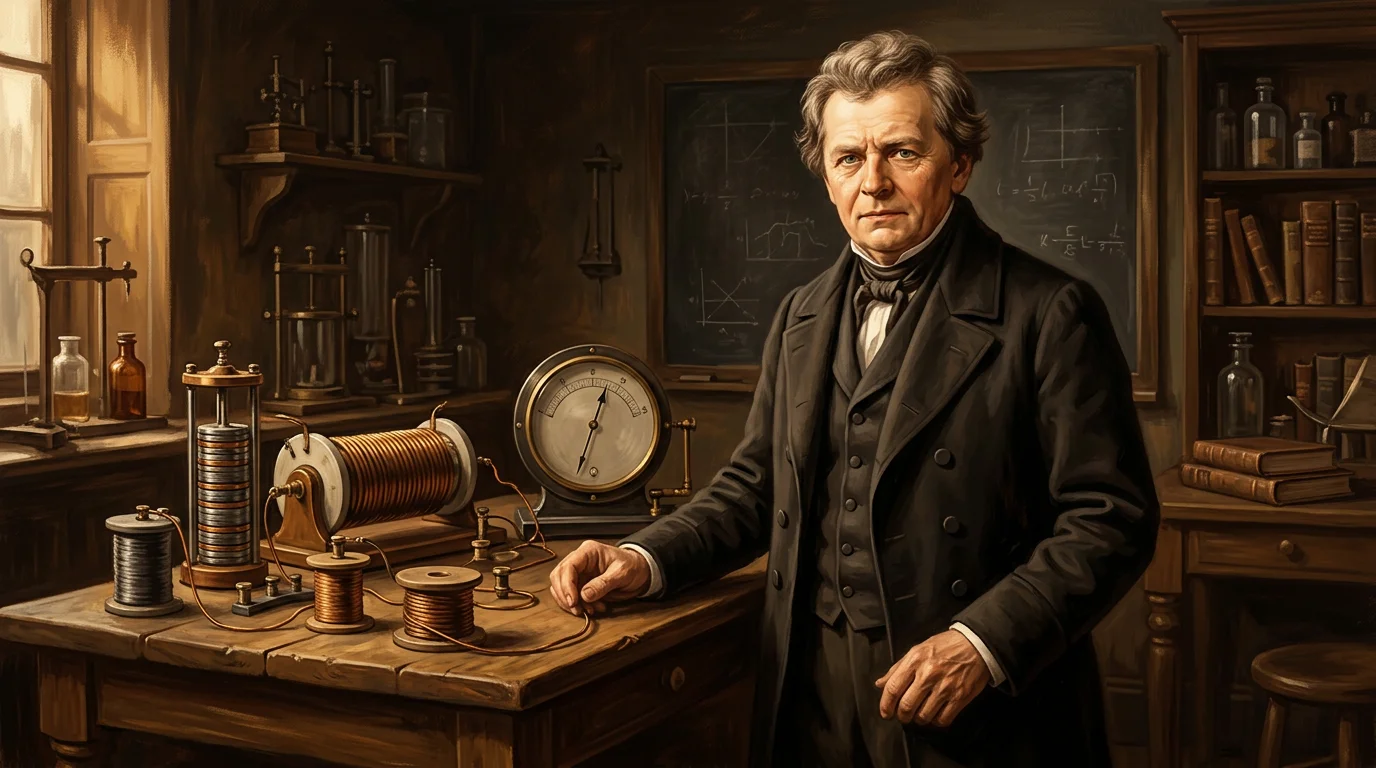
Georg Simon Ohm
1789–1854 · Physicist and Mathematician
A German physicist whose careful experiments with wires and batteries revealed the mathematical law governing all electric circuits — though his work was ignored for years before it was recognised.
Ohm's work was so poorly received in Germany that he resigned his teaching post in frustration. It was only years later, when physicists in England and France confirmed his results, that he was finally given the recognition he deserved.
Why is this scientist famous?
Discovered Ohm's Law, the fundamental relationship between voltage, current, and resistance. The unit of electrical resistance, the ohm, is named after him.
Georg's story
Early Life
Georg Simon Ohm was born in Erlangen, Bavaria, the son of a locksmith who taught himself mathematics and philosophy to a high standard. His father, Johann Wolfgang Ohm, had no formal university education but was determined that his sons would. He personally taught Georg and his brother Martin advanced mathematics from the works of Euler and other masters, giving the boy a mathematical foundation far beyond what any school in Erlangen could offer. Georg entered the University of Erlangen in 1805 but left after a year, partly for financial reasons, and spent several years as a schoolteacher in Switzerland and Bavaria.
Years of Struggle
Ohm spent more than a decade teaching mathematics at secondary schools in Bamberg, Cologne, and elsewhere. He found schoolteaching frustrating and longed for a university position, but his lack of a prestigious degree and academic connections kept the doors closed. During this time he continued his own research privately, reading the latest scientific papers from France and England and conducting experiments in whatever laboratory space he could find. In Cologne he had access to a well-equipped physics workshop, and it was there that he began his serious investigations into electricity, inspired by the recent work of Volta and the availability of stable voltaic piles.
Ohm's Law
In 1826 and 1827 Ohm published his landmark work on the relationship between current, voltage, and resistance in electrical circuits. Using wires of different lengths and thicknesses, and a voltaic pile as his power source, he meticulously measured the current flowing through each wire. He discovered a simple and beautiful relationship: the current through a conductor is directly proportional to the voltage across it and inversely proportional to its resistance. This is Ohm's Law, expressed today as I = V/R. He published the full mathematical treatment in his 1827 book 'Die galvanische Kette, mathematisch bearbeitet' ('The Galvanic Circuit Investigated Mathematically'), one of the first works to bring rigorous mathematics to the study of electricity.
Rejection and Vindication
Ohm's book was met with indifference or outright hostility in Germany. Many academics resented his mathematical approach, feeling that physics should be grounded in philosophical reasoning rather than equations. The minister of education in Prussia called his work 'a web of naked fancies' and Ohm was passed over for university positions. Deeply discouraged, he resigned his Cologne post and lived for a time in near-poverty. But gradually, physicists in England, France, and other countries tested his law and found it correct. By the 1840s Ohm's Law was accepted across Europe, and in 1841 the Royal Society of London awarded him the Copley Medal, its highest honour. The following year he was finally given a university position, becoming professor of physics at the University of Munich.
Legacy
Ohm died in Munich in 1854, having eventually received the academic recognition he had craved for so long. In 1867, thirteen years after his death, the British Association for the Advancement of Science named the unit of electrical resistance the 'ohm' in his honour. Today Ohm's Law is one of the first things every student of physics and electrical engineering learns, and it governs the design of every electrical circuit on the planet. Ohm's insistence on applying rigorous mathematics to physical phenomena helped set the standard for how physics would be done for the rest of the nineteenth century and beyond.
What did they discover?
Ohm's Law
Discovered that the current flowing through a conductor is directly proportional to the voltage and inversely proportional to the resistance (I = V/R). Published in 1827, it is the foundational law of electrical circuits and is used in the design of every electronic device ever built.
Mathematical Treatment of Electrical Circuits
His 1827 book 'The Galvanic Circuit Investigated Mathematically' was among the first works to apply rigorous mathematical analysis to electrical phenomena, setting a new standard for how physics would be studied.
The Copley Medal
Awarded the Royal Society's highest honour in 1841, nearly fifteen years after his law was first published. The long delay reflected the initial rejection of his work in Germany before international scientists confirmed its validity.
Amazing facts
Ohm's father was a locksmith who taught himself university-level mathematics and personally educated his sons using the works of Leonhard Euler.
His groundbreaking 1827 book was dismissed by the Prussian minister of education as 'a web of naked fancies' — the same work that is now foundational to all electrical engineering.
Ohm was 52 years old before he finally received a university professorship, despite having published his law at 38.
The Royal Society awarded him the Copley Medal — their highest honour — in 1841, after physicists in England and France confirmed what German academics had rejected.
The unit of electrical resistance, the ohm, was named in his honour in 1867, thirteen years after his death.
Ohm also made contributions to acoustics, publishing work on the physics of musical tones that influenced Hermann von Helmholtz.
Timeline
Born in Erlangen, Bavaria (now Germany)
Entered the University of Erlangen but left after a year for financial reasons
Appointed teacher of mathematics and physics at the Jesuit Gymnasium in Cologne
Published his first papers on the relationship between current, voltage, and resistance
Published 'The Galvanic Circuit Investigated Mathematically', his landmark work on Ohm's Law
Resigned his Cologne post in frustration at the poor reception of his work
Awarded the Copley Medal by the Royal Society of London
Appointed professor of physics at the University of Munich
Died in Munich, aged 65
Awards & honours
Related Super Scientists
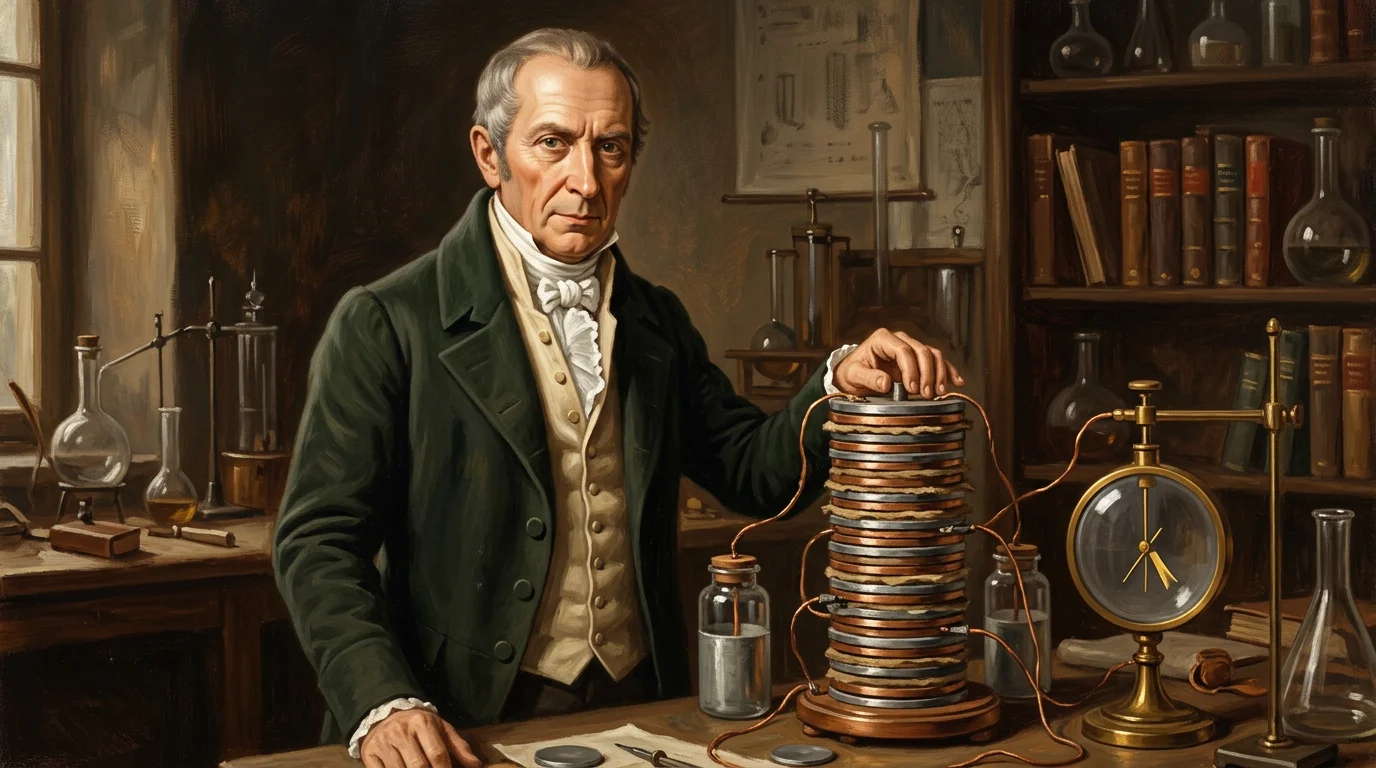
Alessandro Volta
1745–1827 · Physicist
Invented the voltaic pile in 1800, the first electric battery capable of producing a continuous current. The volt is named after him.
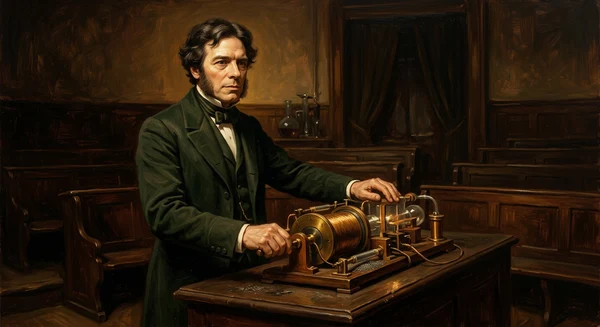
Michael Faraday
1791–1867 · Physicist & Chemist
Discovered electromagnetic induction and built the first electric motor and generator.
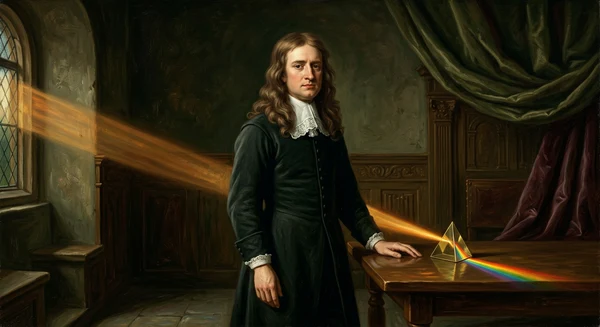
Isaac Newton
1643–1727 · Physicist & Mathematician
Formulating the laws of motion and universal gravitation.
Sources & references
Books and educational kits about Georg Simon Ohm coming soon