_(2).jpg)
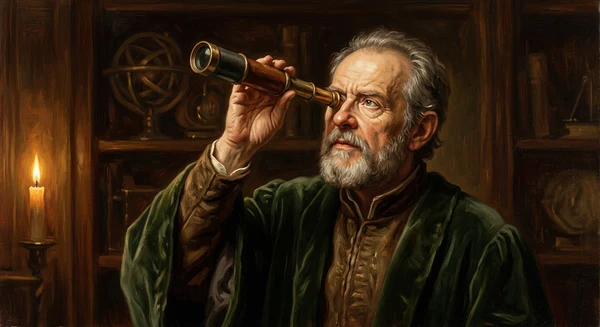
Galileo Galilei
1564–1642 · Astronomer & Physicist
Often called the father of modern science, Galileo turned his telescope to the sky and changed humanity's place in the universe forever.
“And yet it moves.”
Galileo was the first person to point a telescope at the night sky and discover that the Moon had craters, Jupiter had moons, and Venus had phases.
Why is this scientist famous?
Proving that the Earth orbits the Sun and founding modern observational astronomy.
Galileo was the first to point a telescope at the sky and discover moons around Jupiter, craters on the Moon, and spots on the Sun. He championed the idea that the Earth is not the centre of everything. Every space mission, telescope, and planet hunter today follows the trail he blazed — using better tools to see more clearly.
Galileo's story
Early Life
Born in Pisa, Italy, Galileo was tutored privately by a monk before entering the University of Pisa to study medicine. He never completed his degree, but his talent in mathematics was so obvious that he was soon appointed as a mathematics professor. He was argumentative, witty, and brilliant.
The Telescope
In 1609, Galileo heard about a Dutch invention that made distant objects appear close. He quickly built his own telescope — far superior to the original — and turned it to the night sky. He discovered craters and mountains on the Moon, four moons orbiting Jupiter, the phases of Venus, and countless stars invisible to the naked eye.
Champion of Copernicus
His observations showed that not everything orbited the Earth, supporting Copernicus's theory that the Earth moves around the Sun. The Catholic Church, which taught that the Earth was the centre of the universe, condemned this idea. In 1633, Galileo was tried by the Inquisition, found "vehemently suspect of heresy," and forced to recant. He spent the rest of his life under house arrest.
Legacy
Even under house arrest, Galileo continued his work, writing a book summarising his physics discoveries that was smuggled out and published in Holland. His insistence on observation and experiment over authority earned him the title "father of modern science." The Church formally acknowledged it had wronged him in 1992 — 350 years after his death.
What did they discover?
Jupiter's Moons
Discovered four moons orbiting Jupiter — Io, Europa, Ganymede, and Callisto — proving that not everything orbits the Earth.
Phases of Venus
Observed that Venus goes through phases like the Moon, proving it orbits the Sun, not the Earth.
Lunar Mountains
Was the first to see that the Moon has craters and mountains, proving the heavens are not perfect and unchanging.
Laws of Falling Bodies
Showed that objects fall at the same rate regardless of mass (legend says by dropping things off the Leaning Tower of Pisa).
Amazing facts
He was born in the same year as Shakespeare: 1564.
He did not invent the telescope, but he was the first to use it for astronomy — and he built his own, better versions.
He was placed under house arrest by the Church for the last nine years of his life.
He became completely blind before he died, possibly from staring at the Sun through his telescope.
His middle finger is preserved in a glass egg at the Museo Galileo in Florence, pointing skyward.
The Catholic Church did not formally admit it was wrong about Galileo until 1992.
Timeline
Born in Pisa, Italy
Built his first telescope
Discovered Jupiter's four largest moons
Published "Dialogue Concerning the Two Chief World Systems"
Tried by the Inquisition and placed under house arrest
Died under house arrest near Florence
Awards & honours
Related Super Scientists
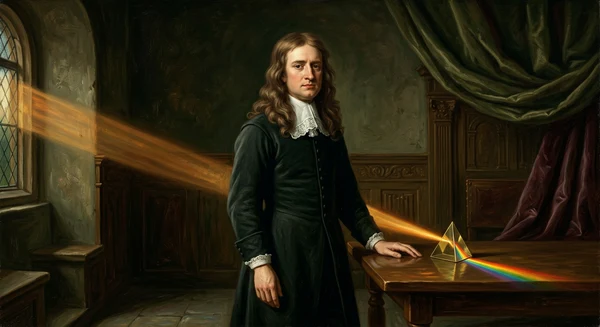
Isaac Newton
1643–1727 · Physicist & Mathematician
Formulating the laws of motion and universal gravitation.
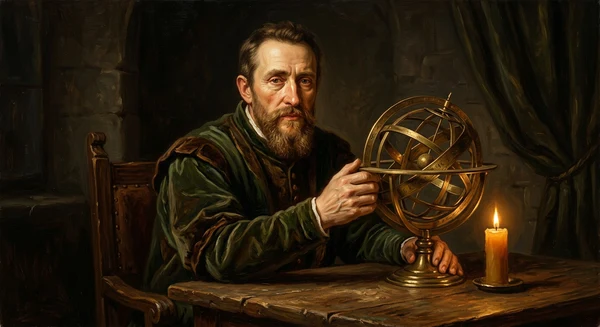
Johannes Kepler
1571–1630 · Astronomer & Mathematician
Discovered the three laws of planetary motion that proved planets orbit in ellipses, not circles.
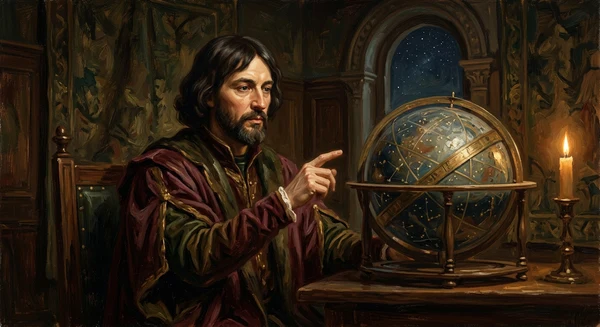
Nicolaus Copernicus
1473–1543 · Astronomer & Mathematician
Proposed the heliocentric model — that the Earth and planets revolve around the Sun.
Sources & references
Books and educational kits about Galileo Galilei coming soon