_(2).jpg)
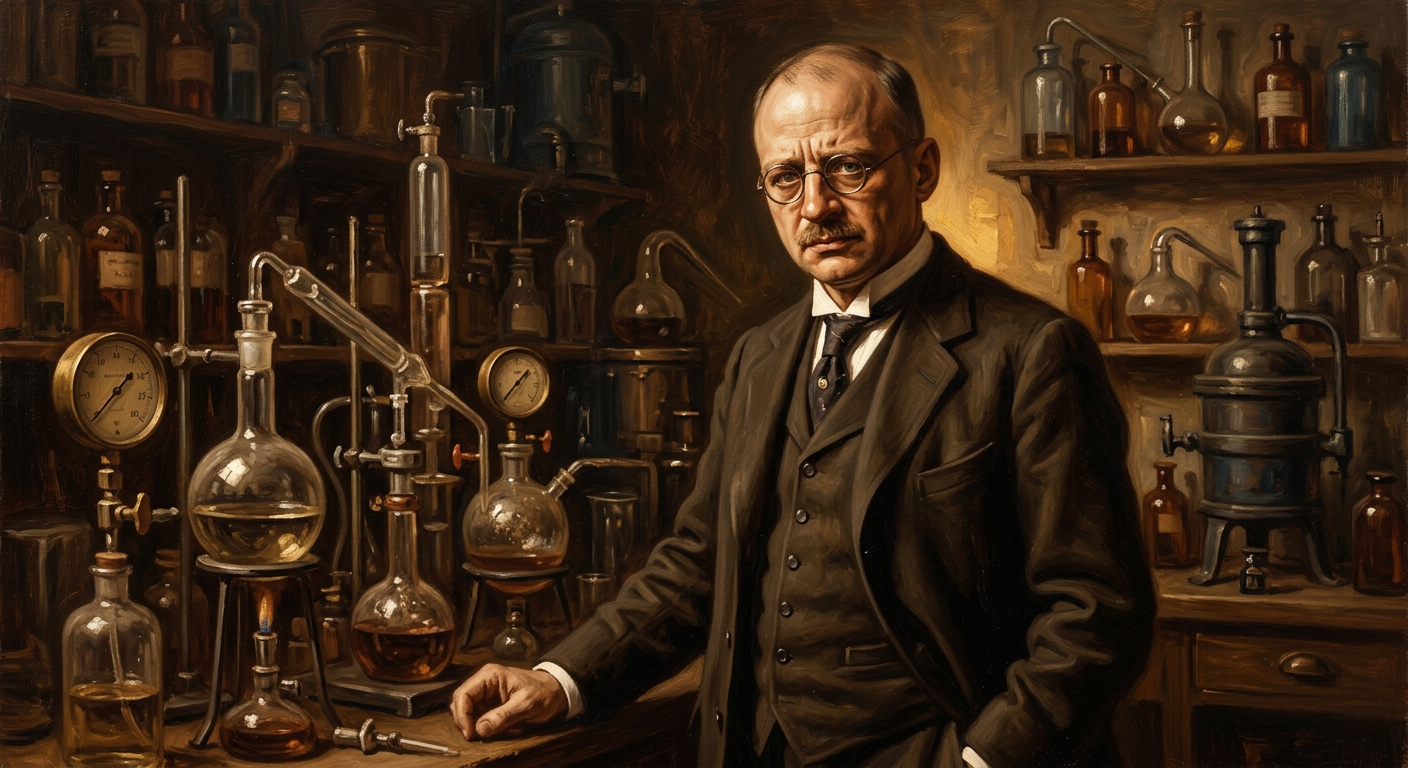
Fritz Haber
1868–1934 · Physical Chemist
A Nobel Prize-winning chemist whose ammonia process fed the world and whose gas weapons horrified it — a life of triumph and tragedy that forces us to ask what science is for.
“A scientist should be a person who is always ready to acknowledge that he may be wrong.”
The Haber-Bosch process is arguably the most important invention of the 20th century: today, the nitrogen in half of all human food comes from ammonia made by this process, and without it, Earth could feed only about 4 billion of its 8 billion people.
Why is this scientist famous?
A brilliant chemist who discovered how to make fertiliser from air, saving billions from starvation — and then turned his genius to poison gas, creating chemical warfare.
Haber found a way to pull nitrogen from the air to make fertilizer, enabling modern agriculture to feed billions. Without his process, half the world's population might not have enough food. His story also carries a warning: the same chemistry was used to make weapons. It shows how science can both nourish and destroy, depending on the choices people make.
Fritz's story
A Chemist''s Ambition
Fritz Haber was born on 9 December 1868 in Breslau, Prussia (now Wrocław, Poland), into a prosperous Jewish family. His father ran a successful dye and pigment business, and Fritz grew up around chemicals. He studied at the University of Heidelberg under the renowned chemist Robert Bunsen, and later at Berlin and Charlottenburg. Though he converted from Judaism to Christianity in 1892 — partly to advance his academic career in a society with deep anti-Semitic prejudice — he was never fully accepted by the German establishment. He married Clara Immerwahr in 1901, a brilliant chemist who became the first woman to earn a PhD from the University of Breslau. Their marriage was troubled: Clara wanted to be a research partner, but Haber expected her to be a traditional wife. The tension would end in tragedy.
The Nitrogen Crisis
By the turn of the 20th century, the world faced a crisis that threatened civilisation itself. Crops need nitrogen to grow, and natural nitrogen deposits — Chilean saltpetre and guano — were running out. Scientists warned that mass starvation was inevitable within decades unless someone found a way to make nitrogen fertiliser from the atmosphere. Air is 78% nitrogen, but nitrogen gas is almost inert — its triple bond is one of the strongest in nature, and no one had been able to break it efficiently. Haber, working at the Karlsruhe Institute of Technology, took up the challenge. In 1909, after years of experiments, he succeeded: by combining nitrogen and hydrogen at high temperature (600°C) and enormous pressure (200 atmospheres) with an osmium catalyst, he produced ammonia. It was a triumph of physical chemistry.
Feeding the World
Haber''s laboratory demonstration was a breakthrough, but it produced only drops of ammonia. The chemical company BASF assigned a brilliant engineer, Carl Bosch, to scale up the process to industrial production. Bosch designed massive high-pressure reactors and found cheaper catalysts. The result — the Haber-Bosch process — began producing ammonia on an industrial scale in 1913. Its impact on humanity has been almost incalculable. Today, the nitrogen in half of all human food comes from Haber-Bosch ammonia. Without the process, Earth could feed roughly 4 billion people instead of 8 billion. Two out of every five humans alive today owe their existence to the fertiliser Haber made possible. He received the Nobel Prize in Chemistry in 1918 for this work — an award that would prove deeply controversial.
The Dark Turn
When World War I began in 1914, Haber threw himself into the war effort with patriotic fervour. He believed that a scientist''s duty was to serve his country in wartime, no matter the cost. He turned his genius to a terrible purpose: chemical warfare. In April 1915, Haber personally supervised the release of 168 tons of chlorine gas at Ypres, Belgium — the first large-scale use of poison gas in warfare. Soldiers choked and drowned in their own lungs. Over 5,000 died in agonising minutes. Haber was promoted to captain the next day. His wife Clara, a chemist who understood what he had done, was devastated. On 2 May 1915, she took Haber''s army pistol and shot herself in the garden. Haber left the next morning to oversee another gas attack on the Eastern Front.
A Tragic End
After the war, Haber continued to lead the Kaiser Wilhelm Institute for Physical Chemistry. He tried to extract gold from seawater to pay Germany''s war reparations — it failed. In the 1920s, he developed the Zyklon process, a fumigation gas used to protect stored grain from pests. The product was later modified by the Nazis into Zyklon B, the gas used to murder millions of Jews in the Holocaust — including members of Haber''s own extended family. When the Nazis came to power in 1933, they forced Jewish scientists from their posts. Haber, despite his conversion to Christianity and his service to Germany, was expelled. He fled to England, broken and destitute. He died of heart failure in Basel, Switzerland, on 29 January 1934, at the age of 65, while attempting to emigrate to Palestine. He had saved billions from starvation and damned himself with gas. The world still lives with both legacies.
What did they discover?
The Haber-Bosch Process
His discovery of how to synthesise ammonia from atmospheric nitrogen and hydrogen, scaled to industrial production by Carl Bosch, enabled mass production of fertiliser and today feeds approximately half the human population.
Chemical Warfare
He initiated and directed Germany''s poison gas programme during World War I, personally supervising the first large-scale chlorine gas attack at Ypres in 1915, which killed over 5,000 soldiers in minutes.
Agricultural Revolution
The Haber-Bosch process made synthetic fertiliser affordable and abundant, triggering an agricultural revolution that allowed the global population to grow from 1.6 billion in 1900 to over 8 billion today.
Gold from Seawater
He led a massive research project to extract dissolved gold from seawater to pay Germany''s World War I reparations — the effort failed because seawater contains far less gold than he had estimated.
Amazing facts
The Haber-Bosch process feeds approximately half the people alive today — without it, Earth could support only about 4 billion humans instead of 8 billion.
His wife Clara Immerwahr was a brilliant chemist and the first woman to earn a PhD from the University of Breslau. She shot herself with his army pistol in protest at his gas warfare work.
Haber was promoted to captain the day after the first poison gas attack at Ypres, which killed over 5,000 soldiers.
He won the 1918 Nobel Prize in Chemistry for ammonia synthesis — while the world was still reeling from the gas attacks he had orchestrated.
He developed the Zyklon fumigation process to protect stored grain from pests. The Nazis later modified it into Zyklon B, the gas used to murder millions of Jews, including members of Haber''s own family.
Despite converting from Judaism to Christianity in 1892 and serving Germany throughout World War I, the Nazis expelled him from his institute in 1933 because of his Jewish ancestry.
Timeline
Born in Breslau, Prussia (now Wrocław, Poland), into a Jewish family
Began studying chemistry at the University of Heidelberg under Robert Bunsen
Converted from Judaism to Christianity to advance his academic career
Married Clara Immerwahr, the first woman to earn a PhD from the University of Breslau
Successfully synthesised ammonia from atmospheric nitrogen and hydrogen in the laboratory
The Haber-Bosch process began industrial ammonia production at BASF''s Oppau plant
Personally supervised the first large-scale chlorine gas attack at Ypres, Belgium, killing over 5,000 soldiers
His wife Clara took her own life with his army pistol in protest at his gas warfare work
Awarded the Nobel Prize in Chemistry for the synthesis of ammonia from its elements
Led a failed project to extract gold from seawater to pay Germany''s war reparations
Forced by the Nazis to resign from his position at the Kaiser Wilhelm Institute due to his Jewish ancestry
Fled to England, then attempted to emigrate to Palestine
Died of heart failure in Basel, Switzerland, at the age of 65
Awards & honours
Related Super Scientists
Antoine Lavoisier
1743–1794 · Chemist
The father of modern chemistry who overturned the phlogiston theory and established the law of conservation of mass.
Louis Pasteur
1822–1895 · Chemist and microbiologist
Proving that germs cause disease, developing pasteurisation, and creating the first rabies vaccine.
Marie Curie
1867–1934 · Physicist & Chemist
Discovering radioactivity and two new elements: radium and polonium.
Sources & references
Books and educational kits about Fritz Haber coming soon