_(2).jpg)

Emmy Noether
1882–1935 · Mathematician
Emmy Noether was a German mathematician who proved one of the most important theorems in physics: that every symmetry in nature corresponds to a conservation law. Einstein called her a genius, but she faced discrimination as a woman throughout her career.
“If one proves the equality of two numbers a and b by showing a = b and b = a, then that does not prove they are equal; it only proves that one cannot tell the difference between them.”
Einstein said Noether was the most important woman in the history of mathematics — but for years she was not allowed to teach because she was a woman.
Why is this scientist famous?
Proved Noether's theorem, linking symmetry and conservation laws — a foundation of modern physics.
Noether discovered a deep link between symmetry and the laws of physics — a principle that underpins how we understand energy, momentum, and the fundamental forces. Her theorem is used in everything from particle physics to the search for dark matter. She showed that some of the most powerful ideas in physics come from pure mathematics.
Emmy's story
Early Life
Born in 1882 in Erlangen, Germany, Noether was the daughter of a mathematician. Initially barred from formally enrolling in university because she was a woman, she audited classes and passed exams. She eventually earned her PhD in 1907 with a dissertation on algebraic invariants.
Noether's Theorem
In 1915, Noether proved a theorem that became one of the most important results in mathematical physics: every continuous symmetry of a physical system corresponds to a conserved quantity. For example, time symmetry means energy is conserved, and rotational symmetry means angular momentum is conserved. This principle underlies all of modern physics, from quantum mechanics to general relativity.
Abstract Algebra
Noether went on to become one of the founders of abstract algebra, developing ring theory and ideal theory. Her approach — studying mathematical structures abstractly rather than through specific examples — transformed how mathematicians think about their field.
Discrimination and Escape
Despite her brilliance, Noether was denied a paid university position for years because she was a woman. She lectured under a male colleague's name and was paid nothing. When the Nazis came to power in 1933, she was fired for being Jewish. She fled to the United States and taught at Bryn Mawr College for just two years before dying after surgery in 1935, age 53.
What did they discover?
Noether's Theorem
Proved that every symmetry in nature corresponds to a conservation law — the foundation of modern physics from quantum mechanics to general relativity.
Founding Abstract Algebra
Developed ring theory and ideal theory, transforming algebra from the study of specific equations to the study of abstract mathematical structures.
Noncommutative Algebra
Pioneered the study of noncommutative algebras, which became important in quantum mechanics and modern physics.
Amazing facts
Einstein wrote that she was "the most significant creative mathematical genius thus far produced since the higher education of women began."
She taught at the University of Erlangen for 7 years without pay, lecturing under a male colleague's name.
She was fired by the Nazis in 1933 for being Jewish and fled to America.
Her theorem connects symmetry and conservation laws — every physics student learns it, but few know her name.
She was known for being an inspiring teacher and had a devoted circle of students called "Noether's Boys."
She died at only 53 after surgery to remove an ovarian cyst.
Timeline
Born in Erlangen, Germany on March 23
Passed the Bavarian teaching exam but chose to study mathematics at university instead
Enrolled at the University of Göttingen, then returned to Erlangen to complete her PhD
Earned her PhD in mathematics from the University of Erlangen
Invited to Göttingen by David Hilbert and Felix Klein; proved Noether's theorem
Finally allowed to teach at Göttingen, but still without pay for several years
Fired by the Nazis for being Jewish; fled to the United States
Began teaching at Bryn Mawr College in Pennsylvania
Died in Bryn Mawr on April 14, age 53
Einstein published a tribute calling her a genius
Awards & honours
Related Super Scientists
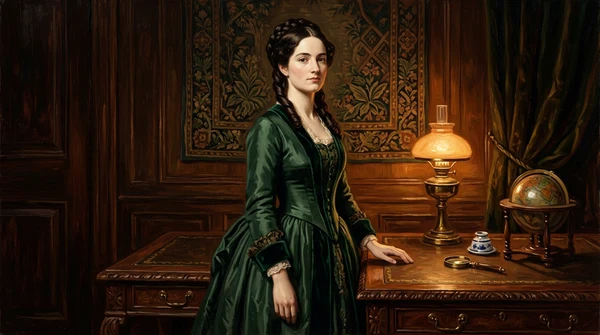
Ada Lovelace
1815–1852 · Mathematician
Writing the first computer algorithm, a century before electronic computers existed.

Alan Turing
1912–1954 · Mathematician & Computer Scientist
Breaking Nazi codes and founding the science of artificial intelligence.
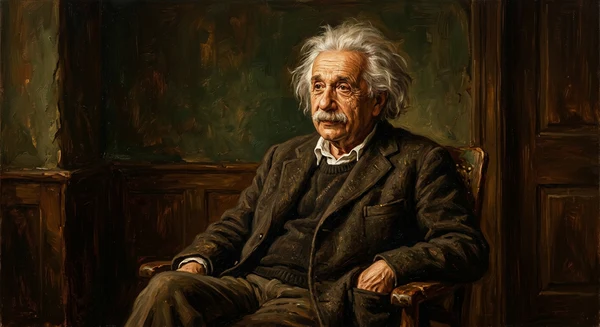
Albert Einstein
1879–1955 · Theoretical Physicist
Developing the theory of relativity and the equation E=mc².
Sources & references
Books and educational kits about Emmy Noether coming soon