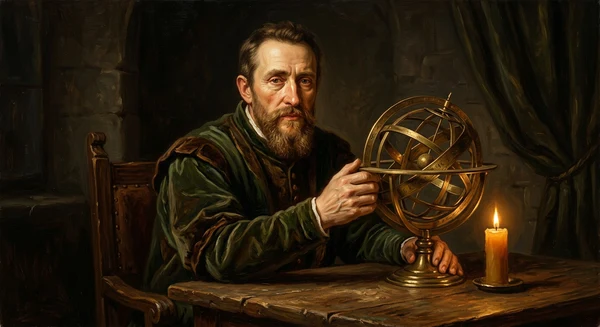
_(2).jpg)
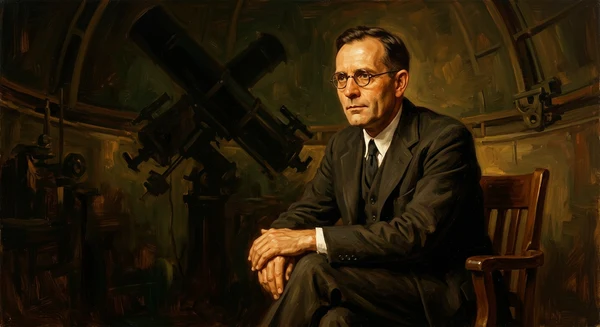
Edwin Hubble
1889–1953 · Astronomer
Edwin Hubble was an American astronomer who proved that the universe is far larger than anyone imagined. He showed that fuzzy patches of light were entire galaxies, and that these galaxies are moving away from us — meaning the universe is expanding.
“Equipped with his five senses, man explores the universe around him and calls the adventure Science.”
Hubble was a star athlete who played basketball for the University of Chicago and almost became a professional boxer — before he discovered that the universe was expanding.
Why is this scientist famous?
Proved that the universe is expanding and that other galaxies exist beyond our own.
Before Hubble, most people thought the Milky Way was the entire universe. He proved that there are countless other galaxies, and that the universe is expanding. His discovery is the foundation of modern cosmology — the science that studies how the universe began and where it is going. The James Webb Space Telescope is continuing the work he started.
Edwin's story
Early Life
Born in 1889 in Marshfield, Missouri, Hubble was an exceptional athlete — he played basketball and ran track at the University of Chicago, and held the Illinois high school high jump record. He studied law as a Rhodes Scholar at Oxford but returned to astronomy, earning his PhD at the Yerkes Observatory.
Other Galaxies
When Hubble began observing at Mount Wilson Observatory in 1919, astronomers believed the Milky Way was the entire universe. Using the new 100-inch Hooker telescope, the largest in the world, Hubble found that the Andromeda nebula was actually a separate galaxy, far beyond the Milky Way. Overnight, the known universe expanded enormously.
The Expanding Universe
In 1929, Hubble discovered that galaxies are moving away from us — and the farther away they are, the faster they're moving. This relationship, now called Hubble's Law, proved that the universe is expanding. This was the first evidence for what would become the Big Bang theory. Einstein had predicted a static universe and even altered his equations to prevent expansion — Hubble proved him wrong.
Legacy
Hubble spent his career at Mount Wilson, classifying galaxies and refining his measurements. He never won a Nobel Prize — astronomy wasn't yet a Nobel category. The Hubble Space Telescope, launched in 1990, was named in his honour and has revealed the universe in unprecedented detail. He died in 1953, and his wife arranged no funeral — his burial location is unknown.
What did they discover?
Other Galaxies Exist
Proved that the Andromeda nebula is a separate galaxy, far beyond the Milky Way, establishing that the universe contains billions of galaxies.
Hubble's Law
Discovered that galaxies move away from us at speeds proportional to their distance, proving the universe is expanding — the foundation of the Big Bang theory.
Galaxy Classification
Developed the Hubble sequence, a system for classifying galaxies (spiral, elliptical, irregular) that is still used today.
Amazing facts
He was a star athlete who held the Illinois high school high jump record.
He studied law as a Rhodes Scholar at Oxford before switching to astronomy.
He proved Einstein wrong — Einstein had predicted a static, non-expanding universe.
The Hubble Space Telescope, launched in 1990, was named after him.
He never won a Nobel Prize because astronomy was not yet a Nobel category.
His burial location is unknown — his wife arranged no funeral, in accordance with his wishes.
Timeline
Born in Marshfield, Missouri on November 20
Graduated from the University of Chicago with a degree in mathematics and astronomy
Studied law as a Rhodes Scholar at Oxford University
Earned his PhD in astronomy from the Yerkes Observatory
Began working at Mount Wilson Observatory in California with the 100-inch Hooker telescope
Proved that Andromeda is a separate galaxy, not part of the Milky Way
Published Hubble's Law, showing the universe is expanding
Einstein visited Hubble at Mount Wilson and accepted the expanding universe
Died in San Marino, California on September 28, age 63
The Hubble Space Telescope was launched and named in his honour
Awards & honours
Related Super Scientists
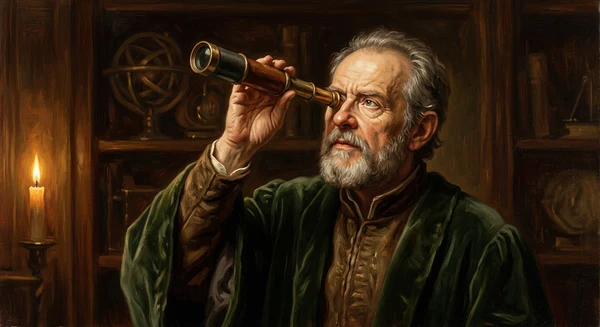
Galileo Galilei
1564–1642 · Astronomer & Physicist
Proving that the Earth orbits the Sun and founding modern observational astronomy.
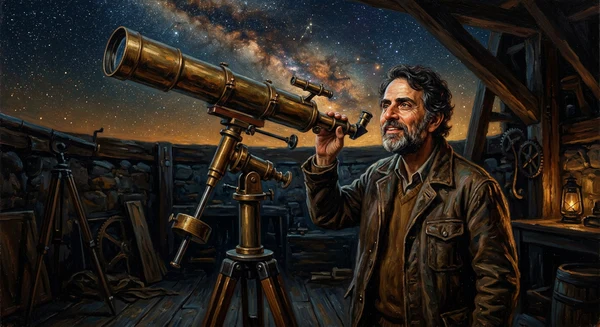
Carl Sagan
1934–1996 · Astronomer & Science Communicator
Created the Voyager Golden Record, wrote Cosmos, and inspired millions to love science.
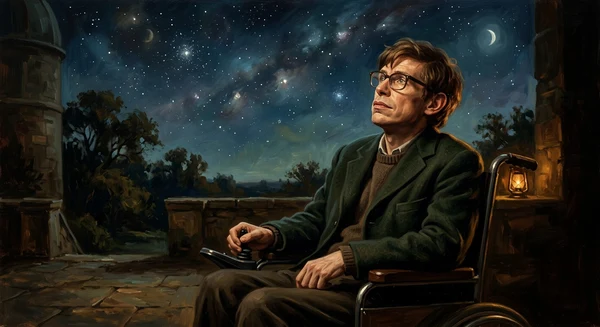
Stephen Hawking
1942–2018 · Theoretical Physicist & Cosmologist
Discovering that black holes emit radiation and writing "A Brief History of Time."
Sources & references
Books and educational kits about Edwin Hubble coming soon