_(2).jpg)
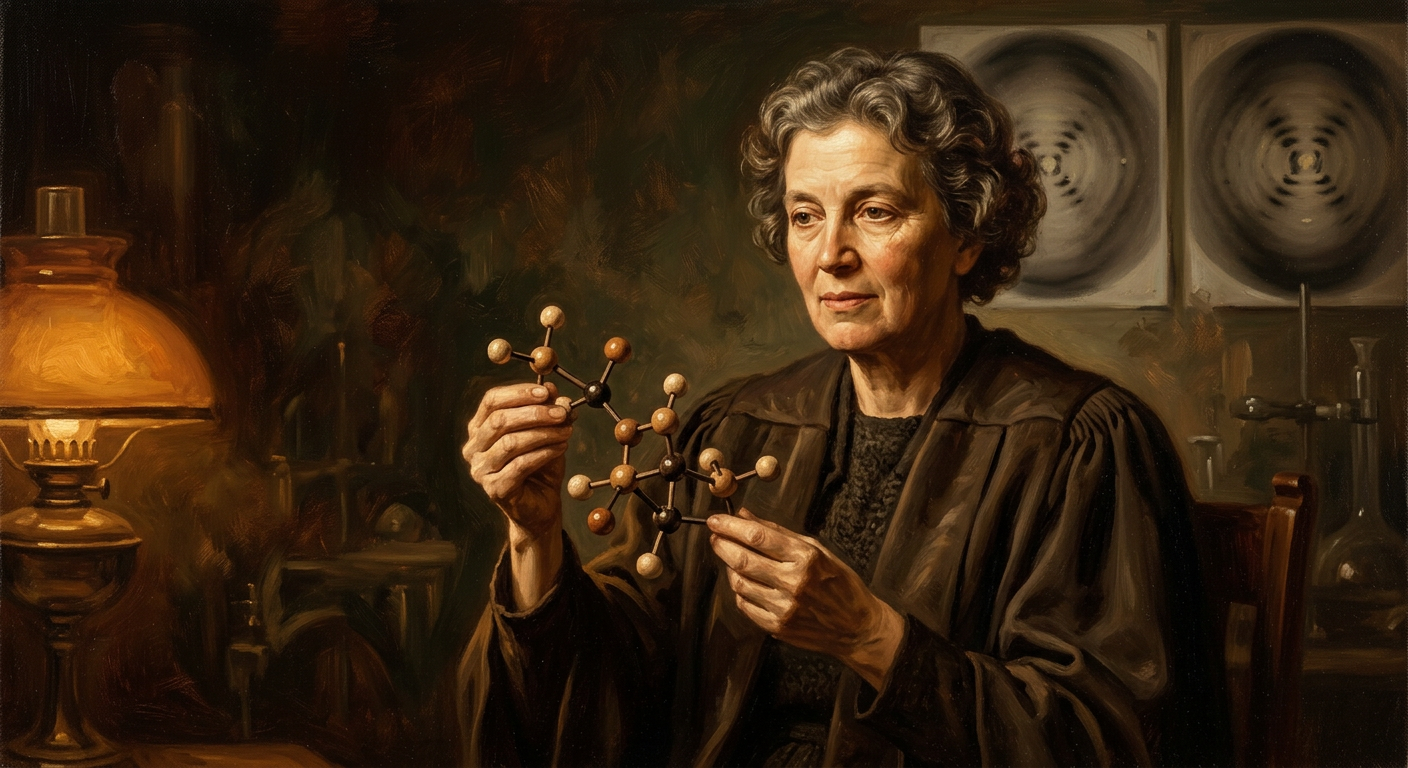
Dorothy Hodgkin
1910–1994 · Chemist
A British chemist who used X-rays to see the invisible shapes of life-saving molecules, and became only the third woman to win a Nobel Prize in science.
“I was captured for life by chemistry and by crystals.”
Hodgkin was only the third woman ever to win a Nobel Prize in a science subject, following Marie Curie and Irène Joliot-Curie.
Why is this scientist famous?
Used X-ray crystallography to reveal the 3D structures of penicillin, vitamin B12, and insulin; won the 1964 Nobel Prize in Chemistry.
Dorothy's story
A Gifted Girl from Cairo
Dorothy Crowfoot Hodgkin was born in 1910 in Cairo, Egypt, where her father was an archaeologist and her mother was a botanist who illustrated desert plants. The family travelled frequently between Egypt and England, and Dorothy and her sisters were often left with relatives in England while their parents worked abroad. At the age of ten, she became fascinated by crystals after watching a friend’s mother grow them in a home laboratory. Her mother, who had studied botany at university, encouraged her interest in science. At twelve, Dorothy attended a school in Beckenham where she was one of very few girls allowed to study chemistry — the subject had been considered too difficult for girls until a pioneering headmistress opened the science labs to all pupils. Dorothy thrived. She went on to study chemistry at Somerville College, Oxford, where she was one of only a handful of women in the course, and graduated with first-class honours in 1932.
Seeing Molecules with X-Rays
After Oxford, Hodgkin moved to Cambridge to study with J. D. Bernal, a brilliant and unconventional physicist who was pioneering a new technique called X-ray crystallography. The idea was extraordinary: if you fire a beam of X-rays at a crystal, the rays scatter in a pattern that reveals the arrangement of atoms inside it. By analysing the pattern of spots on a photographic plate, you can work out the three-dimensional shape of the molecule. But the mathematics was fiendishly complex, and the calculations took weeks or months by hand. Hodgkin had a gift for it. She could look at a pattern of spots and almost intuit the shape it represented. She worked on the structures of proteins and minerals, and in 1934 she returned to Oxford to set up her own laboratory. She would spend the rest of her career there, using X-ray crystallography to solve some of the most important molecular puzzles of the twentieth century.
Penicillin, B12, and Insulin
Hodgkin’s first great triumph was penicillin. During the Second World War, penicillin was being used to treat infections and save soldiers’ lives, but no one knew its chemical structure, which meant it was difficult to manufacture or improve. In 1945, after years of painstaking analysis, Hodgkin worked out the structure of penicillin — a complex ring-shaped molecule with a sulphur atom at its centre. It was one of the largest molecules ever solved by X-ray crystallography at the time, and it enabled chemists to mass-produce and modify penicillin. Next, she turned to vitamin B12, a molecule so complex that it took her eight years to solve. The work required thousands of calculations and some of the earliest computers, but in 1955 she revealed its structure — the largest molecule ever mapped at that point. For this, she was awarded the Nobel Prize in Chemistry in 1964. She was still not finished. Her greatest challenge was insulin, the hormone that controls blood sugar. She began working on it in the 1930s and finally solved its structure in 1969, after thirty-four years of effort. It was one of the greatest achievements in structural biology, and it helped pave the way for the genetic engineering of insulin for people with diabetes.
Teacher, Mentor, and Campaigner
Hodgkin was as beloved as a teacher as she was respected as a scientist. Her students at Oxford included Margaret Roberts, who later became Prime Minister Margaret Thatcher — Thatcher kept a portrait of Hodgkin in Downing Street, the only scientist given that honour. Hodgkin was gentle, unassuming, and deeply committed to peace. She served as president of the Pugwash Conferences, an organisation of scientists working to prevent nuclear war, and she campaigned for nuclear disarmament and for better relations between East and West during the Cold War. She was also a passionate advocate for scientists in developing countries and mentored crystallographers from India, China, and Africa. She suffered from rheumatoid arthritis for most of her adult life, which deformed her hands and made laboratory work increasingly painful — yet she continued to work and travel well into her seventies. She died in 1994, aged eighty-four, at her home in Shipston-on-Stour, Warwickshire. She remains one of the most admired British scientists of the twentieth century — a woman who saw the shapes of molecules that saved millions of lives, and who used her fame to fight for a more peaceful world.
Legacy of a Quiet Revolutionary
Hodgkin’s work laid the foundation for modern structural biology. Her solution of the insulin structure was a prerequisite for the synthetic insulin that millions of people with diabetes rely on today. Her penicillin work helped make antibiotics cheaper and more widely available. Her B12 structure advanced the understanding of vitamins and anaemia. She was awarded the Royal Medal in 1956, the Copley Medal in 1976, the Order of Merit in 1982, and the Lenin Peace Prize in 1987. A portrait of her appeared on a British postage stamp. The Dorothy Hodgkin Building at Oxford and the Dorothy Hodgkin Institute at the Royal Society both bear her name. She proved that X-ray crystallography could solve the most complex molecules in biology, and she opened the door to the era of molecular medicine — all while defying the expectations placed on women in science.
What did they discover?
Structure of Penicillin
In 1945, Hodgkin determined the three-dimensional structure of penicillin, revealing its complex ring-shaped molecule. This enabled chemists to mass-produce and modify the antibiotic, making it widely available and saving millions of lives.
Structure of Vitamin B12
After eight years of work, Hodgkin solved the structure of vitamin B12 in 1955 — the largest molecule ever mapped by X-ray crystallography at the time. For this, she received the 1964 Nobel Prize in Chemistry.
Structure of Insulin
Hodgkin solved the structure of insulin in 1969 after thirty-four years of effort, revealing the hormone that controls blood sugar. This work laid the foundation for genetically engineered insulin used by people with diabetes worldwide.
Pioneering X-ray Crystallography Methods
Hodgkin advanced the techniques of X-ray crystallography to solve increasingly complex biological molecules, opening the field of structural biology and paving the way for modern molecular medicine.
Amazing facts
Hodgkin was only the third woman to win a Nobel Prize in a science subject, after Marie Curie and Irène Joliot-Curie.
She suffered from severe rheumatoid arthritis for most of her adult life, which deformed her hands but never stopped her laboratory work.
One of her Oxford students was Margaret Thatcher, who kept a portrait of Hodgkin in 10 Downing Street.
She worked on the structure of insulin for thirty-four years, from the 1930s until 1969.
She served as president of the Pugwash Conferences, an organisation of scientists working to prevent nuclear war.
She mentored crystallographers from India, China, and Africa, and was a passionate advocate for science in developing countries.
She received the Order of Merit in 1982, one of Britain’s highest honours, given to only twenty-four living people at a time.
She was the first woman to receive the Copley Medal, the Royal Society’s oldest and most prestigious award, in 1976.
A British postage stamp bearing her portrait was issued in 1996.
She was known for her gentle, unassuming manner and her habit of giving credit to her students and collaborators before herself.
Timeline
Born in Cairo, Egypt, to British parents
Begins studying chemistry at Somerville College, Oxford
Graduates with first-class honours and moves to Cambridge to study X-ray crystallography with J. D. Bernal
Returns to Oxford to establish her own X-ray crystallography laboratory
Solves the structure of penicillin, enabling mass production of the antibiotic
Solves the structure of vitamin B12 after eight years of work
Awarded the Royal Medal of the Royal Society
Awarded the Nobel Prize in Chemistry for her work on vitamin B12
Solves the structure of insulin after thirty-four years of effort
Becomes the first woman to receive the Copley Medal
Appointed to the Order of Merit
Dies at her home in Shipston-on-Stour, Warwickshire, aged 84
Awards & honours
Related Super Scientists
Rosalind Franklin
1920–1958 · Chemist & X-ray Crystallographer
Taking the photograph that revealed the double-helix structure of DNA.
Marie Curie
1867–1934 · Physicist & Chemist
Discovering radioactivity and two new elements: radium and polonium.
Alice Ball
1892–1916 · Chemist
Developed the first effective injectable treatment for leprosy by making chaulmoogra oil water-soluble, a method that remained the best treatment available for over two decades.
Sources & references
Books and educational kits about Dorothy Hodgkin coming soon