_(2).jpg)
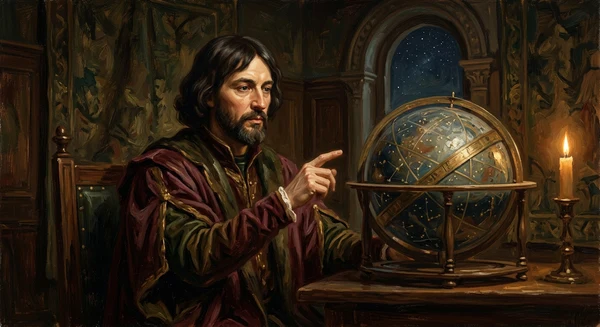
Nicolaus Copernicus
1473–1543 · Astronomer & Mathematician
Nicolaus Copernicus was a Polish astronomer who launched the Scientific Revolution by proposing that the Earth revolves around the Sun, not the other way around. This idea, obvious to us now, was world-shattering in 1543.
“To know that we know what we know, and to know that we do not know what we do not know, that is true knowledge.”
Copernicus was so afraid of the Church's reaction to his Sun-centreed theory that he didn't publish it until he was on his deathbed — he held the first printed copy the day he died.
Why is this scientist famous?
Proposed the heliocentric model — that the Earth and planets revolve around the Sun.
Copernicus realized the Earth orbits the Sun, not the other way around. That single idea moved humanity from the centre of the universe to a small planet circling an ordinary star. It was the start of modern astronomy and the scientific method — the idea that we should trust observations over assumptions. Every map of the solar system on a classroom wall begins with his courage to question what everyone believed.
Nicolaus's story
Early Life
Born in 1473 in Toruń, Poland, Copernicus studied mathematics, astronomy, medicine, and law at universities in Kraków, Bologna, and Padua. He was a polymath — a physician, lawyer, economist, translator, and diplomat — but astronomy was his passion.
The Problem with Ptolemy
For over 1,400 years, the accepted view was Ptolemy's model: the Earth sat at the centre of the universe, with the Sun and planets orbiting it. The model required absurdly complicated circles-within-circles to match observations. Copernicus realized that putting the Sun at the centre made everything far simpler and more elegant.
De Revolutionibus
Copernicus developed his heliocentric theory over decades but hesitated to publish, fearing controversy. His book, "On the Revolutions of the Celestial Spheres," was finally printed in 1543. Legend says he received the first copy on his deathbed and died shortly after.
The Start of the Revolution
Though his model wasn't perfect — he still used circular orbits instead of ellipses — Copernicus's idea was the spark that ignited the Scientific Revolution. Galileo, Kepler, and Newton all built on his work. The Church banned his book in 1616, but the truth could not be stopped.
What did they discover?
Heliocentric Model
Proposed that the Earth and all planets revolve around the Sun, overturning 1,400 years of Earth-centreed astronomy.
Theory of Money
Formulated an early version of the quantity theory of money, now a foundational principle in economics.
Amazing facts
He was a physician, lawyer, economist, translator, diplomat, and astronomer — a true Renaissance man.
He wrote his revolutionary book in Latin and circulated it privately for decades before publishing.
His book was banned by the Catholic Church in 1616, 73 years after his death.
He figured out that the Earth rotates on its axis and that seasons are caused by the Earth's tilt.
The element Copernicium (Cn, atomic number 112) was named in his honour in 2010.
He delayed publishing his theory for so long partly because he feared ridicule from other scholars.
Timeline
Born in Toruń, Poland on February 19
Began studying at the University of Kraków
Studied law and astronomy at the University of Bologna
Moved to Frombork, where he began his serious astronomical observations
Wrote the Commentariolus, a brief outline of his heliocentric theory circulated privately
Published "On the Revolutions of the Celestial Spheres" — received the first copy on his deathbed
Died in Frombork on May 24, age 70
The Catholic Church placed his book on the Index of Forbidden Books
Awards & honours
Related Super Scientists
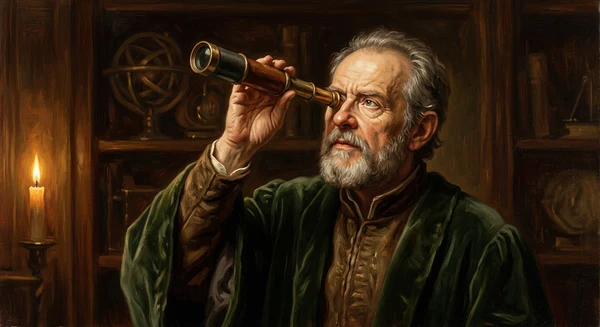
Galileo Galilei
1564–1642 · Astronomer & Physicist
Proving that the Earth orbits the Sun and founding modern observational astronomy.
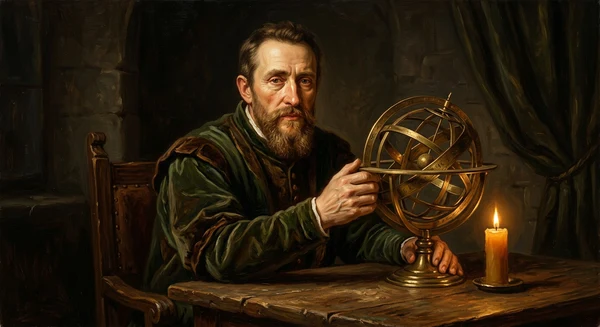
Johannes Kepler
1571–1630 · Astronomer & Mathematician
Discovered the three laws of planetary motion that proved planets orbit in ellipses, not circles.
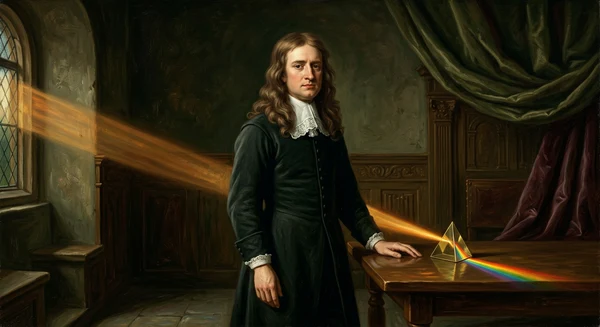
Isaac Newton
1643–1727 · Physicist & Mathematician
Formulating the laws of motion and universal gravitation.
Sources & references
Books and educational kits about Nicolaus Copernicus coming soon